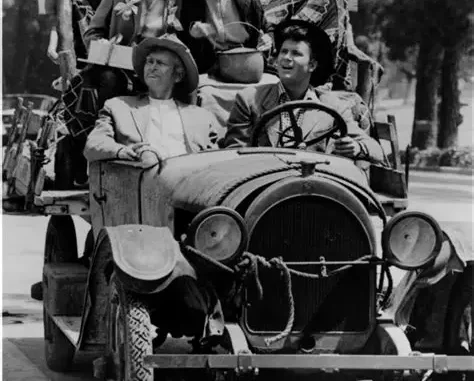
At first glance, The Beverly Hillbillies appears to be nothing more than a simple fish-out-of-water comedy built on exaggerated jokes and broad humor. But beneath its folksy charm and laugh track lies a surprisingly sharp satire of American society—one that many critics initially overlooked.
The core of the show’s satire rests on contrast. The Clampett family represents rural values: honesty, community, and a straightforward moral compass. When they suddenly find themselves living in Beverly Hills, surrounded by wealth, status symbols, and social pretensions, the absurdity does not come from their ignorance—but from the world around them. The series repeatedly suggests that sophistication and refinement are often superficial, while genuine decency exists outside elite social circles.
Wealth, in The Beverly Hillbillies, is stripped of its glamour. The Clampetts’ fortune does not elevate them socially, nor does it make them morally superior or inferior. Instead, money becomes a lens through which the show critiques class anxiety. Neighbors, bankers, and social climbers frequently attempt to exploit or “civilize” the Clampetts, revealing their own greed and insecurity. The joke, more often than not, is on the so-called elites.
Jed Clampett himself functions as a quiet rebuke to American materialism. Despite his immense wealth, he remains cautious, generous, and uninterested in status. In an era increasingly defined by consumer culture and upward mobility, Jed’s refusal to equate money with worth was subtly radical. The show never preaches this message outright, but its consistency makes the point unavoidable.
Even the cultural clash between rural and urban America is handled with more nuance than it appears. While the Clampetts are frequently confused by modern customs, they are rarely portrayed as foolish. Instead, the series implies that progress does not necessarily mean improvement—and that modernity can coexist with moral emptiness. This inversion of expectations is where much of the show’s enduring appeal lies.
What makes The Beverly Hillbillies especially compelling in hindsight is how effectively it disguised social commentary as harmless comedy. By presenting its critique through humor, the show reached audiences that might otherwise reject overt social analysis. Viewers laughed first, then—perhaps unconsciously—absorbed its observations about class, wealth, and authenticity.
In the end, The Beverly Hillbillies was not mocking rural America, as many critics claimed. It was holding up a mirror to American society itself, exposing the fragility of social hierarchies and the emptiness of status without substance. That this message was delivered through a sitcom dismissed as “simple” may be the show’s most subversive achievement—and the reason it still invites reevaluation decades later.