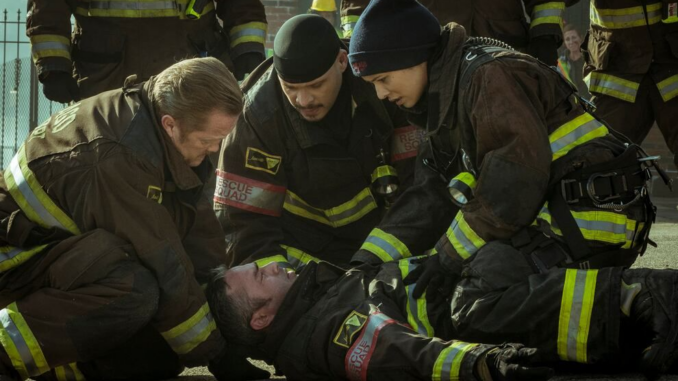
One of the reasons Chicago Fire feels so intense is because the danger often looks real. Massive flames, collapsing structures, high-speed rescues, and rooftop chaos have helped make the series one of television’s most action-packed dramas. But behind many of those jaw-dropping moments is a team fans rarely see:
The stunt doubles.
No matter how committed the cast is, some scenes are simply too dangerous to perform without professionals trained for extreme risk. Here are five kinds of Chicago Fire moments that almost certainly required stunt performers to keep everyone safe.
1. Running into fully burning buildings
Some of the show’s most iconic sequences involve firefighters charging into structures engulfed in flames. While actors may film close-up shots in controlled environments, the more dangerous wide shots with heavy heat, smoke, unstable debris, and limited visibility are typically handled by stunt professionals.
That’s because even controlled fire is unpredictable.
2. High falls from ladders or rooftops
Whenever a character slips from height, hangs from a ledge, or crashes through part of a roof, chances are a stunt double stepped in. Falls require harness systems, timing precision, crash pads, and rehearsed choreography that trained stunt teams specialize in.
Fans see drama.
The crew sees physics.

3. Explosion scenes with shock impact
Chicago Fire loves dramatic blasts—gas leaks, vehicle fires, industrial accidents. Scenes where a character is thrown backward by force or narrowly escapes an explosion usually rely on stunt performers. These moments involve pyrotechnics, blast timing, protective gear, and careful distance calculations.
One mistake is too many.
4. Vehicle crashes and rescue collisions
Ambulances, fire trucks, and cars often collide or skid through emergency scenes. Even when the sequence looks smooth on screen, stunt drivers and doubles are commonly used for impact moments or dangerous driving angles. Real actors may handle dialogue shots before or after the action.
But the hardest part belongs to the stunt crew.
5. Water rescues in freezing or unstable conditions
Episodes involving icy rivers, submerged victims, or underwater extractions are among the toughest to film. Cold exposure, visibility issues, heavy gear, and underwater coordination make these scenes especially risky. Stunt divers and doubles are often essential in bringing them to life safely.
These scenes are some of the most intense because they combine multiple hazards at once.
What makes Chicago Fire impressive is that the transitions are seamless. Fans often can’t tell when the actor has been replaced because the editing, camera work, wardrobe matching, and stunt performance are so polished.
That invisible teamwork is part of the magic.
Stars like Taylor Kinney, Jesse Spencer, and the rest of the cast get deserved praise for carrying the emotional weight of the series. But the stunt performers help carry the physical danger that makes those stories believable.
Without them, many unforgettable moments would never make it to screen.
So the next time you watch a firefighter leap through flames, survive a blast, or dangle from a rooftop edge, remember:
You may be watching a hero on screen—
But also a stunt professional risking everything behind the scenes.