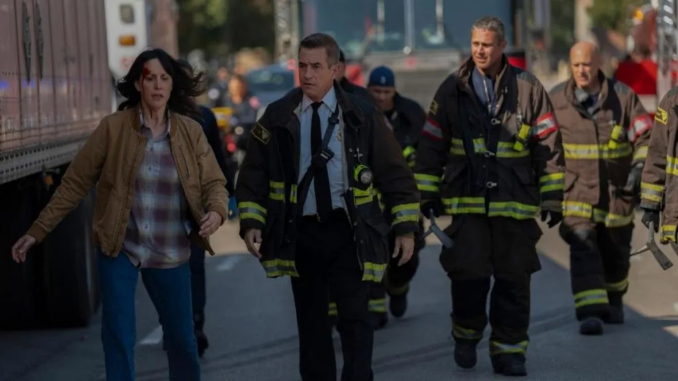
The legendary Firehouse 51 has long been regarded as the unbreakable gold standard of the Chicago Fire Department, but the latest developments suggest that even the strongest foundations can crumble under enough pressure. Following a catastrophic incident that pushed every member of the team to their absolute physical and emotional limits, the atmosphere within the station has shifted from one of unified strength to a fractured landscape of blame and isolation. As the dust settles from the tragedy, fans are left asking a haunting question: is Firehouse 51 finally breaking apart? The internal stability of the house, once held together by the ironclad leadership of Chief Boden and the brotherhood of its crews, now feels more fragile than ever before, marking a potential turning point that could redefine the series for years to come.
The catastrophic event at the heart of this crisis wasn’t just another routine call; it was a high-stakes disaster that resulted in a rare failure of the team’s usually flawless coordination. In a profession where success is measured in lives saved and failure is measured in loss, the psychological weight of an operation gone wrong is immense. In the aftermath, the usual camaraderie that defines the common room has been replaced by a chilling silence. The finger-pointing has begun, and surprisingly, the tension is not coming from outside sources or administrative interference, but from within the ranks themselves. Veteran firefighters who have bled together for a decade are now exchanging cold glances, and the trust that acts as the lifeblood of a rescue squad is visibly hemorrhaging.
At the center of the storm is the friction between the leaders of the different companies. Kelly Severide and the officers of Truck and Engine are finding themselves at odds over the tactical decisions made during the heat of the moment. When a leader begins to doubt their own instincts, or worse, the instincts of their partners, the entire hierarchy of the firehouse begins to wobble. This isn’t just a simple disagreement; it is a fundamental breakdown of the chain of command. Stella Kidd, who has fought so hard to establish her place as a leader, now finds herself trying to bridge gaps that may be too wide to close. The emotional exhaustion is palpable in every scene, as the characters struggle to process their grief while maintaining the professional facade required to keep responding to new alarms.
The impact on the younger generation of firefighters is perhaps the most tragic aspect of this potential dissolution. New recruits and candidates look to Firehouse 51 as a beacon of what a department should be. Seeing their mentors and idols engage in petty squabbles and deep-seated resentments creates a ripple effect of disillusionment. The mentorship that defines the 51 experience is failing, leaving the junior members to navigate the dangers of the job without the steady hands they were promised. If the veterans cannot hold it together, the future of the house is in serious jeopardy, as the culture of excellence begins to erode from the inside out.
Furthermore, the external pressure from the department brass is only adding fuel to the fire. A catastrophic incident usually brings an investigation, and the threat of a station being decommissioned or the crew being split up across the city is a very real possibility. In the past, 51 has always closed ranks against outside threats, but this time, the walls are already cracked. There is a growing sense that some members might be looking for an exit strategy, seeking a fresh start in a house that doesn’t carry the heavy baggage of recent failures. The idea of favorite characters taking transfers to other stations is a terrifying prospect for the audience, yet it feels more realistic now than at any other point in the show’s history.
As we look toward the upcoming episodes, the show seems to be exploring the theme of resilience in a new way. It is easy to be a family when things are going well, but the true test of Firehouse 51 will be whether they can forgive one another for the mistakes made in the line of fire. The path to healing will require more than just a few shifts; it will require a total rebuilding of the trust that was shattered during the disaster. The writers are expertly highlighting that while buildings can be rebuilt and wounds can heal, a broken spirit is much harder to mend.
The drama currently unfolding is a masterclass in tension, proving that Chicago Fire is at its best when it focuses on the human element of the job. The spectacle of the fires provides the excitement, but the breaking of Firehouse 51 provides the heart. Whether the team can find their way back to each other or if this is the beginning of a permanent fracture remains to be seen. One thing is certain: the bells are still ringing, but the hearts of those answering the call are heavier than they have ever been. The firehouse is on the brink, and the next few decisions made by its leaders will determine if 51 remains a family or becomes just another name in the department directory.