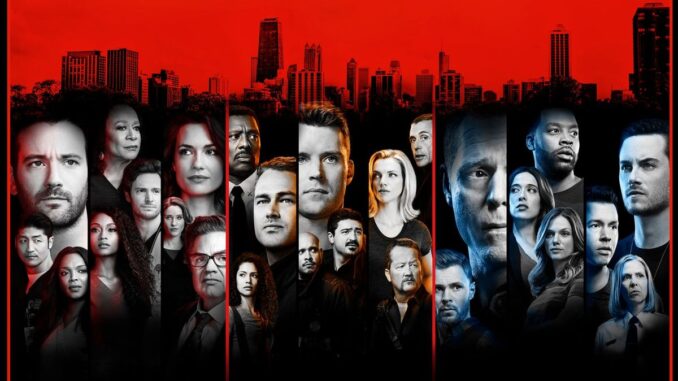
The television landscape is no stranger to expansion. When a show succeeds, networks often move quickly to build a universe around it—introducing spin-offs, crossovers, and interconnected storylines designed to capture a wider audience. But success in one series does not always guarantee success in another. And now, with FBI reportedly losing both of its spin-offs in 2026, many viewers are looking back at a similar moment in NBC history—when the One Chicago franchise faced a rare but telling failure.
At first glance, the situations seem different. The FBI franchise, built on high-stakes federal investigations, carved out its own identity with multiple series running in parallel. But the recent contraction of that universe highlights a recurring truth in television: expansion comes with risk. And that risk is something NBC encountered firsthand with Chicago Justice.
Launched as part of the broader One Chicago universe—which includes Chicago Fire, Chicago P.D., and Chicago Med—Chicago Justice had all the ingredients of success. It was backed by an established franchise, featured crossover potential, and explored a new angle: the legal system that follows police work. On paper, it made perfect sense.
In reality, it didn’t last.
Chicago Justice struggled to find its footing, ultimately becoming the only One Chicago series that failed to continue beyond its initial run. For fans accustomed to the franchise’s consistency, it was an unexpected outcome—and one that still raises questions today.
So what went wrong?
Part of the challenge lies in identity. While Chicago Fire, P.D., and Med each carved out distinct tones—action-driven rescue, morally complex policing, and emotionally intense medical drama—Chicago Justice occupied a space that felt less defined. Legal dramas require a different pacing, a different kind of tension, one built on arguments and procedure rather than immediate physical stakes. For a franchise rooted in urgency and frontline action, that shift may have been harder for audiences to embrace.
There’s also the issue of timing. By the time Chicago Justice premiered, the One Chicago universe was already well established. Viewers had formed strong attachments to existing characters and dynamics. Introducing a new branch meant asking audiences to invest again—to learn new faces, new systems, new stakes. That’s never an easy transition, even within a successful franchise.
Now, as the FBI universe faces its own restructuring in 2026, those same themes are resurfacing. Spin-offs don’t just need to exist—they need to justify their place. They must offer something new while still feeling connected. Too much similarity, and they risk redundancy. Too much difference, and they risk alienation.
It’s a delicate balance.
The recent developments surrounding FBI’s spin-offs serve as a reminder that even the most stable franchises are not immune to change. Television is evolving, audience habits are shifting, and networks are becoming more selective about what they sustain. What worked a decade ago may not work in the same way today.
And yet, there’s a reason these universes continue to be built.
When they succeed, they create something rare: a sense of continuity that extends beyond a single show. Characters cross paths, stories intersect, and viewers feel part of a larger world. That’s the magic that both One Chicago and FBI have, at different times, managed to capture.
But as recent events in 2026 suggest, that magic is not guaranteed.
Looking back at Chicago Justice in the context of today’s industry, it feels less like an isolated misstep and more like an early example of a challenge that continues to shape television. Not every expansion will work. Not every spin-off will survive. And sometimes, even within a powerful franchise, there are limits to how far a universe can grow.
For fans, these moments can be disappointing. But they also offer perspective.
Because behind every cancellation or failed spin-off is a larger story about how television adapts, experiments, and ultimately evolves. And in that sense, both the FBI shake-up and the legacy of Chicago Justice are part of the same ongoing narrative—
One that proves even the biggest franchises have their breaking points.