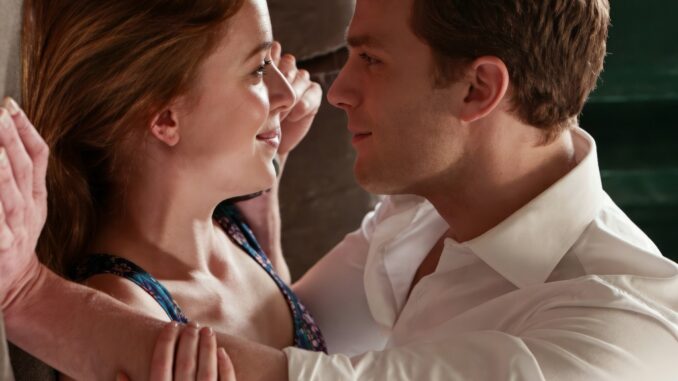
When Fifty Shades of Grey first hit theaters, audiences were captivated by the film’s bold, intimate scenes and the intense on-screen presence of Jamie Dornan as Christian Grey. But behind the polished final cut, there was one production secret that has continued to intrigue fans for years: not every scene viewers assumed featured Dornan was actually filmed by him. In fact, some of the most talked-about body shots in the film reportedly relied on a professional body double rather than the actor himself.
According to reports from the time, Canadian model and actor Peter James Gray was brought in as Dornan’s body double for certain explicit sequences, particularly shots where only parts of Christian Grey’s body were visible on camera. This wasn’t unusual for a film of this nature. Productions involving intimate scenes often use body doubles for technical, logistical, or comfort-related reasons. But because Fifty Shades was so heavily scrutinized, every detail quickly became part of the public conversation.
What made this especially interesting was the narrative that Dornan had “refused” to shoot certain scenes. The reality appears far more nuanced. In interviews, Dornan openly discussed having clear boundaries regarding nudity, particularly when it came to full-frontal exposure. He explained that he didn’t feel showing more than necessary served the story, saying the film was not intended to be pornography and that anything included had to feel justified within the narrative. That distinction is important because it reframes the idea of “refusal” not as conflict, but as a professional boundary.

In fact, later reports complicate the rumor even further. Director James Foley revealed that fully nude footage of Dornan was actually filmed for Fifty Shades Freed, but those shots were ultimately left out of the final cut because they didn’t feel necessary in the edit. This suggests the issue was never simply about unwillingness, but rather about what best served the final version of the film.
For Dornan himself, body confidence also played a role. Despite his background as a model, he admitted in interviews that he did not have “a lot of body confidence” and shared that he had the same insecurities many people have about how they look. That honesty gives additional context to why certain boundaries existed during filming. Far from being scandalous, it reflects a very human concern beneath the Hollywood image.
The use of a body double also highlights how carefully constructed these scenes really were. What appears spontaneous and seamless on screen is often the result of technical planning: strategic camera angles, modesty garments, digital editing, and doubles for specific shots. IMDb trivia for the film notes that both Dornan and Dakota Johnson wore modesty patches during filming, and some intimate visuals were enhanced or altered in post-production. In other words, much of what audiences perceived as raw intimacy was in fact highly choreographed movie-making.
So the truth behind “that was a body double” is less about a scandalous refusal and more about the realities of filmmaking. Jamie Dornan did not simply walk away from the material; rather, he worked within agreed boundaries while the production team used every tool available to create the final illusion.
And perhaps that’s the most fascinating part of the story: the scene fans thought revealed everything was, in reality, one of the most carefully controlled moments in the entire film.