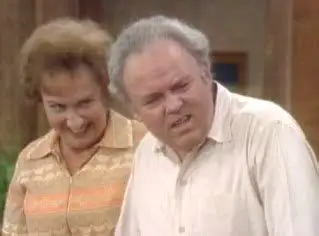
When Norman Lear created the groundbreaking sitcom All in the Family, he had a very clear idea in mind for its main character. The loud, opinionated, and often offensive Archie Bunker was never meant to be loved.
In fact, Lear designed Archie specifically so audiences would dislike him.
The goal was simple: by exaggerating Archie’s outdated attitudes and prejudices, the show would hold up a mirror to certain social views in America. Viewers were supposed to laugh at Archie, recognizing how absurd many of his opinions were.
But something unexpected happened.
Instead of rejecting Archie Bunker… millions of viewers embraced him.
And Norman Lear was completely shocked.
The Plan: A Character Meant to Expose Prejudice
When All in the Family premiered in 1971, television rarely tackled serious social issues. Lear wanted to change that by creating a sitcom that openly addressed racism, politics, gender roles, and generational conflict.
Archie Bunker was written as the embodiment of a certain mindset—an older, working-class man who felt threatened by the rapid social changes happening in America during the late 1960s and early 1970s.
Every week, Archie would clash with his liberal son-in-law Michael Stivic, played by Rob Reiner. Their arguments were designed to highlight the growing divide between traditional beliefs and the progressive ideas of a younger generation.
Lear assumed audiences would recognize Archie as the “wrong” side of these debates.
But audiences had other ideas.
The Unexpected Twist: America Loved Archie
Soon after the show became popular, Norman Lear began hearing something surprising from viewers.
Instead of saying, “Archie is ridiculous,” many people were saying, “Archie tells it like it is.”
For a large portion of middle America, Archie Bunker didn’t feel like a satire. He felt familiar.
Many viewers saw him as a hardworking man who spoke honestly, defended his family, and expressed frustrations they felt but rarely heard on television.
The character Lear intended as a critique suddenly became a hero to some audiences.
It was one of the most fascinating audience reactions in television history.
The Actor Who Made Archie Human
Part of the reason Archie became so beloved was the performance by Carroll O’Connor.
O’Connor didn’t play Archie as a cartoon villain. Instead, he gave the character depth and humanity.
Yes, Archie could be stubborn, ignorant, and loud. But he was also loyal to his family and clearly loved his wife, Edith Bunker, played by Jean Stapleton.
These moments of warmth made Archie feel real rather than purely offensive.
Viewers could laugh at his outrageous comments one minute and sympathize with him the next.
The Brilliant Irony of the Show
In a strange way, the audience reaction actually proved Norman Lear’s point.
All in the Family wasn’t just a sitcom—it was a social experiment.
By placing Archie’s views on full display, the show revealed how different people interpreted the same character in completely different ways.
Some viewers saw Archie as the joke.
Others saw him as the voice of common sense.
That tension turned the show into one of the most talked-about series in television history.
A Character That Became Bigger Than the Plan
More than fifty years later, Archie Bunker remains one of the most iconic characters ever created for television.
What makes him fascinating isn’t just what he said—but how audiences responded to him.
Norman Lear set out to create a character people would dislike.
Instead, he accidentally created a character millions of viewers felt they understood.
And that unexpected reaction is part of what made All in the Family not just a sitcom—but a cultural landmark.