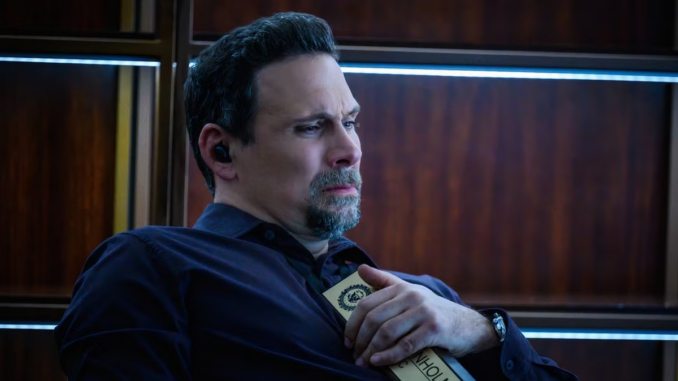
The high-pressure environment of the New York FBI Field Office is known for its relentless pace and clinical precision, but the latest developments in the franchise have taken a sharp, agonizing turn into the personal life of Assistant Special Agent in Charge Jubal Valentine. In an series that often prioritizes the procedural over the personal, the most recent narrative arc has delivered what many are calling Jubal’s darkest moment. This isn’t just a professional setback or a botched raid; it is a deep, soul-shaking personal crisis that hits hard, forcing the man who usually coordinates the chaos to face a catastrophe he cannot control from behind a computer screen.
For seasons, Jubal Valentine, played with a frantic yet focused energy by Jeremy Sisto, has been the glue holding the team together. He is the voice in the ear of the field agents, the man who balances dozens of moving parts during a ticking-clock investigation. However, his strength has always been his greatest vulnerability. As a recovering alcoholic and a father navigating the complexities of a blended family and a son’s health battles, Jubal has always lived on a knife-edge. The latest crisis pushes him off that edge, blending the professional demands of a high-profile kidnapping case with a devastating revelation regarding his own family’s safety.
The intensity of this moment stems from the juxtaposition of Jubal’s role as a leader and his reality as a grieving or terrified parent. When a case involving a lethal chemical agent intersects with the very school his children attend, the cool, professional exterior we have come to expect begins to crack in real-time. The writers have expertly crafted a scenario where Jubal’s institutional knowledge becomes a curse; he knows exactly how small the margin for error is, and he knows precisely what happens when the FBI fails. This creates a level of claustrophobic tension that is rare for a broadcast procedural, as the camera stays tight on Jubal’s face while he tries to maintain a steady voice for his team while his world is crumbling in the background.
What makes this his darkest moment is the moral ambiguity he is forced to navigate. In a desperate bid to protect his own, Jubal is seen flirting with the boundaries of bureau protocol. We see a man who has spent his career enforcing the law suddenly tempted to bypass it. This internal conflict is a masterclass in acting from Sisto, who portrays Jubal’s desperation not through grand gestures, but through the shaking of a hand or the hollow look in his eyes during a briefing. It raises the uncomfortable question of whether any agent, no matter how seasoned, can truly remain objective when the stakes are no longer abstract statistics but the lives of those they love most.
The fallout of this personal crisis is expected to ripple through the entire New York office. Jubal’s relationship with Isobel Castille is put to the ultimate test as she is forced to decide whether her second-in-command is still fit for duty. The friction between them adds a layer of office politics that feels earned rather than forced. Meanwhile, agents like OA and Maggie are left to pick up the slack, realizing for the first time just how much they rely on Jubal’s stability. The void left by his distraction creates a palpable sense of unease within the J. Edgar Hoover Building, proving that when the heart of the team is compromised, the entire body suffers.
Fans have reacted strongly to this shift in tone, praising the series for finally peeling back the layers of a character who often stays in the shadows of the field agents. By centering a major crisis on Jubal, the showrunners have breathed new life into the franchise, reminding viewers that the people behind the badges are just as fragile as the victims they seek to rescue. This arc serves as a stark reminder of the “invisible” toll of federal law enforcement—the missed birthdays, the strained relationships, and the constant, low-level hum of anxiety that comes with knowing the world’s darkest secrets.
As we move toward the season finale, the resolution of Jubal’s crisis remains uncertain. Even if the immediate danger is neutralized, the psychological scars are likely to remain. This moment of darkness isn’t just a plot point; it is a character-defining event that will dictate Jubal’s trajectory for seasons to come. It forces a reckoning with his sobriety, his career goals, and his identity as a father. For a show that usually moves on to the next case within the hour, this deep dive into the human spirit is a refreshing and necessary evolution.
The intensity of Jubal’s struggle has elevated the show from a standard crime drama to a compelling character study. As the screen fades to black on his most vulnerable hour, the audience is left with a profound sense of empathy for the man in the tech pit. The FBI may be an elite organization, but Jubal Valentine has proven that no amount of training can fully shield a person from the devastating impact of a personal crisis hitting home.