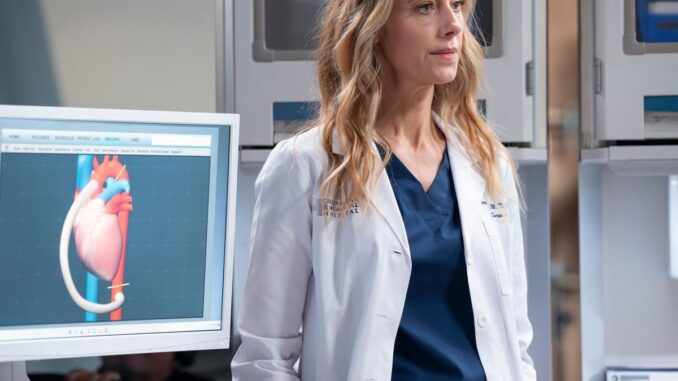
At Grey Sloan Memorial Hospital, goodbyes are never simple. They echo through corridors filled with history, loss, and survival. And when two of its most enduring figures—Owen Hunt and Teddy Altman—step away, it doesn’t feel like just another departure. It feels like something deeper, something heavier… as if the hospital itself is keeping a secret it cannot fully reveal.
A Legacy Built on Invisible Wounds
From the moment Owen Hunt arrived, he carried more than the title of a surgeon. He brought with him the unseen weight of war—trauma that shaped every decision, every relationship, every moment of silence. His strength was never clean or uncomplicated. It was forged in chaos, and it often came at a cost.
Beside him stood Teddy Altman, whose calm presence masked a resilience just as complex. Teddy wasn’t defined by the storms around her, but by how she endured them. Where Owen was intensity, she was control. Where he fractured, she steadied. Together, they formed a bond that felt unbreakable—until it wasn’t.
The Love Story That Refused to Heal
Their relationship was never meant to be easy. Across seasons of Grey’s Anatomy, Owen and Teddy’s story unfolded like a wound that never fully closed. War separated them. Timing betrayed them. Choices—sometimes desperate, sometimes flawed—left scars that love alone couldn’t erase.
Every reunion felt earned, but also fragile. Every promise carried the quiet fear that it wouldn’t last. And as time went on, the question was no longer whether they loved each other—but whether love was enough to save them from everything they had been through.
The Darkness Beneath Grey Sloan
Grey Sloan has always been more than a hospital. It is a place where life and death coexist, where miracles are born alongside devastating losses. But beneath its reputation lies something darker—a pattern of emotional tolls that no one escapes unscathed.
For Owen and Teddy, that darkness wasn’t just external. It lived within their choices, their pasts, and the consequences they could no longer outrun. The pressure of who they were—individually and together—began to fracture what remained.
Leaving wasn’t an act of weakness. It was, perhaps, the only way to survive what Grey Sloan had turned them into.
A Departure That Feels Like Disappearance
Unlike other exits, theirs doesn’t feel resolved. It feels like a quiet vanishing—like something unfinished, something intentionally left in the shadows. The kind of goodbye that lingers, raising more questions than answers.
Did they leave to find peace?
Or did they leave because staying meant losing themselves completely?
Grey Sloan doesn’t answer. It never truly does.
What Remains After They’re Gone
Even in absence, Owen and Teddy remain part of the hospital’s pulse. Their choices, their love, their mistakes—they are embedded in every hallway, every operating room, every life they touched.
New doctors will come. New stories will unfold. But the emotional architecture of Grey Sloan has already been shaped by what they left behind.
And perhaps that is the real secret: no one ever truly leaves this place. Not completely.
Final Thoughts
The departure of Owen and Teddy is not just a narrative shift—it’s a reminder of what Grey’s Anatomy has always done best. It doesn’t offer clean endings. It doesn’t promise closure. Instead, it reflects the complexity of real life, where love and pain often exist side by side.
Their goodbye feels dark, not because it is tragic, but because it is honest. Because sometimes, the only way forward… is to walk away from everything that once defined you.