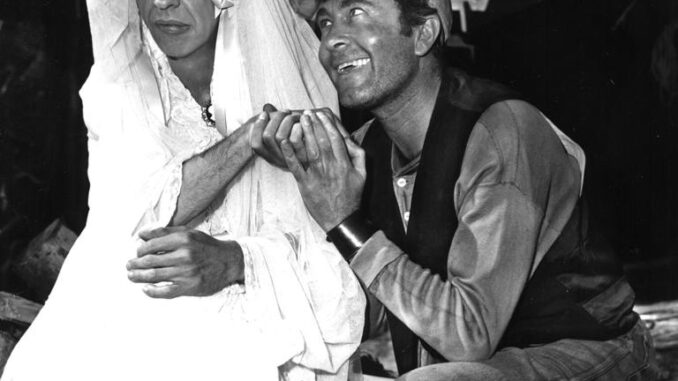
Howard Morris may forever be remembered by generations of television fans as Ernest T. Bass, the wild-eyed rock-throwing menace of The Andy Griffith Show (who joined such luminaries as Floyd the Barber and Otis the Drunk), but that single character barely scratches the surface of his astonishing career. Morris was a fixture in the early days of live television, a pioneering sketch comic on Your Show of Shows, a respected director of sitcoms and commercials and a prolific voice actor whose work for Hanna-Barbera and others became a soundtrack of Saturday morning. Yet behind the laughter was a man who lived with insecurities, contradictions and a restless need to prove himself.
That path brought him into comic legend Sid Caesar’s orbit just as television was entering its golden age. When Your Show of Shows debuted in 1950, Morris was not a guest star, not a sometime player, but part of the official ensemble. Week after week, in front of a live audience at New York’s Center Theater, Morris unleashed characters that ranged from the timid to the deranged, usually throwing himself headlong into slapstick. It was the perfect outlet for a performer who had the “funny in him,” as pop culture historian Geoffrey Mark would later put it, and it established Howard Morris as one of the great comic forces of the medium’s earliest decade.
A Quick Look at Howard Morris
- Who was Howard Morris? Howard Morris was a comedian, actor, director, and voice actor known especially for his role as Ernest T. Bass on The Andy Griffith Show.
- Why is Howard Morris famous? Though he appeared in just a few episodes, Ernest T. Bass became a cult favorite; Morris was also part of Sid Caesar’s Your Show of Shows and directed many sitcoms and commercials.
- How many times did Howard Morris play Ernest T. Bass? He starred as Ernest T. Bass in five episodes during the black-and-white seasons of The Andy Griffith Show.
- What other work did Howard Morris do? He directed TV shows (e.g. Hogan’s Heroes, Get Smart), performed voice work (e.g. The Flintstones, Jetsons, Garfield), and directed high-profile commercials.
- What was Howard Morris’ comedic style? Highly physical, unpredictable, blending wild caricature with emotional sincerity – he made even the strange feel human.
- When was Howard Morris born and when did he die? He was born September 4, 1919, and died May 21, 2005, at age 85.
The Caesar years
If Howard Morris never did another role after Your Show of Shows, his place in television history would still be secure. The weekly 90-minute live variety series remains one of the most influential programs ever to appear on American television. Alongside Sid Caesar, Imogene Coca and Carl Reiner, Morris formed the core cast that embodied a new kind of sketch comedy: sharper, more physical and more satiric than the vaudeville routines that had dominated earlier broadcasts.
Morris recalled the pressure of working in that atmosphere. “It was live,” he told the Television Academy. “You couldn’t fix anything. You had to make it work right there in front of the audience. That kept you honest-and it kept you scared, too.” His small stature, rubbery face and willingness to throw himself into the most humiliating situations made him a natural foil for Caesar’s towering presence.
CAESAR’S HOUR, front, from left, Howard Morris, Sid Caesar, Carl Reiner; back, center, Nanette Fabray, ca. 1954-57
Geoffrey Mark, author of The Lucy Book, paints a vivid picture of the moment Morris truly broke out from the ensemble: a parody called “This is Your Story.” The sketch spoofed Ralph Edwards’ popular program This Is Your Life, with Carl Reiner as the host dragging Sid Caesar reluctantly onto the stage. When Morris entered as “Uncle Goopy,” a spindly relative overcome with affection, he attached himself to Caesar’s massive thigh and refused to let go. “This was live,” Mark explained. “Howie went over the top with it and Sid went right with it-walking across the stage with Howard hanging from his leg, lifting him off the floor. They’d drag him away, introduce another guest and here came Howie again, clinging to them both. The audience went wild.” It was the kind of moment that sealed Morris’ reputation as a fearless physical comedian, able to wring laughs out of sheer commitment.
The show’s writers were a murderer’s row of future legends, among them Mel Brooks, Neil Simon, Woody Allen and Larry Gelbart. Within that cauldron of creativity, Morris became known as the utility player who could disappear into anything. Caesar might thunder, Coca might charm, Reiner might anchor, but Morris-with his darting eyes and elastic voice-was the chameleon. He could be pitiful, terrifying or sweet, sometimes all within the same sketch.
In his own view, though, there was never a “method” to what he did. “I don’t know if I have a style,” he admitted later. “That’s for audiences to decide. I just wanted it to be fun.”
Ernest T. Bass on ‘The Andy Griffith Show’
For all the sophistication Morris displayed in the Caesar years, his most enduring role came more than a decade later in Mayberry. Beginning in 1963, he appeared in a handful of episodes of The Andy Griffith Show as Ernest T. Bass, the scruffy, rock-hurling troublemaker who seemed to erupt into town from some primitive corner of the hills.
Author Daniel de Vise admits he once underestimated the character. At book signings for his nonfiction effort Andy and Don: The Making of a Friendship and a Classic American TV Show, fans would pepper him with questions about Ernest T., and he was embarrassed to realize he hadn’t mentioned the character in the main text. “People love him,” de Vise reflected. “I think of him as the Tasmanian Devil of Mayberry. He’s only in a handful of episodes, but he rampaged with such memorable abandon that he left a deep impression on many viewers.”
Ernest T.’s debut came in the Season 3 installment “Mountain Wedding,” written by Jim Fritzell and Everett Greenbaum. In it, he menaces Charlene Darling, insisting her marriage is invalid because it wasn’t conducted by a pastor. Morris remembered the props of mayhem- “foam rocks” to smash windows, “candy glass” to shatter with glee-and relished Ernest T.’s anarchic energy. De Vise points out that the climax, with Barney Fife disguised in Charlene’s wedding dress, was “one of the odder things you would’ve seen on primetime television in 1963.”
The character was unlike anyone else in Mayberry. “Ernest T. was rather insane,” he observed. “He was the only truly broad, exaggerated character they had at the time. Viewers might even have thought of him as Andy’s alter ego-a comic Mr. Hyde to Andy’s Dr. Jekyll.”
Eddie Kilbourne, a Christian minister who is also a tribute artist known on Facebook for his page Ernest T. Bass Review, and who just portrayed the character again at the 2025 annual Mayberry Days celebration, offers, “Each time Ernest appears on the scene by causing some kind of trouble. And, if he doesn’t get his way, he throws rocks or becomes like that spoiled little child. Ernest brings out the child in each of us and reminds us that all anyone really wants is to love and be loved. That’s a basic need that we all have, and the show lets us see this in a funny way. We find ourselves rooting for Ernest T.”
Geoffrey Mark points out that what might have been a one-shot caricature endured because of Morris’ humanity. “Probably because Howie was such a lovely human being, he imbued Ernest T. with just enough in his acting that you almost understand why he is the way he is,” he explained. “Despite his incredibly bad behavior, people saw him as an underdog-and they wanted more.”
“My Fair Ernest T. Bass,” a fourth season highlight, was Mark’s favorite. Modeled after My Fair Lady, the story finds Andy and the townsfolk trying to make Ernest T. a gentleman so he can woo a local girl, played by Jackie Joseph. “Jackie is such a warm person,” he recalled. “She made you believe that a woman in Mayberry, educated and charming, might actually fall for him. And together, they sold it.”
Even as the character drifted toward caricature in later appearances, fans remained enthralled. De Vise notes that Ernest T. is a textbook case of how “the ratio of fan interest to the character’s actual prominence” can be wildly out of balance. “Howard Morris would win that contest,” he said. “He was in only a handful of episodes, and yet people always want to talk about him.”
Morris himself looked back on Ernest T. with bemusement. The voice, remember, “came from my groin.” The character’s mania gave him the freedom to unleash every antic he had stored up since Your Show of Shows. And while Andy Griffith’s Mayberry was meant to be an oasis of civility, Ernest T. Bass became its glorious exception: half menace, half clown and entirely unforgettable.
Behind the camera-directing for television
Howard Morris, July 25, 1965.
Even as Ernest T. Bass became a fan favorite, Howard Morris was carving out a second career behind the camera. His first directing assignments came on The Andy Griffith Show, where he handled episodes with the same mix of timing and empathy that defined his acting. “I do think being an actor made me a better director,” he would say. “I understood what their process was and I behaved in a way not to hurt or upset them, but to help. I never went into anything thinking I was going to teach somebody how to act. You can’t do that. It’s either there or it isn’t.”
Geoffrey Mark recalls that Morris’ transition to directing was seamless. He helmed installments of Hogan’s Heroes, The Dick Van Dyke Show and even episodes of The Lucy Show. Lucille Ball thought so highly of him that she built an episode-“Lucy and the Golden Greek”-around his talents in 1965, casting him as a timid man who transforms into a plate-smashing, amorous Greek whenever he hears the right music. “She chose him as her first guest star when the show moved to Hollywood,” Mark emphasized. “That’s how important he was.”
Morris also ventured into features. He directed the Doris Day and Brian Keith comedy With Six You Get Eggroll (1968), and Don’t Drink the Water (1969), based on Woody Allen’s play and starring Jackie Gleason. Of Gleason, Morris recalled bluntly: “You couldn’t direct him. He knew exactly what he wanted to do at all times and wouldn’t even listen to you. But he was a great talent.” Doris Day, by contrast, he found “tough” but naturally gifted-someone with instincts you couldn’t teach.
THE DANNY KAYE SHOW, from left: Howard Morris, Danny Kaye, Buddy Ebsen, (Season 2, ep. 215, aired December 30, 1964)
Not all directing experiences were pleasant. Frances Bavier, better known as Aunt Bee, refused to take direction from him. “She would yell at him, raise her voice, refuse to take the direction,” Mark remembered. “‘I’m Frances Bavier, I’m an actress. Don’t you tell me where to stand.'” Morris admitted she was difficult, though he took pride in the episodes he did manage to shape.
By the 1970s and beyond, he had become one of television’s most dependable journeyman directors, capable of tackling everything from The Love Boat to specials with Bea Arthur. Asked if he had a particular style, he shrugged off the question: “Fun. I don’t know if I have a style-that’s for audiences to decide.”
What is clear is that his experience in front of the camera, coupled with his innate comic timing, made him a director who knew how to get the best from actors, even when they didn’t always want to hear it.
The voice of a generation: animation and commercials
If Howard Morris wasn’t on screen, chances are audiences still heard him. Beginning in the 1960s, he became one of the busiest voice actors in the business, lending his elastic tones to Hanna-Barbera, Disney and later Garfield creator Jim Davis. To generations of children, Morris was Saturday morning.
His Television Academy interview reveals both the breadth of his voiceover work and his hazy memory of it. Asked about The Flintstones, he admitted, “God, I don’t remember. Wild voices. Grandpa, uncle, son, daughter.” On The Jetsons, however, he lit up: Jet Screamer, the rock ‘n’ roll idol who belts out “Eep Opp Ork Ah-Ah,” was one he remembered fondly. “He was very loud and raucous,” Morris laughed. He also voiced Beetle Bailey, Atom Ant, Jughead in the Archie cartoons and countless others. “Wade Duck” on Garfield and Friends-the perpetually anxious waterfowl in a life preserver-was a personal favorite. “I did that for eight years,” Morris said, praising writer-producer Mark Evanier as a “dear friend” who kept him inspired.
Geoffrey Mark points out that this work was not a sideline but the bedrock of Morris’ career. “That was his bread and butter,” he explained. “That was the money he counted on to pay the bills.” Whether it was Hanna-Barbera or Ruby-Spears, Morris could walk into a booth, invent a new timbre or whistle and bring a cartoon to life. For Disney, he created the character of Gopher in the Winnie the Pooh shorts, punctuating every line with a whistle he invented on the spot. “I don’t think I can do it anymore,” he chuckled years later, but audiences never forgot it.
Commercials provided another steady stream of income, and here too Morris excelled. He directed hundreds, including the wildly successful McDonald’s “You Deserve a Break Today” spots. “There’s no difference between a commercial and a movie,” he said. “You’re still telling a story.” Geoffrey Mark recalls that Morris also helmed Ethel Merman’s Texaco commercial. Decades later, he surprised his old friend by showing him the raw footage. “Howie was very frail by then,” Mark said, “but he got so excited he literally leapt up from his chair. His son and I had to calm him down. He loved seeing it so much.”
Late in life, Morris was philosophical about the grind of commercial directing. It wasn’t glamorous, but it paid well and kept him in demand. “You get the script a couple of days in advance, you cast it, you shoot it-it’s still making movies,” he shrugged. And when he wasn’t behind the camera, his voice was everywhere, filling the airwaves with an astonishing gallery of characters that remain embedded in American pop culture.
Later career and personal life
Actor Howard Morris, actress Imogene Coca, actor Sid Caesar and actor Carl Reiner attend the HBO’s Television Comedy Special “Comic Relief VI” to Benefit America’s Homeless on January 15, 1994 at the Shrine Auditorium in Los Angeles
By the late 1970s and into the ’80s and ’90s, Howard Morris had settled into a rhythm: directing television episodes and commercials, voicing animated characters and occasionally popping up on screen. He was a guest star on Baywatch-which he joked mostly meant “getting wet”-and appeared in Ron Howard’s hit film Splash (1984). The experience was particularly sweet: “He had me in to read, which I did, and we embraced,” Morris remembered. “As I was heading to my car, Ron came running after me and said, ‘I just wanted to tell you you’ve got the part.’ That was an awfully sweet thing to do. Usually, it doesn’t work that way.”
His personal life, though, was more complicated. Geoffrey Mark, who knew him well, describes a man whose love life was as turbulent as some of his characters. “Howie had lots of women in his life,” he recalled. “Which hurt his marriages. He has children from different women and the children don’t get along.” Those fractured family dynamics came to a head late in his life when his daughters filed suit to stop work on his planned autobiography, arguing he was no longer of sound mind. The project collapsed, leaving Morris frustrated.
Yet even as his health declined, his wit-as off-color as it could be at times-never deserted him. Mark remembered visiting Morris at his West Hollywood home: “We were just sitting in his bedroom, talking, and he said, ‘Geoff, I’ve always wanted to ask you something.’ I said, ‘Of course.’ He said, ‘You’re fat.’ I laughed, and he said, ‘No-really, really fat. How do you get laid?'” It was pure Howard Morris-a punchline wrapped in outrageousness, followed by laughter so infectious that Mark retold it at his funeral, bringing the house down among comedy royalty.
Actor Howard Morris attends the Hollywood Collectors and Celebrity Show October 6, 2001 in Los Angeles, CA.
For all the humor, there was sadness, too. “One of the disappointments of Howie’s life at the end was the lack of communication and support from the people he had once worked with,” Mark said. “People knew he was ill, but there were no calls, no visits. He felt abandoned.” It was a bitter irony for a man who had once been at the center of a golden era of television comedy, surrounded by Caesar, Reiner, and Brooks.
Still, Morris clung to life’s pleasures. Mark remembered him in adult diapers, frail and bedridden, suddenly springing up to dance when a woman came to visit. That mix of vulnerability, appetite, and mischief was pure Howie-impossible to contain, always reaching for another laugh.
Howard Morris remembered
Actor Howard Morris attends the HBO’s Television Comedy Special “Comic Relief VI” to Benefit America’s Homeless on January 15, 1994 at the Shrine Auditorium in Los Angeles, California.
Howard Morris never pretended that show business was easy. Asked what advice he would give young performers, he said simply, “Don’t. It’s too hard. The propensity for failure is greater than success.” As for directing? “Same thing. Shun it like the plague.” Yet despite the warning, Morris had lived the dream: a working actor, a television pioneer, a director of hit comedies and a voice heard in living rooms around the world.
When the Television Academy interviewer asked how he wished to be remembered, Morris grew reflective. “As a guy who has been able to reveal certain things of humor and reality to the public,” he said. “And my great gratitude for the fans. They’ve always been there.”
Geoffrey Mark, who stood up to speak at his funeral, recalled a room filled with giants: Andy Griffith, Sheldon Leonard, Nanette Fabray, Sid Caesar, Carl Reiner and Gary Owens. He told the story of Morris calling him “really, really fat” and then asking, “How do you get laid?” It brought the house down, a final punchline that made people laugh through their tears. “To make those people laugh at a funeral,” Mark reflected, “that was a gift.”