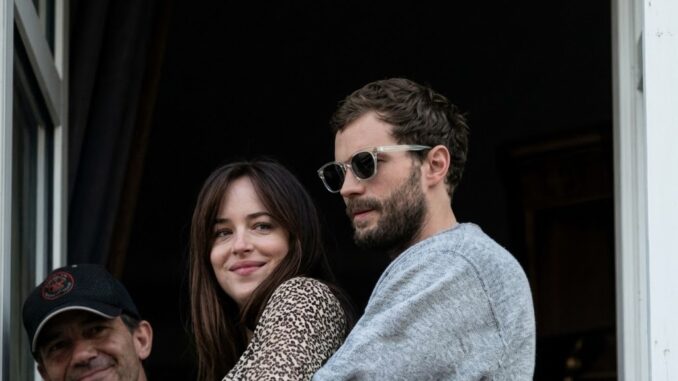
Jamie Dornan has never been one to dwell publicly on the past, but in recent interviews—particularly those tied to his evolving career in 2026—he has admitted that certain memories from his most intense filming experiences remain vivid, almost inescapable, years later.
The actor has pointed most frequently to the Fifty Shades trilogy as the source of those lingering moments. “There are scenes and days on that set that still stay with me,” he said in a reflective conversation earlier this year. “Not in a bad way, necessarily—just in a way that’s hard to shake. The vulnerability, the repetition, the strange intimacy of it all… it imprints on you.” He described how the combination of physical exposure, emotional demands, and the high-pressure environment created experiences that felt larger than the job itself. Dornan has recounted specific sensations: the heat of lights during long takes, the awkward silence after “cut” while still in restraints or undressed positions, and the quiet reliance on co-star Dakota Johnson to get through it together.
One recurring memory he’s shared involves the protective ritual that developed between them. “I’d always make sure to cover her the second they called cut,” he explained. “It became automatic. But even now, I can feel that split-second shift—from being in character to suddenly being two people trying to preserve some dignity in a room full of crew.” Those small, human gestures amid the mechanical process left a lasting mark, reminding him of the real trust required when vulnerability is so public.

Beyond Fifty Shades, Dornan has referenced darker roles that haunt in different ways. Playing serial killer Paul Spector in The Fall required him to inhabit a chilling mindset for extended periods. “Some of those monologues, the quiet moments alone with the character… they don’t just disappear when you go home,” he noted. He has spoken about the need to compartmentalize intensely, yet admits fragments of that darkness occasionally resurface in unexpected ways—perhaps during a quiet evening or when reading similar material.
More recently, filming The Tourist in the remote Australian Outback brought its own indelible moments: isolation, extreme weather, and the psychological strain of portraying amnesia and survival. Dornan described long stretches of waiting in harsh conditions, punctuated by bursts of adrenaline during action sequences. “There were nights out there where the silence was so loud it stayed in my head for weeks after,” he reflected. Those sensory memories—the dust, the heat, the vast emptiness—linger as sharply as any scripted line.
Even in lighter or more personal projects like Belfast, certain emotional beats remain etched. Working with Kenneth Branagh and drawing from his own Northern Irish roots brought cathartic but heavy moments. “There were scenes where the tears weren’t acting,” he has admitted. “And those feelings don’t switch off the moment the camera stops.”
Dornan frames these persistent memories not as burdens but as evidence of how deeply he invests in his work. “You can’t give everything without some of it staying behind,” he said. As he moves into 2026 with a noticeable shift toward comedy (The Worst) and ensemble pieces, these lingering echoes serve as quiet reminders of the emotional cost—and reward—of his craft.
While fans often focus on the glamour or controversy of his biggest roles, Dornan’s admissions reveal a more human truth: the most powerful moments on screen often leave the deepest traces off it. And for him, some of those traces are still very much present.