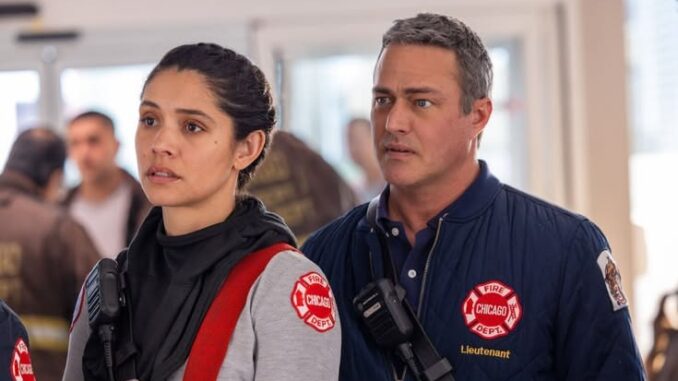
For years, Miranda Rae Mayo has been a powerful presence on Chicago Fire, bringing Stella Kidd to life with strength, confidence, and emotional depth. On screen, Kidd is fearless, composed, and often the one others rely on when things get intense. Whether she’s leading a rescue or holding the team together during difficult moments, she rarely shows hesitation. But behind that steady exterior, Mayo admits the experience of playing Kidd has been far more challenging than it appears.
“It was harder than it looked” is how she describes certain parts of her journey on the show, and for fans, that insight changes how those scenes are understood. Because while the character makes it seem effortless, the reality of bringing Stella Kidd to life required a level of emotional and physical commitment that pushed Mayo in ways she didn’t fully anticipate when she first joined Chicago Fire.
From the outside, a series like Chicago Fire can look like controlled chaos. Explosions, rescues, and high-pressure emergencies are carefully choreographed to feel real but remain safe for the actors. However, Mayo has suggested that even with all the preparation, stepping into those moments still demands focus, stamina, and trust. The gear is heavy, the environments can be physically exhausting, and the pacing of filming leaves little room to reset once the cameras start rolling.

But for her, the physical side was only part of the challenge.
The deeper difficulty came from the emotional weight of the role.
Stella Kidd isn’t just a firefighter. Over time, she has evolved into a leader, a mentor, and someone who carries the expectations of those around her. That evolution didn’t happen overnight, and portraying it meant Mayo had to grow alongside the character. As Kidd took on more responsibility inside Firehouse 51, the pressure to reflect that growth authentically became more intense.
That’s where things became harder than expected.
There are moments in Chicago Fire where the action slows down and the emotional reality of the job takes over. Scenes involving loss, fear, or the aftermath of a failed rescue can be just as demanding as any explosion. For Mayo, those scenes required her to tap into something deeper, to make the audience believe not just in the situation, but in how it affects the person experiencing it.
And sometimes, that meant sitting with emotions that didn’t fade the moment filming ended.
Over the years, Kidd’s journey has included personal struggles, career challenges, and the complexities of relationships inside and outside the firehouse. One of the most defining aspects of her storyline has been her partnership with Kelly Severide, played by Taylor Kinney. Their relationship brought new layers to the character, requiring Mayo to balance strength with vulnerability in ways that weren’t always easy to portray.
It’s that balance that she says took the most work.
Playing a character who is both emotionally open and professionally strong means constantly shifting between different states of mind. One scene might require complete control and authority, while the next demands raw honesty and emotional exposure. Moving between those extremes, sometimes within the same episode, can be more exhausting than viewers might realize.
And yet, that challenge is also what made the role meaningful.
Mayo’s reflections suggest that the difficulty of the experience is part of what shaped her performance. The moments that pushed her the most often became the ones that resonated most strongly with fans. When a scene feels real, it’s often because the actor had to work through something real to get there.
That connection is part of what has made Stella Kidd such an important character in Chicago Fire. She represents a new generation of leadership inside Firehouse 51, someone who has earned her place through resilience and determination. But that journey, both for the character and the actress, didn’t come easily.
Hearing Mayo speak openly about the challenges behind the scenes adds a new layer to how viewers experience the show. The next time Kidd steps into a high-stakes rescue or faces an emotional turning point, it’s harder to see it as just another scene. There’s an understanding now that more goes into those moments than what appears on screen.
In the end, “it was harder than it looked” isn’t just a reflection on the difficulty of the role. It’s a reminder of the work, dedication, and emotional investment required to make a character feel real over the course of so many seasons.
And for fans of Chicago Fire, that realization only makes Stella Kidd’s journey — and Miranda Rae Mayo’s performance — even more powerfu