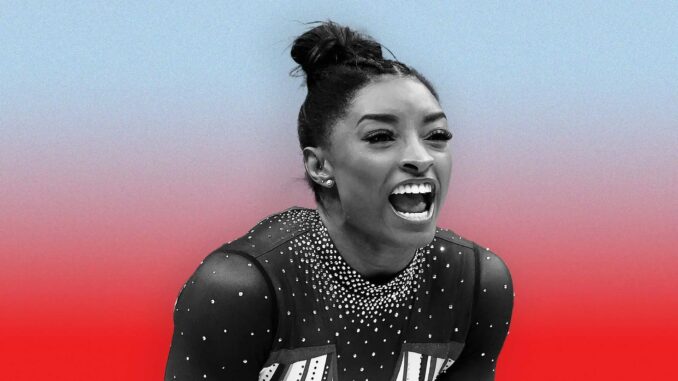
When people talk about greatness in gymnastics, one name always rises to the top: Simone Biles. Her explosive power, gravity-defying skills, and unmatched consistency have transformed modern gymnastics.
But as conversations begin about a potential return for the 2028 Summer Olympics in Los Angeles, fans and analysts are asking a new question. Could changes to her body—such as breast implants—affect her performance?
At first glance, it might sound like gossip. Yet in elite gymnastics, even tiny shifts in body weight, balance, and biomechanics can matter. A fraction of a second. A centimeter of rotation. That’s the difference between gold and silver.
So let’s break it down: how could body changes like implants potentially influence strength, power, and performance for one of the greatest gymnasts of all time?
Understanding Simone Biles’ Athletic Superpower
Why Power Defines Biles’ Gymnastics
If you watch Biles compete, one thing stands out immediately: explosive power.
Her routines rely on:
-
Rapid acceleration during vault runs
-
Massive vertical jumps on floor
-
Lightning-fast rotations in the air
These skills demand an almost perfect ratio between strength, weight, and body control.
Gymnastics experts often call this the power-to-weight ratio.
Simply put:
The more strength an athlete has relative to their body weight, the higher and faster they can move.
And Biles has historically had one of the best ratios in the sport.
The Role of Body Composition in Elite Gymnastics
Why Small Physical Changes Matter
In most sports, adding a little weight isn’t a big deal.
But gymnastics is different.
Even minor changes in body composition can affect:
-
Rotation speed in the air
-
Landing control
-
Balance on the beam
-
Energy expenditure during routines
Think of a gymnast like a spinning figure skater. If the body’s mass distribution changes even slightly, the spin dynamics change too.
This is basic physics.
Breast Implants and Athletic Performance
Do Implants Actually Affect Strength or Power?
Breast implants themselves do not directly reduce muscle strength.
However, they may indirectly affect athletic movement in a few ways:
-
Added weight to the upper body
-
Shifted center of gravity
-
Potential discomfort during intense movement
For most athletes, these effects are minimal.
But gymnastics is one of the most body-sensitive sports on the planet.
Center of Gravity: The Hidden Factor
Why Balance Is Everything
Gymnasts rely heavily on precise balance.
Events like:
-
Balance beam
-
Uneven bars
-
Floor tumbling
require absolute body awareness.
A small change in upper-body mass can subtly shift the center of gravity.
Imagine carrying a small backpack on your chest while doing flips. It wouldn’t make things impossible—but it might require adjustments.
Elite athletes constantly retrain their bodies to adapt.
Rotation Physics in Gymnastics
Why Weight Distribution Changes Spin Speed
When Biles performs complex skills—like her famous double-twisting vaults—she relies on rapid rotation.
Physics tells us something important:
Rotation speed depends on how mass is distributed around the body.
If more mass sits farther from the body’s center, rotation can slow slightly.
For most people, this effect is negligible.
For Olympic-level gymnasts attempting multiple twists in the air, it could require technical adjustments.
Strength vs. Power in Gymnastics
They’re Not the Same Thing
Many fans assume strength and power are identical. They’re not.
Strength:
The ability to exert force.
Power:
The ability to exert force quickly.
Gymnastics demands both—but power matters more.
Biles’ success has always come from explosive power during takeoffs.
Upper Body Dynamics on the Uneven Bars
Why Core Stability Matters
The uneven bars require incredible upper-body coordination.
Athletes must swing, release, and re-grasp bars while maintaining perfect body alignment.
If body mass shifts even slightly, it can affect:
-
Swing timing
-
Grip transitions
-
Release distances
However, elite athletes regularly retrain their muscle memory to compensate.
Recovery and Adaptation in Elite Athletes
Why Simone Biles Could Easily Adjust
One thing fans often forget: Biles isn’t just talented—she’s extremely adaptable.
Elite athletes constantly adjust to:
-
New training methods
-
Injuries
-
Aging bodies
Even something as complex as changing body composition can be accommodated with:
-
Strength training
-
Technique adjustments
-
Core stabilization work
Professional sports science teams specialize in these transitions.

The Age Factor for the 2028 Olympics
Will Age Matter More Than Body Changes?
By the time the 2028 Games arrive, Biles will be in her early 30s.
In gymnastics, that’s considered experienced—but not impossible.
In fact, the sport is changing.
Modern athletes are extending careers thanks to:
-
Better recovery science
-
Advanced strength training
-
Improved nutrition
If Biles returns, age might be a bigger challenge than implants.
The Mental Edge of Simone Biles
Confidence Is a Performance Multiplier
Gymnastics isn’t only physical.
Confidence drives performance.
Athletes who feel comfortable and confident in their bodies often perform better under pressure.
For Biles, feeling strong mentally could outweigh minor physical adjustments.
Training Adjustments That Could Offset Changes
How Coaches Would Adapt Training
If body changes required adjustments, coaches might modify:
Strength Training
Focus on:
-
Core stabilization
-
Upper-body control
-
explosive leg power
Skill Technique
Minor tweaks in:
-
takeoff angles
-
arm positions
-
landing mechanics
Conditioning
Ensuring the power-to-weight ratio remains elite.
What Sports Medicine Experts Usually Say
Most Athletes Return to Full Performance
According to sports medicine discussions, athletes in many sports—including runners, martial artists, and gymnasts—have competed successfully after similar procedures.
Key factors include:
-
implant size
-
surgical technique
-
recovery period
-
training adjustments
With proper recovery, performance impacts are usually small.
Why Simone Biles Is Still the GOAT
Even after stepping away from competition at times, Biles’ legacy remains unmatched.
Her achievements include:
-
Multiple Olympic gold medals
-
Dozens of world championship medals
-
Skills so difficult they carry her name in the rulebook
Very few athletes redefine an entire sport.
Biles did exactly that.
Could Simone Biles Still Dominate in 2028?
The Honest Answer
Yes—it’s possible.
Her biggest strengths remain:
-
explosive leg power
-
unmatched air awareness
-
technical precision
-
mental resilience
Small physical changes are just one variable in a very complex equation.
And if history tells us anything, it’s this:
Never underestimate Simone Biles.
The Bigger Picture: Athletes and Body Autonomy
This conversation also highlights something important.
Athletes are human beings.
They make personal choices about their bodies just like anyone else.
What matters most is that those choices support their health, happiness, and long-term well-being.
Performance always matters in sports—but so does personal agency.
Conclusion
Simone Biles has spent her entire career pushing the limits of human performance. Discussions about how physical changes—like breast implants—might affect her gymnastics abilities are ultimately rooted in the science of biomechanics, balance, and power.
In theory, changes in body composition could influence rotation speed, balance, or energy use. But elite athletes adapt constantly, and Biles has proven time and again that she can evolve.
If she decides to compete at the 2028 Olympics, the real story likely won’t be about implants or body changes. It will be about determination, training, and the relentless drive that made her the greatest gymnast of her generation.
And if Biles has shown the world anything, it’s this: when people doubt her, she tends to surprise them.
FAQs
1. Can breast implants affect athletic performance in gymnastics?
In theory, implants could slightly alter body weight distribution or center of gravity. However, with proper training and adaptation, most athletes continue to perform at high levels.
2. Would implants reduce Simone Biles’ strength?
No. Implants do not directly reduce muscle strength. Strength comes from muscles and training, not body structure.
3. Could body changes affect gymnastics rotation?
Possibly. Small shifts in body mass distribution may affect rotation speed, but elite gymnasts often adjust technique to compensate.
4. Is Simone Biles planning to compete in the 2028 Olympics?
There has been speculation and discussion among fans, but any official decision would come directly from Biles herself.
5. What will be the biggest challenge for Biles in 2028?
Age, recovery time, and the evolving difficulty of gymnastics may pose bigger challenges than minor body composition changes.