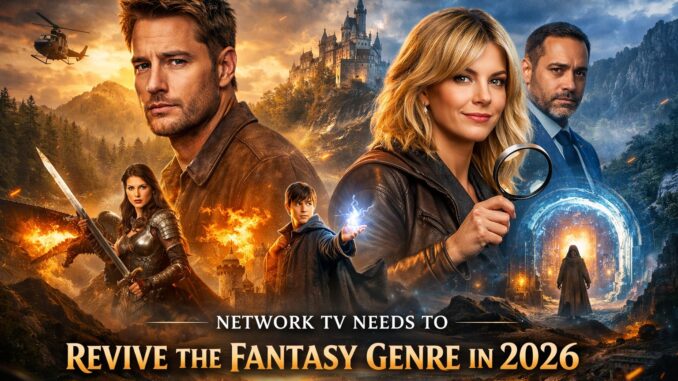
Network television is in a strange place right now.
On one hand, it’s thriving. Shows like Tracker and High Potential prove that audiences still crave smart, character-driven storytelling on traditional broadcast channels. Crime-solving thrillers? Still hot. Procedurals with a twist? Absolutely working.
But here’s the question nobody’s asking loudly enough:
Where’s the fantasy?
If 2026 is going to be a breakout year for network TV, it needs more than sharp detectives and complex investigations. It needs imagination. It needs spectacle. It needs dragons, portals, time loops, prophecies—something bold.
Let’s talk about why the fantasy genre deserves a prime-time comeback.
The Current Network TV Landscape: Safe but Predictable
Procedurals Dominate the Ratings
There’s no denying it—procedurals are king.
From FBI task forces to lone-wolf trackers, network schedules are stacked with crime dramas and investigative series. They’re reliable. They’re formula-friendly. They’re advertiser-safe.
But they’re also… familiar.
Shows like Tracker succeed because they refine a winning formula. The same goes for High Potential, which adds intellect and charm to a crime-of-the-week structure. These series are polished and compelling.
Yet if you zoom out, you’ll notice something:
Network TV has become a sea of realism.
What’s Missing? Escapism.
In uncertain times, audiences don’t just want logic—they want magic.
Streaming platforms understand this. That’s why fantasy continues to thrive in premium and streaming spaces. But broadcast networks? They’ve largely stepped back from ambitious genre storytelling.
And that’s a missed opportunity.
Why Fantasy Works—Now More Than Ever
Fantasy Offers Ultimate Escapism
Let’s be honest—life can feel overwhelming. News cycles spin fast. Social media never sleeps. Reality rarely gives us a break.
Fantasy does.
It invites us into worlds where the rules bend. Where heroes rise. Where destiny matters. It’s not just entertainment—it’s emotional release.
And in 2026, that kind of escape could feel essential.
Fantasy Builds Loyal Fandoms
Procedurals create viewers.
Fantasy creates communities.
Think about it. Genre shows inspire fan art, theories, conventions, online debates, cosplay, and long-term engagement. Viewers don’t just watch fantasy—they live in it.
Network TV could benefit massively from that kind of devotion.
Learning from Past Network Fantasy Success
Networks Have Done It Before
Fantasy isn’t foreign to broadcast television. It’s just been dormant.
Over the years, network hits have dipped into supernatural and fantastical territory with major success. Audiences showed up. They invested emotionally. They stayed for years.
So what changed?
Fear of risk.
The Budget Myth
One argument against fantasy on network TV is cost. Dragons and digital worlds aren’t cheap.
But here’s the reality: production technology has evolved. Visual effects are more accessible than ever. And creative storytelling doesn’t always require blockbuster budgets.
Sometimes, the most compelling fantasy is intimate—grounded in character, not CGI.
Why Shows Like Tracker and High Potential Prove the Timing Is Right
Audiences Love Character-Driven Stories
Both Tracker and High Potential succeed because they anchor their narratives in strong protagonists. Viewers care about the people solving the mysteries.
Now imagine that same character depth—inside a fantasy world.
What if the tracker wasn’t just finding missing persons, but navigating hidden magical societies? What if the brilliant mind in High Potential could see patterns others couldn’t because reality itself was bending?
Fantasy doesn’t replace procedural tension. It amplifies it.
Hybrid Genres Are the Future
Here’s the secret: network TV doesn’t need pure fantasy.
It needs hybrid fantasy.
Fantasy-procedural. Fantasy-legal drama. Fantasy-medical thriller.
Blend the structure audiences love with the imaginative spark they crave. That’s the formula for 2026.
The Streaming Competition Is Winning the Fantasy Game
Streaming platforms have dominated the genre space for years. They’ve built empires on epic storytelling.
Network TV, meanwhile, has focused on grounded realism.
But here’s the thing: not everyone subscribes to every streaming service. Broadcast still reaches millions of households weekly.
If a major network launches a compelling fantasy series with strong marketing and a strategic time slot, it could break through in a big way.
Why 2026 Is the Perfect Year for a Fantasy Comeback
Audience Fatigue Is Real
There are only so many crime scenes viewers can process before they crave something different.
The audience isn’t rejecting procedurals. They’re just ready for variety.
2026 offers a clean slate. A new programming cycle. A chance to surprise viewers.
Younger Viewers Want Genre Innovation
Gen Z and younger millennials grew up on expansive fantasy universes. They expect bold storytelling. They crave high-concept ideas.
If networks want to stay relevant, they can’t just repeat formulas from the past. They need fresh mythologies.
What a Network Fantasy Hit Could Look Like
Let’s imagine.
A small-town sheriff discovers a hidden realm beneath her city. Each week, she balances everyday crimes with supernatural disturbances leaking into the real world.
It’s procedural enough to feel familiar.
It’s fantastical enough to feel new.
That’s the sweet spot.

The Business Case for Fantasy on Broadcast
Merchandising and Cross-Platform Potential
Fantasy opens doors that crime dramas rarely do.
Merchandise. Graphic novel spin-offs. Podcasts. Expanded universes.
A successful fantasy property isn’t just a show—it’s an ecosystem.
Event Television Is Back
Fantasy thrives as event television.
When something extraordinary happens on-screen, viewers don’t wait days to catch up. They watch live. They discuss immediately. They turn premieres into shared experiences.
And that’s exactly what networks need to stay culturally relevant.
Taking Smart Risks Instead of Playing It Safe
Networks don’t need to gamble recklessly.
They need calculated creativity.
Start with limited series. Test hybrid concepts. Invest in strong showrunners. Cast charismatic leads. Build mythology slowly.
Fantasy doesn’t require chaos—it requires commitment.
Why Fantasy Complements, Not Replaces, Procedurals
This isn’t about canceling what works.
Procedurals like Tracker and High Potential prove that structure and character drive ratings. Fantasy can adopt that structure and layer in imagination.
Think of it as adding spice to a dish that’s already popular.
You don’t throw out the recipe. You elevate it.
The Cultural Moment Is Ready for Myth and Meaning
Fantasy often mirrors real-world struggles in symbolic ways. It tackles themes of power, identity, justice, and hope.
In times of uncertainty, myth becomes meaningful.
It reminds us that darkness can be challenged. That heroes can rise. That transformation is possible.
And maybe that’s exactly the kind of storytelling audiences need heading into 2026.
Conclusion: 2026 Should Be the Year Network TV Dares to Dream
Shows like Tracker and High Potential prove one thing clearly: audiences still trust network television.
But trust alone isn’t enough.
To grow, networks must innovate. To captivate, they must surprise. To compete, they must imagine bigger.
Fantasy isn’t a gamble—it’s an opportunity.
2026 could be the year broadcast television stops playing it safe and starts building worlds again. And when that happens, viewers won’t just tune in.
They’ll believe.