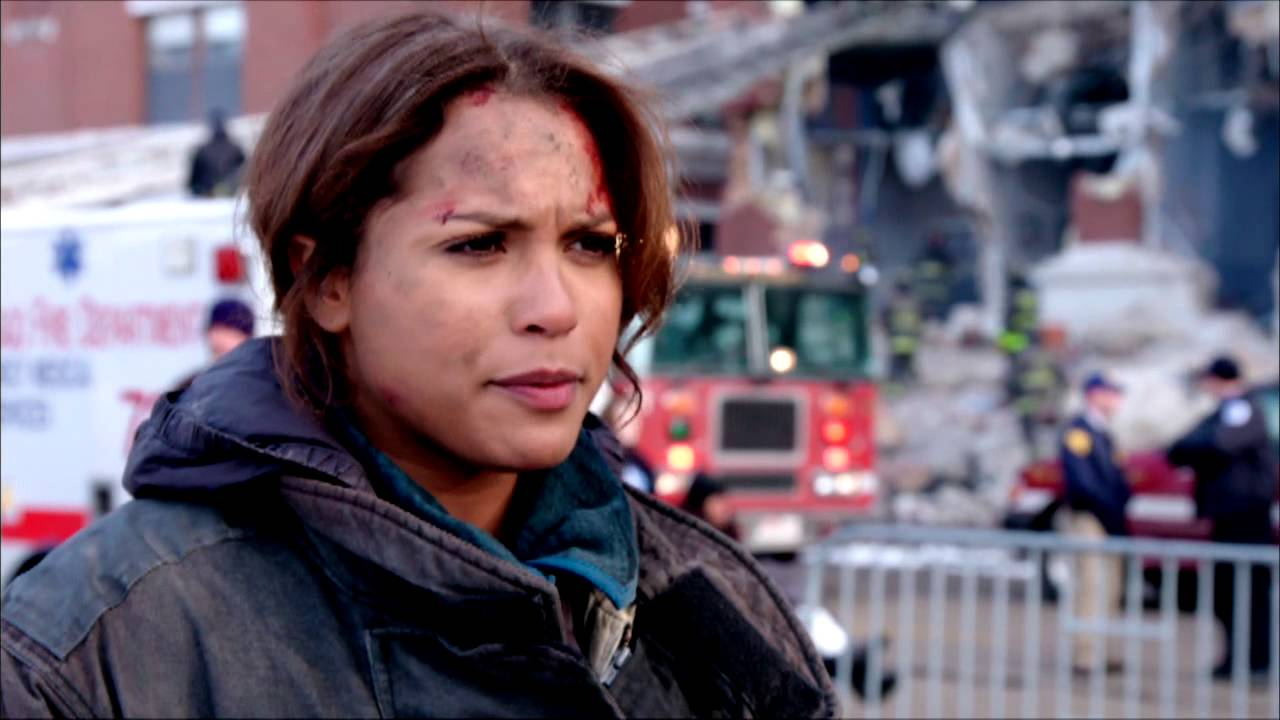
The legacy of Chicago Fire is built upon the scorched remains of countless emergencies, but its true strength has always been the heartbeat of its characters. While many have worn the bunker gear of Firehouse 51, few left as indelible a mark as Monica Raymund, whose portrayal of Gabriela “Gabby” Dawson redefined the role of women in procedural dramas. From the pilot episode in 2012 to her eventual departure as a series regular, Raymund’s journey from the cramped quarters of Ambulance 61 to the prestigious halls of Hollywood serves as a testament to her talent and the enduring impact she left on the “One Chicago” universe. Even in 2026, as the show continues to evolve with new faces, the “Dawson Era” remains the gold standard for character-driven storytelling within the franchise.
Monica Raymund’s impact was immediate and revolutionary. In a genre often dominated by stoic male leads, Gabby Dawson was a firestorm of ambition, empathy, and raw grit. Raymund didn’t just play a paramedic; she portrayed a woman who refused to be confined by the boundaries of her assigned role. Her transition from Paramedic-in-Charge to a candidate at Firehouse 51 remains one of the most significant “high-stakes” arcs in the show’s history. It broke the “Elite of the Elite” glass ceiling, showing millions of viewers that the fire line was a place for anyone with the courage to stand in the heat. Raymund brought a visceral, physical reality to the role, performing many of her own stunts and working closely with real-life first responders to ensure that every chest compression and every hose-drag felt authentic.
Beyond the tactical heroics, Raymund’s chemistry with the ensemble cast—most notably Jesse Spencer’s Matthew Casey—provided the emotional spine of the series for six seasons. The “Dawsey” romance was more than just a sub-plot; it was a sprawling, complex exploration of sacrifice, love, and the “Elite” pressure of balancing a dangerous career with a personal life. Raymund’s ability to navigate Dawson’s fierce independence alongside her deep vulnerability made her one of the most relatable characters on television. When she finally departed for a humanitarian mission in Puerto Rico, it wasn’t just a plot point; it was a reflection of the character’s—and the actor’s—growth into a global force for good.
The transition from Firehouse 51 to Hollywood was a natural evolution for an actor of Raymund’s caliber. Since leaving the series, she has showcased her versatility as a lead in the gritty crime drama Hightown, where she plays Jackie Quiñones with a jagged, uncompromising edge that contrasts sharply with the maternal warmth of Gabby Dawson. Yet, even as she headlines her own shows and moves into the director’s chair—directing episodes of FBI and other major network hits—the “Chicago Fire” DNA remains visible in her work. Raymund’s enduring impact is felt in the way she paved the way for more diverse, complex female leads in the Dick Wolf universe. Every time a female candidate steps into the firehouse in 2026, they are walking a path that Raymund’s boots cleared first.
Furthermore, Raymund’s legacy is preserved through the “Shocking Returns” she has made over the years. Her guest appearances, such as her return for the midseason finale of Season 8, consistently draw some of the highest ratings in the show’s history. These moments serve as a bridge between the show’s origins and its future, reminding the “Chi-Hard” community that while members of Firehouse 51 may move on, they never truly leave the family. In 2026, as the show celebrates its legacy, Raymund is often cited by current cast members as a mentor and a trailblazer who set the tone for the professional and supportive culture on set.
Monica Raymund’s impact also extends to the cultural footprint of Chicago Fire. She was a pioneer in representing the Latinx community in a prominent, heroic light on a major network. Her portrayal of Dawson as a professional, a leader, and a woman of deep convictions resonated with a global audience, making her a symbol of empowerment. Raymund proved that a character could be flawed, impulsive, and sometimes “in trouble” with the higher-ups, yet remain a hero worth rooting for.
Ultimately, the story of Monica Raymund and Chicago Fire is one of mutual growth. The show provided the platform for a star to rise, and in return, Raymund gave the series its soul. As she continues to conquer Hollywood with her “Elite” talent and directorial vision, the echoes of Gabby Dawson’s siren can still be heard in the streets of Chicago. She didn’t just play a part in a show; she helped build a universe. As Firehouse 51 moves forward into new frontiers, the foundational fire that Monica Raymund ignited continues to burn bright, ensuring that her impact will be felt as long as the bells continue to ring.