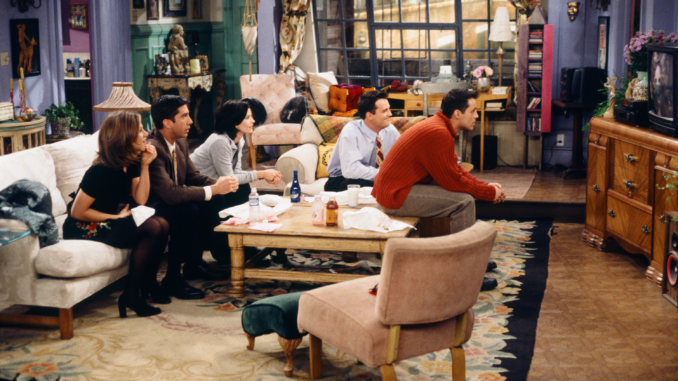
For years, fans believed the magic of Friends lived in its punchlines, its romances, and its unforgettable Thanksgiving disasters. But now, a new wave of online discussion has shifted the spotlight somewhere unexpected — Monica’s apartment.
Not the characters.
Not the catchphrases.
The apartment.
And the deeper fans dig, the more they realize that the show’s most iconic “character” wasn’t played by any actor at all.
The Man Who Quietly Shaped Television History
Long before binge-watching became a cultural ritual, art director John Shaffner was designing what would become one of television’s most recognizable interiors.
But this wasn’t some glamorous Hollywood fantasy.
It was personal.
Shaffner modeled Monica’s apartment after a cramped sixth-floor walk-up he once lived in during 1970s New York. The narrow layout. The worn-in realism. The sense of vertical isolation. It wasn’t random — it was memory.
And here’s where it gets fascinating.
He made one bold architectural decision that changed everything: every single door in the apartment opened into the living room.
Bedrooms. Bathroom. Hallway.
All roads led to the couch.
The Living Room Was Never Just a Living Room
That design wasn’t aesthetic — it was psychological.
By forcing every entrance and exit through one shared space, Shaffner created a built-in emotional collision point. Arguments exploded there. Confessions unraveled there. Relationships began and ended there.
It turned the living room into a gravitational center.
It wasn’t just where scenes happened.
It was where the show happened.
And when producers saw how naturally it fueled ensemble energy, the same structural philosophy was applied to Joey’s apartment as well — reinforcing the idea that connection, chaos, and comedy must always funnel back to one shared heart.

The Illusion Was So Real, It Fooled Executives
Most sitcom sets are hollow illusions. Fake appliances. Empty cabinets. Prop screens.
Not this one.
Shaffner insisted on fully functional appliances — a working refrigerator, an operational television, real electronics humming behind the scenes.
The result?
Visitors forgot they were standing inside a soundstage.
Friends, family members, even network executives reportedly treated the space like an actual apartment. At one point, guests had to be reminded that the bathroom plumbing didn’t function.
The realism was that convincing.
In an era before hyper-detailed streaming production design, this level of authenticity quietly raised the bar for sitcom staging.
The Golden Frame That Was Never Supposed to Exist
And then there’s the detail fans can’t stop revisiting — the golden picture frame around Monica’s purple peephole.
An icon.
A merchandising staple.
A symbol of 1990s television comfort.
But it was never part of the original plan.
During early preparations for the pilot episode of Friends, a crew member accidentally knocked a decorative frame off a side table. The glass shattered.
Instead of discarding it, set decorator Greg Grande removed the backing and mounted the empty frame around the peephole.
A mistake became mythology.
It’s the kind of behind-the-scenes accident that rarely happens — and almost never becomes cultural shorthand for an entire show.
Today, that golden frame is as recognizable as Central Perk itself.
Why Fans Are Talking About This Again Now
In the streaming era, viewers aren’t just watching episodes — they’re dissecting them.
High-definition re-releases and social media rewatches have reignited fascination with the apartment’s layout. Fans are mapping floor plans. Debating square footage. Questioning New York rent logic.
But beyond the jokes about impossibly affordable Manhattan living, something deeper has emerged.
People are realizing that the set design helped define the emotional rhythm of the series.
Without that central living room funnel, would the ensemble chemistry have felt the same?
Without that accidental golden frame, would the door have become such an instantly recognizable symbol of comfort television?
The Set That Outlived the Sitcom Era
When Friends premiered in 1994, few could predict it would become one of the most rewatched shows in history.
But the apartment remains frozen in time — purple walls, mismatched furniture, warm lighting.
It represents a specific kind of storytelling: intimate, contained, character-driven.
In today’s landscape of sprawling cinematic television, massive CGI budgets, and global location shoots, Monica’s apartment feels almost radical in its simplicity.
Six people.
One couch.
One doorway everyone must pass through.
The Real Legacy
We often credit cast chemistry — and rightly so.
We celebrate performances, laugh at bloopers, debate Ross and Rachel endlessly.
But production design is the silent architect of emotional storytelling.
And in this case, it built something unforgettable.
A broken prop became a cultural icon.
A cramped memory became a television sanctuary.
And a living room became the emotional engine of a generation.
Sometimes the most powerful character in a show doesn’t speak at all.
It just stands there — purple, imperfect, and impossible to forget.