For fourteen seasons, Blue Bloods hasn’t just been a police procedural. It has been a ritual. A Friday-night tradition. A generational story about loyalty, justice, and family dinners that felt more real than most reality shows.
And then came the announcement that changed everything.
CBS confirmed that Season 14 would be the final chapter of Blue Bloods. What should have been a celebratory farewell instead ignited one of the loudest fan uprisings in recent network TV history. Petitions exploded. Cast members spoke out. And suddenly, a show that was “ending” didn’t feel quite finished.
So what is really happening behind the scenes?
The Cancellation That Sparked a Movement
When CBS revealed that Season 14 would close the Reagan family saga, fans were blindsided. Ratings were still strong. The show remained a dependable performer on Friday nights. And unlike many aging dramas, it hadn’t suffered a visible creative collapse.
Almost instantly, campaigns demanding a renewal began circulating online. Supporters argued that the series still had stories to tell — and an audience eager to watch them.
This wasn’t a quiet goodbye. It was a protest.
Tom Selleck Breaks His Silence
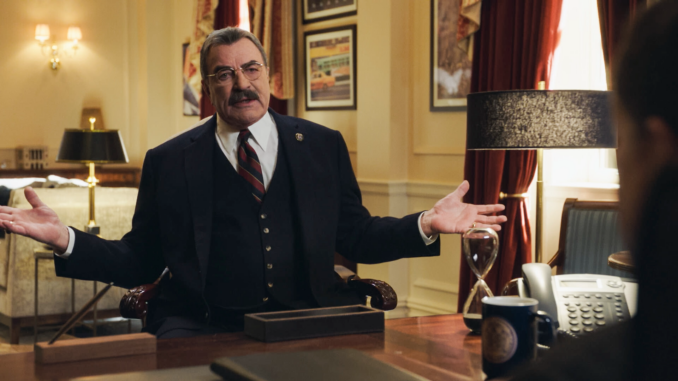
At the center of the storm stands Tom Selleck, the face of Commissioner Frank Reagan and the steady anchor of the series since 2010.
Selleck made headlines after publicly expressing disappointment over the cancellation. He pointed out that the show was still performing well and suggested that ending it now felt premature.
For fans, this wasn’t just an actor promoting his show. It was Frank Reagan himself questioning the decision. And that emotional overlap blurred the line between fiction and reality.
If the patriarch isn’t ready to hang up his badge, why should the network?
:max_bytes(150000):strip_icc()/BLUE-BLOODS-112023-52043ecfe06a477cb15a860de6b9ee96.jpg)
The Reagan Family: More Than Just Characters
Over fourteen seasons, viewers have grown attached to a cast that feels unusually cohesive:
-
Donnie Wahlberg as Danny Reagan
-
Bridget Moynahan as Erin Reagan
-
Will Estes as Jamie Reagan
-
Len Cariou as Henry Reagan
Their weekly dinner table scenes became iconic — not because of explosions or plot twists, but because of debate, disagreement, and deep-rooted love.
Ending Blue Bloods doesn’t just conclude storylines. It dissolves a television family that viewers have invited into their homes for over a decade.
Why Season 14 Feels Like a Calculated Goodbye
The final season has carried an unmistakable tone of reflection.
Frank is weighing legacy more heavily than ever. Danny’s personal life feels like it’s reaching emotional crossroads. Erin’s political ambitions and moral conflicts are sharpening into defining choices. Jamie’s future inside — or possibly outside — the NYPD feels uncertain.
These are not random arcs. They feel intentional. Structured. Almost like a series of final statements.
When writers begin giving every major character “full circle” moments, it rarely happens by accident.
Is This Really About Ratings — Or About Money?
Behind every cancellation lies the business equation.
Long-running series become expensive. Veteran actors command higher salaries. Production costs rise. Contract negotiations grow complicated. Networks start calculating long-term profitability versus fresh programming investments.
CBS has not framed the decision as a creative failure. Instead, industry insiders speculate that cost efficiency may have played a major role.
But here’s the tension: when a show remains stable in ratings, canceling it becomes a public relations risk.
And that risk is now playing out in real time.
Spin-Off Rumors: A Quiet Escape Plan?
While CBS has stood firm on calling Season 14 the end, speculation about potential spin-offs refuses to die.
Could Danny Reagan lead his own grittier detective-focused series?
Could a next-generation Reagan step into the spotlight?
Could the franchise evolve rather than disappear?
In today’s television landscape, intellectual property rarely vanishes entirely. It transforms.
And Blue Bloods has built enough brand loyalty to justify expansion.
The Cultural Impact No One Can Ignore
Since its 2010 premiere, Blue Bloods has occupied a unique space in network television. It blended traditional procedural storytelling with generational ethics. It tackled policing debates without fully abandoning its pro-law-enforcement core. It centered Catholic family values without becoming preachy.
Few shows balanced ideology, drama, and emotional warmth this consistently.
That balance is difficult to replicate. And once it’s gone, it leaves a noticeable absence.
Fans vs. The Network: Who Wins?
Historically, fan campaigns have revived shows before. Streaming platforms have rescued canceled dramas. Networks have reversed decisions under pressure.
But fourteen seasons is already a long run. Executives may feel the story has reached its natural endpoint.
Still, the energy around this cancellation feels different. It’s not apathy. It’s active resistance.
And resistance creates headlines.
The Final Episodes: Closure or Cliffhanger?
As the remaining episodes of Season 14 air, viewers are watching closely for clues.
Will Frank retire?
Will Danny finally find personal peace?
Will the family dinner table remain intact?
A neatly wrapped ending would signal true closure.
An open-ended farewell could leave the door cracked for revival.
Every line of dialogue now feels weighted with possibility.
The Bigger Question: What Does Blue Bloods Represent?
At its core, Blue Bloods represents stability. Tradition. Moral debate within a family framework.
In an era where television constantly reinvents itself with darker, faster, more fragmented storytelling, the show remained steady.
Maybe that’s why its cancellation feels symbolic. It marks the potential end of a certain kind of network drama — one rooted in weekly rhythm rather than binge-fueled chaos.
So… Is This the End?
Officially, yes. Season 14 is the final chapter.
Emotionally? The story feels unfinished.
Between Tom Selleck’s public disappointment, the passionate fan response, and persistent spin-off speculation, Blue Bloods does not feel like a show fading quietly into the night.
It feels like a franchise at a crossroads.
And until the final Reagan family dinner airs, one truth remains:
In television, “goodbye” is sometimes just the beginning of negotiation.
Whether this is truly the last salute for the Reagan family — or the calm before a strategic reinvention — the conversation surrounding Blue Bloods has proven one thing beyond doubt:
The badge may be retiring.
But the legacy is very much alive.