For fourteen seasons, Blue Bloods hasn’t just been a police drama. It’s been a Sunday night ritual. A generational saga. A story about duty, legacy, and the weight of the Reagan name. And now, as the franchise prepares to evolve with Boston Blue, the people steering the next chapter are finally addressing the question that’s been haunting fans:
What happens to Jamie and Eddie? And where do Henry and Erin stand in this new era?
The answers are tantalizing — and they may signal more than anyone expected.
A Franchise at a Turning Point
As Blue Bloods concludes its historic run, attention has shifted to the expanding universe under development. The new project, widely referred to as Boston Blue, promises to carry the DNA of the Reagan legacy into fresh territory.
While the original series anchored itself in New York and the Reagan family dinner table, the next chapter hints at geographical and emotional expansion. But fans don’t just care about cities. They care about people.
And at the center of the storm are two couples whose journeys feel unfinished.
Jamie & Eddie: Stability or Storm Ahead?
From partners on patrol to husband and wife, the relationship between Jamie Reagan and Eddie Janko became one of the show’s emotional pillars. Their dynamic balanced professional tension with personal devotion — and fans have long debated whether their story still has unexplored depth.
Now, producers connected to Boston Blue have teased that updates on Jamie and Eddie are coming — and that those updates won’t be surface-level.
The implication? Their marriage may face new pressures in the evolving law enforcement landscape. Promotions, relocations, or shifting departmental structures could challenge their partnership in ways the original series only hinted at.
For a couple often portrayed as the “steady” Reagan unit, any shake-up would represent a bold narrative risk. But risk is exactly what keeps long-running franchises alive.
Henry Reagan: The Moral Compass in Question
If Jamie represents the future, Henry Reagan represents the past — and the principles that shaped generations.
Throughout Blue Bloods, Henry stood as a living reminder of tradition. His voice at the dinner table carried authority not just because of his former rank, but because of the values he embodied.
Producers have suggested that Henry’s presence will not simply fade into nostalgia. Instead, they’ve hinted at deeper exploration of his legacy — possibly examining how an older generation reconciles its ideals with a rapidly changing justice system.
In a time when policing narratives on television are evolving, Henry’s perspective could become more layered, more conflicted, and perhaps more vulnerable than ever before.
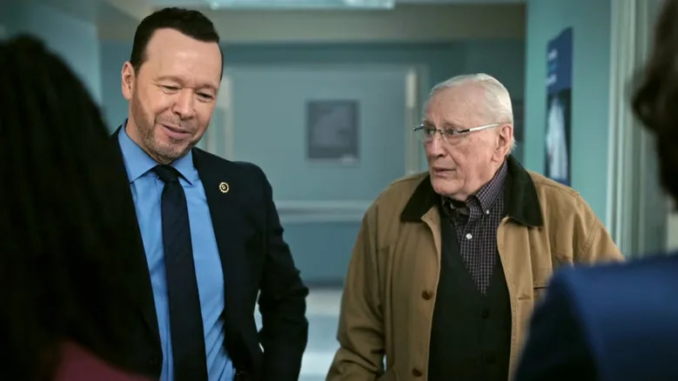
:max_bytes(150000):strip_icc()/donnie-wahlberg-blue-bloods-101624-1-d995696c901148d59e06242d9b965fa7.jpg)
Erin Reagan: A Crossroads of Power and Principle
Few characters have navigated internal conflict as consistently as Erin Reagan. As an assistant district attorney, she has often stood between loyalty to family and loyalty to the law.
With Boston Blue signaling broader institutional shifts, insiders suggest Erin’s arc may involve professional recalibration. Could she seek higher office? Step into a leadership role beyond what we’ve seen? Or confront a case that fundamentally challenges her prosecutorial philosophy?
Erin has always operated in the gray space between justice and family allegiance. Expanding that tension would allow the franchise to mature alongside its audience.
And fans are watching closely.
Why This Moment Feels Different
Unlike past seasons where renewal debates centered on contracts and ratings, this transition feels creative.
The original series, led by Tom Selleck as Frank Reagan, built its reputation on consistency — steady storytelling, grounded conflicts, and weekly moral dilemmas. But expansion demands reinvention.
A new city backdrop suggests new institutional politics, new departmental cultures, and new social climates. That inevitably affects every returning character.
The question isn’t whether change is coming.
It’s how far the franchise is willing to go.
The Business Behind the Drama
Long-running dramas face a delicate balance: honor legacy while courting new audiences. Moving into a spin-off format allows producers to preserve core themes without being confined to past formulas.
Franchise television thrives on familiarity with evolution. Viewers want the comfort of recognizable characters — but they also crave unpredictability.
By teasing updates about Jamie, Eddie, Henry, and Erin rather than offering immediate answers, producers are fueling anticipation while protecting narrative surprises.
It’s strategic. And it’s working.
Social Media Speculation Is Exploding
Within hours of producers hinting at these character developments, online discussions intensified. Fans are dissecting interviews, reading into phrasing, and debating which characters are most likely to relocate or undergo transformation.
Some believe Jamie could take on a leadership role in a different jurisdiction. Others speculate that Eddie’s independence may drive a professional divergence. Meanwhile, theories about Erin entering higher political office are gaining traction.
The silence on specifics has only amplified the noise.
A Legacy That Refuses to Fade
Few procedural dramas maintain cultural relevance for over a decade. Blue Bloods did so by anchoring itself in family — not just crime.
That’s why the uncertainty surrounding its next chapter feels personal to viewers. These characters aren’t interchangeable. They represent continuity in a constantly shifting television landscape.
And if Boston Blue succeeds, it won’t be because it abandons the Reagan ethos.
It will be because it challenges it.
End of an Era — Or Evolution of One?
So what does this all mean?
It means the Reagan story isn’t ending quietly. It’s recalibrating.
Jamie and Eddie’s future may test their unity. Henry’s legacy may face deeper scrutiny. Erin could step into uncharted territory that redefines her role within both family and system.
What began as a traditional procedural is now poised to confront transformation head-on.
And that transformation might be the boldest move the franchise has ever made.
The dinner table may look different.
The city skyline may change.
But the questions at the heart of this story — about justice, loyalty, and legacy — remain as powerful as ever.
The only certainty? The next chapter won’t be predictable.