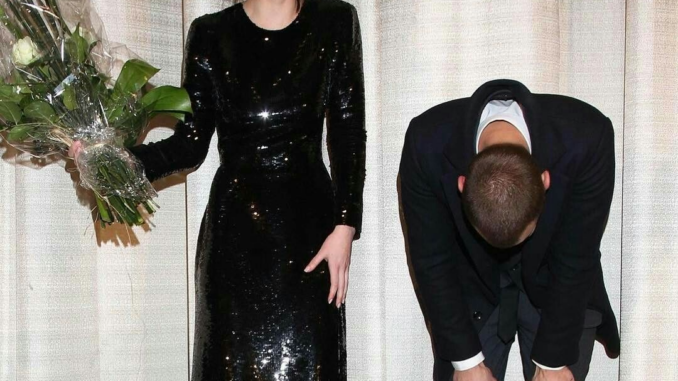
It was the laugh that launched a thousand conspiracy threads.
Behind the polished, brooding intensity of Fifty Shades of Grey, there were moments that felt almost absurd in their awkwardness. Silk sheets. Carefully choreographed blocking. Dozens of crew members standing just out of frame. And in the middle of it all, Jamie Dornan — the supposed embodiment of controlled dominance — reportedly breaking into giggles during some of the film’s most intimate takes.
Fans have spent years asking the same question: why?
Was it nerves? Immaturity? Discomfort? Or was it something more complicated — something emotional bubbling just beneath the surface?
To understand the giggle, you have to understand the environment.
Filming simulated intimacy is rarely “sexy.” It is technical, repetitive, and highly controlled. Actors hit marks. Adjust lighting. Repeat movements to match continuity. Between takes, robes go on, lighting is reset, camera angles shift. What appears on screen as breathless tension is often surrounded by cables, boom mics, and whispered direction.
In that kind of hyper-aware setting, laughter can be a release valve.
Jamie has spoken in past interviews about the surreal nature of filming those scenes. The choreography required. The clinical atmosphere. The pressure of knowing millions would later analyze every expression. For someone not accustomed to that specific genre, it can trigger nervous energy — and nervous energy often escapes as laughter.
Dakota Johnson, by contrast, has described immersing herself deeply into emotionally vulnerable headspaces for certain scenes. When one actor processes intensity internally and the other diffuses tension externally, the dynamic can look… mismatched.
But mismatch doesn’t equal disrespect.
In fact, some crew accounts over the years have suggested that laughter on set often helped prevent scenes from becoming psychologically overwhelming. When emotions are running high — especially in stories built around control, vulnerability, and power dynamics — a small break in tone can ground everyone back in reality.
Giggles can mean: This is just a movie.
Giggles can mean: We’re safe here.
Giggles can mean: Let’s not let this get too heavy.
Of course, the internet rarely settles for the simplest explanation.
Because chemistry between Jamie Dornan and Dakota Johnson was always electric — sometimes playful, sometimes tense, always layered — fans began reading the laughter differently. Was it suppressed attraction? Was he overwhelmed? Was it the awkwardness of blurred emotional lines?
Speculation thrives in ambiguity.
There were interviews where Dakota teased him. Press junkets where their banter felt razor-sharp. Moments of silence that fans labeled “loaded.” The narrative of something deeper became irresistible.
But actors often develop a shorthand that looks intimate from the outside. Shared eye contact. Inside jokes. Energy shifts only they fully understand. That doesn’t automatically translate to romance. Sometimes it’s simply professional trust forged under unusual circumstances.
Giggles can also be self-protection.
Imagine performing simulated intimacy in front of a room full of technicians while global media speculates about your personal life. Imagine knowing that any flicker of real emotion could become a headline. Humor becomes armor. It keeps things light. It keeps boundaries intact.
If anything, laughter suggests awareness — awareness of how strange the situation is. Awareness that what appears intense must remain contained.
The deeper question might not be why he giggled.
It might be how they managed to maintain believable chemistry despite the awkwardness.
Because whatever happened between takes — whether laughter, tension, or quiet recalibration — the camera captured something convincing. Something layered enough that audiences still debate it more than a decade later.
Was it nerves?
Almost certainly.
Was it something deeper?
Perhaps only in the sense that vulnerability, even simulated, affects people in unpredictable ways.
The giggle wasn’t proof of hidden scandal.
It was proof that behind the polished fantasy, two actors were navigating a bizarre, high-pressure situation in real time — human, imperfect, occasionally awkward.
And sometimes, when intensity becomes overwhelming, the most honest response is laughter.