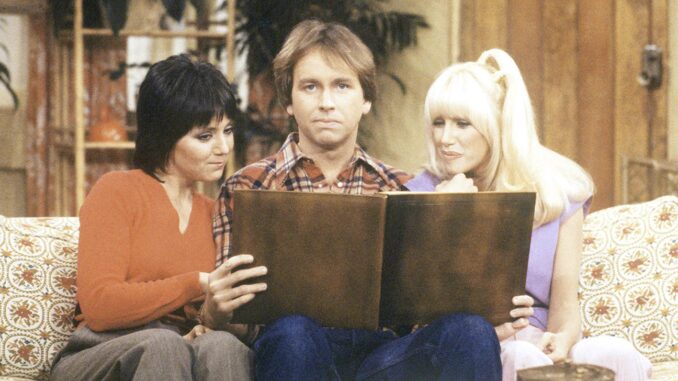
For eight hilarious seasons, Three’s Company ruled American television with its chaotic misunderstandings, romantic mix-ups, and the unforgettable chemistry between roommates Jack, Janet, and Chrissy. But when the beloved sitcom aired its final episode in September 1984, fans were left wondering: Why did such a successful show suddenly come to an end?
📉 The Real Reasons Behind the Cancellation
Despite its popularity, several behind-the-scenes issues slowly pushed the series toward its inevitable finale:
1. Cast Conflicts That Changed Everything
One of the earliest turning points came when actress Suzanne Somers left the show in 1981 after a highly publicized salary dispute with network executives. She reportedly asked for equal pay to co-star John Ritter — and was written out when negotiations broke down.
Many critics later argued that her departure marked “the beginning of the end” for the show’s original magic.
2. Creative Fatigue After 8 Seasons
By the mid-1980s, the sitcom format that once felt bold — centered on a man pretending to be gay so he could live with two women — had begun to feel repetitive. Writers increasingly recycled slapstick gags and double-entendre humor, signaling that the show had largely run its course after 172 episodes.
3. A Planned Transition to a Spin-Off
Rather than an abrupt cancellation, ABC actually ended the series to launch a new spin-off titled Three’s a Crowd, which followed Jack’s life after moving out of the apartment. The final episode of Three’s Company was even structured to lead directly into this new chapter.
In other words: the show didn’t just fail — it evolved, but audiences weren’t ready to let go of the original trio dynamic.
📺 Would an Updated Version Be Popular Today?
Surprisingly… maybe yes — but only with major changes.
Modern audiences are now far more open to unconventional living arrangements, gender identity themes, and relationship-based comedy — topics that Three’s Company once approached only through misunderstanding-driven humor.
A reboot today could succeed by:
-
Replacing outdated stereotypes with authentic LGBTQ+ representation
-
Updating the roommate dynamic for urban Gen Z living culture
-
Focusing more on emotional storytelling than slapstick misunderstandings
-
Exploring dating apps, gig economy struggles, and modern friendships
Ironically, the very premise that once shocked 1970s audiences could feel perfectly normal in 2026 — making a revival more socially relevant than ever.
⭐ Final Verdict
Three’s Company wasn’t cancelled because people stopped loving it — it ended because television (and its cast) had changed.
But in an age of reboots and nostalgic revivals, a smartly reimagined version might just turn that classic apartment into TV’s hottest address once again.