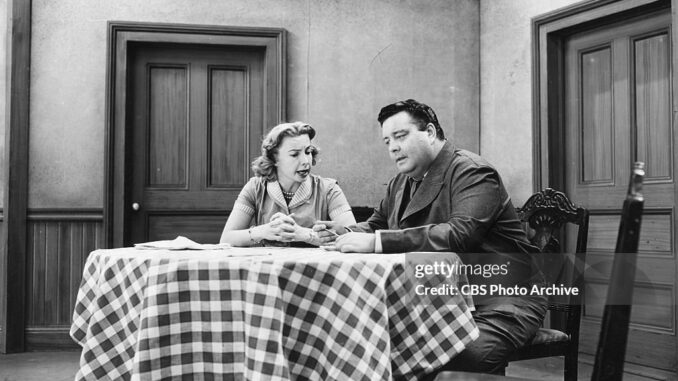
In the early days of television, actors were expected to show up, say their lines, and be grateful for the opportunity.
Negotiating power?
Demanding long-term security?
Thinking like a businessperson?
That was almost unheard of — especially for a young actress stepping into a major role.
But when Audrey Meadows was cast in The Honeymooners, she did something that would ripple through television history.
She refused to think like just an actress.
She thought like an owner.
And the studio never saw it coming.
The Role That Almost Went to Someone Else
Believe it or not, Meadows wasn’t the first choice to play Alice Kramden.
Producers initially doubted whether she could embody the sharp, grounded wife needed to balance the explosive energy of Ralph Kramden. To them, she seemed almost too polished — not quite the working-class presence they imagined.
So Meadows did something bold.
She deliberately toned down her glamour during auditions, presenting herself as more practical and relatable. It worked.
She landed the role.
But the smartest move of her career was still ahead.
The Contract Trick That Shocked Executives
At the time, television contracts were simple — and often unfair.
Actors were typically paid per episode with little protection if a show exploded in popularity. Studios held the power, the profits, and the future.
Most performers accepted that reality.
Audrey Meadows didn’t.
Before signing her contract, she reportedly hired a sharp legal team and inserted a clause that few actors even thought to request:
👉 Residual payments.
If the show were ever rebroadcast, she would continue earning money.
Today, that sounds normal.
In the 1950s?
It was revolutionary.
Studio executives allegedly assumed reruns wouldn’t become a major business. Television was still young — who would want to watch the same episode twice?
History, of course, had other plans.
The Decision That Made Her a Fortune
When The Honeymooners entered syndication, the show found new generations of viewers… again and again.
And thanks to that single contract clause, Meadows kept getting paid.
While many actors from early television saw little financial reward after their shows ended, Meadows benefited from the very future others failed to predict.
Industry insiders would later point to her deal as one of the earliest examples of performers protecting their long-term value.
In other words:
She didn’t just act in television history.
She helped reshape it.
More Than Just a Smart Contract
What makes this story even more compelling is how perfectly it mirrors Alice Kramden herself.
On screen, Alice was observant, practical, and nearly impossible to outmaneuver.
Off screen?
Audrey Meadows proved she possessed those very same qualities.
At a time when many actresses were underestimated, she demonstrated something powerful:
Preparation creates leverage.
And leverage creates freedom.
Why Her Move Was So Groundbreaking
Today, profit participation and residual structures are standard conversation points in entertainment deals.
But someone has to be early.
Someone has to challenge the system before the system changes.
Meadows recognized something others missed:
Television wasn’t temporary.
It was forever.
Once recorded, a performance could live on indefinitely — generating value long after the cameras stopped rolling.
That insight placed her years ahead of the industry.
The Quiet Power Move No One Talks About Enough
Audrey Meadows rarely framed herself as a trailblazer.
She simply made a smart decision.
Yet her foresight helped normalize the idea that actors weren’t just talent — they were stakeholders in the success they helped create.
And perhaps the most remarkable part?
She accomplished all this without scandal, without public battles, and without burning bridges.
Just strategy.
Just intelligence.
Just timing.
Final Thought
Hollywood history often celebrates the loud rebels — the rule-breakers who forced change through confrontation.
But sometimes, the people who transform an industry do it quietly… with a pen in hand instead of a protest.
Audrey Meadows didn’t just secure her future.
She sent a message that still echoes through entertainment contracts today:
Know your worth — and make sure the paperwork reflects it.
Because every once in a while, a single signature doesn’t just change a career.
It changes the business forever.