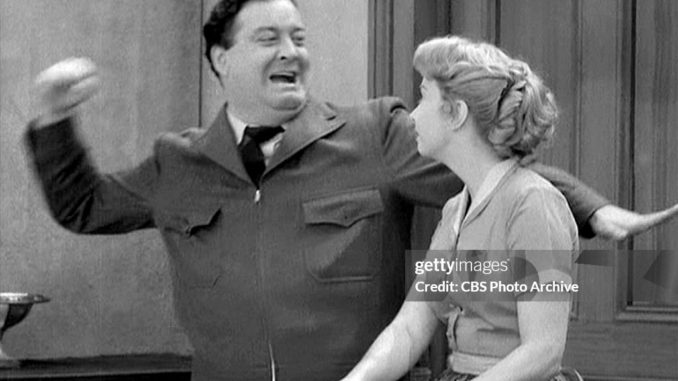
Some TV couples are easy to define. They’re either romantic ideals or obvious disasters.
And then there’s Ralph and Alice Kramden — a marriage that has made audiences laugh for nearly seventy years… while quietly making some viewers wonder:
“Wait — is this relationship actually unhealthy?”
It’s the kind of question people didn’t ask much in the 1950s. But today? Fans are looking back with sharper eyes — and the answers aren’t as straightforward as you might expect.
A Love Story That Was Never Polished
From the very first episode, the show made one thing clear: this was not a fairy-tale marriage.
Ralph, brought to life by Jackie Gleason, is loud, emotional, and often driven by pride. When life doesn’t go his way, the tiny apartment walls practically vibrate with his frustration.
Money is tight.
Dreams fall apart.
Tempers flare.
Yet Alice never disappears into the background.
Portrayed by Audrey Meadows, she doesn’t just respond — she anchors the entire relationship.
Instead of backing down, Alice meets Ralph’s storms with something far more powerful:
composure.
And sometimes, a perfectly timed sarcastic remark.
But Here’s Where Modern Viewers Pause…
Watch the show today and certain moments hit differently.
The shouting feels louder.
The arguments feel longer.
The power struggles feel more noticeable.
It raises a natural question:
Would audiences accept this dynamic if the show premiered now?
Maybe not without debate.
But stopping the analysis there misses something important — because what looks harsh on the surface often softens when you watch a little longer.
The Detail People Forget
Ralph may explode, but the story rarely lets him stay on that pedestal for long.
Again and again, episodes peel back his bluster to reveal something unexpectedly tender:
-
A quiet apology
-
A bruised ego hiding embarrassment
-
A husband who hates disappointing his wife
-
A dreamer terrified of being ordinary
And Alice? She always sees straight through him.
Not with fear.
Not with submission.
But with understanding.
Their marriage isn’t built on intimidation.
It’s built on emotional endurance.
Not Toxic — Just Extremely Human?
Here’s the fascinating part: what unsettles some modern viewers is exactly what made the show revolutionary.
During an era when many sitcom wives were written as agreeable and soft-spoken, Alice was neither.
She challenged her husband.
Corrected him.
Outsmarted him.
In many ways, she quietly held the real power in the relationship — something audiences of the time immediately recognized.
So rather than portraying a fragile marriage, the show may have been presenting something far more progressive:
A partnership where conflict didn’t signal collapse.
It signaled honesty.
Because real relationships aren’t silent.
They’re messy.
They’re emotional.
Sometimes they’re exhausting.
And yet — they endure.
Why This Marriage Still Feels So Familiar
Decades have passed, but the core tension of Ralph and Alice’s relationship hasn’t aged nearly as much as you’d expect.
Who hasn’t:
-
Said something in frustration?
-
Worried about money?
-
Dreamed bigger than reality allowed?
-
Needed forgiveness after a bad moment?
Underneath every argument is something unmistakable:
They never stop choosing each other.
That’s the detail that transforms the noise into warmth.
So… Toxic or Timeless?
Maybe the reason this question refuses to fade is because the marriage refuses to fit neatly into a box.
It isn’t gentle enough to be a fantasy.
It isn’t dark enough to be tragic.
Instead, it lives in that complicated space most real couples recognize — somewhere between irritation and devotion.
And perhaps that’s the real magic of The Honeymooners.
It didn’t show audiences a perfect love.
It showed them a durable one.
Final Thought
If Ralph and Alice teach us anything, it’s this:
A strong marriage isn’t defined by the absence of conflict — but by the ability to find your way back to each other afterward.
Not polished.
Not idealized.
But deeply real.
And maybe that’s why, all these years later, viewers are still watching… still laughing… and still asking the same irresistible question:
Was their love chaotic — or simply honest?
Because sometimes, the relationships that look the loudest on the outside
are the ones rooted most firmly in loyalty.