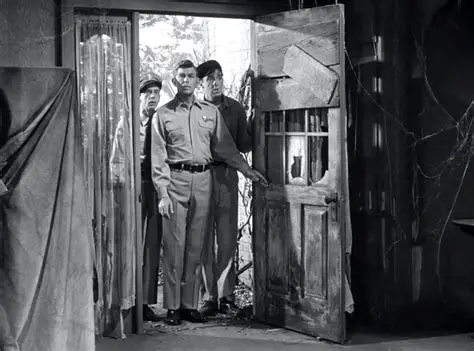
For most viewers, The Andy Griffith Show represents comfort — a television world where problems are small, neighbors are friendly, and Sheriff Andy Taylor always restores order before the credits roll. Fear simply doesn’t belong in a place like Mayberry.
Yet one episode quietly challenged that expectation.
“The Haunted House” remains one of the most unusual stories the series ever told — not because it turned the sitcom into horror, but because it proved how easily fear can take hold even in the safest communities.
A Town Built on Calm — Disturbed by a Rumor
The mystery begins with a simple accident: a baseball lands on the property of the long-abandoned Rimshaw House. What should have been a minor inconvenience quickly becomes something larger, because the house already carries a reputation.
No one goes near it.
No one knows who last lived there.
And everyone seems to have heard a story.
In small towns, information travels quickly — but certainty does not. The less people know, the more space imagination has to grow.
Soon, the question is no longer whether someone will retrieve the ball.
The question becomes:
What if the stories are true?
How the Episode Carefully Builds Suspense
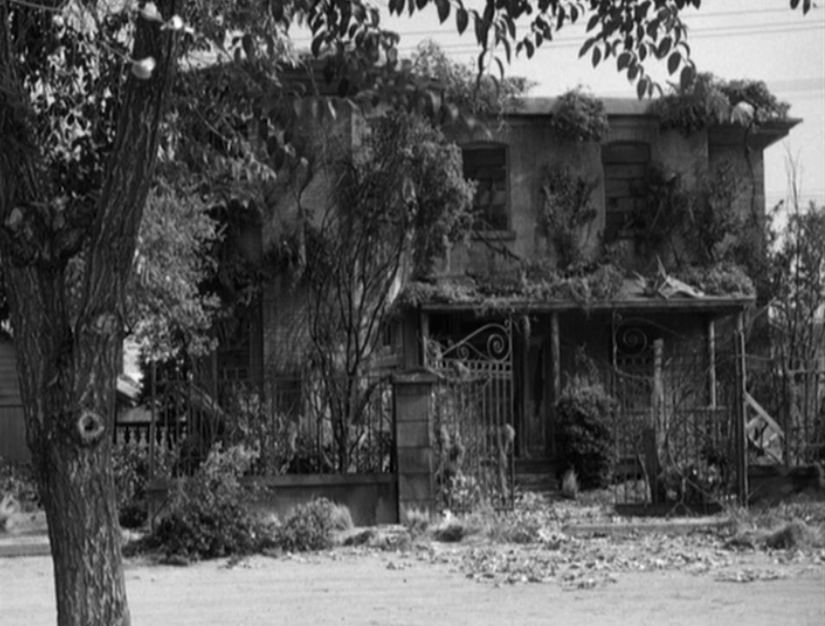
What makes this installment remarkable is its restraint. Instead of relying on dramatic scares, the tension grows through subtle details:
-
unexplained noises echo through empty rooms
-
shadows distort familiar shapes
-
objects seem slightly out of place
-
the house feels occupied, yet no one appears
None of these elements are overwhelming on their own. Together, however, they create psychological unease — the kind that invites viewers to lean closer to the screen.
Importantly, the fear never feels exaggerated. It unfolds exactly the way real fear does: gradually, socially, and persuasively.
Once a few people become nervous, others begin noticing things they might otherwise ignore.
Fear, after all, is often a shared experience.
Sheriff Andy Taylor: The Voice of Reason
Every strong mystery needs a steady presence, and Andy Taylor fulfills that role perfectly.
Rather than reacting emotionally, he observes patterns. He listens more than he speaks. While others speculate about ghosts, Andy focuses on evidence.
This contrast drives the episode forward:
Emotion vs. logic
Rumor vs. observation
Imagination vs. reality
The structure is simple but effective — viewers are pulled between the thrill of the unknown and the quiet confidence that reason will eventually prevail.
The Reveal: Not Supernatural — But Very Human
When the truth emerges, it reframes everything that came before.
The haunting was staged.
Strange sounds, eerie signals, and ghostly rumors were intentionally created to scare people away from illegal activity hidden inside the house. What appeared mysterious was actually strategic.
This twist works particularly well because it doesn’t mock the characters for being afraid. Instead, it acknowledges a universal truth:
👉 When context is missing, the human mind fills the gap — often with the worst possibilities.
The episode transforms from a ghost story into something more thoughtful: a commentary on perception.
Why This Episode Still Stands Out Decades Later
Many sitcoms succeed by staying within predictable emotional boundaries. The Andy Griffith Show occasionally succeeded by stepping just outside them.
“The Haunted House” is memorable for several reasons:
1. Tonal Courage
The writers allowed a famously gentle show to experiment with suspense without losing its identity.
2. Psychological Realism
The fear feels believable because it grows from suggestion rather than spectacle.
3. Timeless Insight
Even today, rumors spread quickly, assumptions shape reactions, and people often accept emotional explanations before rational ones.
In that sense, the episode feels surprisingly modern.
More Than Entertainment — A Quiet Lesson
By the end, Mayberry returns to normal. The streets are calm again, the mystery solved, the illusion dismantled.
But the story leaves behind an idea worth remembering:
The unknown is rarely as dangerous as the stories we attach to it.
True leadership — the kind Andy models — is not about eliminating fear instantly. It is about slowing down, asking questions, and guiding others back toward clarity.
That message is part of what has allowed The Andy Griffith Show to endure across generations.
Not every lesson needs urgency.
Not every mystery needs darkness.
Sometimes, all it takes is a steady voice reminding us to look a little closer.
And perhaps that is the quiet brilliance of this episode:
For a brief moment, Mayberry let viewers feel uncertainty — only to show them that understanding is never far away for those willing to search for it.