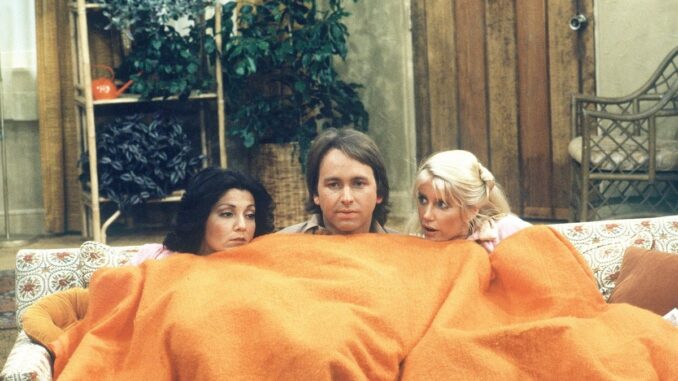
Decades after it first aired, Three’s Company is being rediscovered by a new generation of viewers — and many are shocked by what they see.
What once felt like innocent slapstick comedy now appears, through modern eyes, to be one of the most sexually charged sitcoms of its era. A growing number of fans rewatching the series as adults are asking the same provocative question: Were the characters a little more than just “friends”?
📺 A Sitcom Full of Physical Intimacy
On a recent rewatch, viewers have noticed how frequently the characters engage in physical closeness. Playful grabbing, long hugs, flirtatious touching, and casual kissing are common throughout the series.
Jack Tripper, in particular, crosses lines that would raise eyebrows today. On-screen, he kisses both Janet and Chrissy on multiple occasions — not as jokes, but as moments played straight within the story.
Despite the show’s constant insistence that they are “just roommates,” the physical chemistry often suggests something looser, more complicated, and far less innocent.
🌈 The 1970s Context: Sexual Liberation on TV
To understand Three’s Company, it’s impossible to ignore the era in which it was made.
The late 1970s marked a period of cultural and sexual liberation in America. Television began pushing boundaries, reflecting changing attitudes toward relationships, cohabitation, and sexuality. Three’s Company was controversial from the start — built entirely around misunderstandings, innuendo, and suggestive humor.
In that context, the show’s flirtation-heavy tone wasn’t accidental. It was part of a broader movement that blurred the line between propriety and provocation, all while staying just safe enough for network television.
🤔 A “Loose Arrangement” in the Sitcom Universe?
Many fans now speculate that within the fictional universe of the show, Jack, Janet, and Chrissy may have shared an unspoken understanding — a relaxed, undefined relationship dynamic that the series could never openly acknowledge.
The constant intimacy, emotional closeness, and absence of serious boundaries make it easy for modern viewers to imagine a far more complex off-screen reality within the story world.
While nothing explicit is ever shown, the implication is often strong enough to fuel endless debate.
😂 Comedy Then, Eye-Opening Now
What once flew under the radar now feels bold, even shocking. Yet that contrast is part of what keeps Three’s Company relevant today.
The show remains a fascinating time capsule — not just of comedy, but of how far television has come in portraying relationships honestly.
Whether viewers see it as harmless fun or a surprisingly risqué classic, one thing is clear:
Three’s Company wasn’t just about misunderstandings — it was about pushing limits, wrapped in laughter.