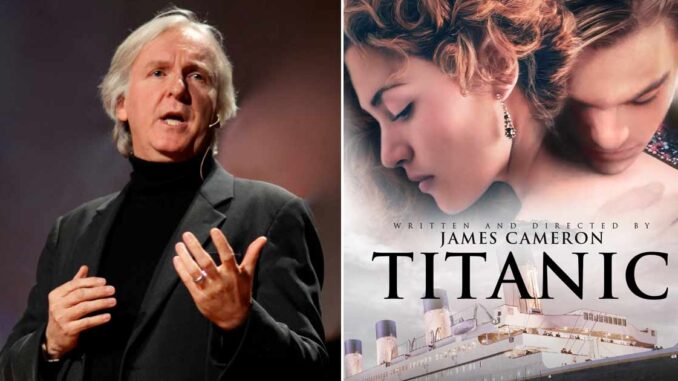
🌊 The Ghost of the Unsinkable: Why We’re Still Obsessed
Can you believe it’s been nearly three decades since Jack Dawson told Rose DeWitt Bukater that he’d never let go? Fast forward 29 years, and we are still obsessed with that ship. But I’m not talking about the historical tragedy of 1912—I’m talking about the cinematic “war zone” of 1996. While Titanic went on to win 11 Oscars and break every box office record in existence, the journey to the big screen was anything but smooth sailing.
In Hollywood, we often see the glitz and glamour of the red carpet, but we rarely see the blood, sweat, and literal tears that go into a production of this magnitude. As we hit the 29-year milestone, new testimonies from crew members and updated memoirs from the stars have pulled back the curtain on some truly dark secrets. From mass poisonings to near-drowning experiences, the set of Titanic was a pressure cooker that almost exploded. Let’s dive deep into the murky waters of the production that James Cameron famously called “a logistical nightmare.”
📽️ James Cameron: The Captain Who Refused to Sink
To understand the darkness of the Titanic set, you have to understand the man at the helm. James Cameron isn’t just a director; he’s a force of nature. In the mid-90s, the industry thought he was insane. The budget was ballooning past $200 million, the trades were calling it “the biggest flop in history,” and Cameron was feeling the heat.
The “Dictator” of the Deep
Crew members often described Cameron as a demanding, uncompromising perfectionist. He didn’t just want a movie; he wanted a digital and physical resurrection of the ship. This meant 14-hour workdays, often in waist-deep water.
-
The Screaming Matches: It was common knowledge that if you messed up a shot, you’d face the “Cameron Wrath.”
-
Safety vs. Spectacle: While safety protocols were technically in place, the sheer scale of the stunts—like the ship breaking in half—put everyone on edge.
H3: The Extreme Physical Toll on the Cast
Kate Winslet and Leonardo DiCaprio weren’t just acting; they were surviving. Kate famously refused to wear a wetsuit under her thin dress because she wanted her reactions to the cold water to be authentic. The result? She ended up with pneumonia.
🥣 The Great PCP Chowder Incident: A Real-Life Horror Story
If you think the movie was dramatic, wait until you hear about the night the entire crew was drugged. Yes, you read that right. In one of the most bizarre “dark secrets” of Hollywood history, someone spiked the lobster chowder with PCP (Angel Dust) during filming in Nova Scotia.
A Night of Pure Chaos
Over 60 people, including James Cameron and many crew members, were rushed to the hospital. Imagine the scene: world-class filmmakers suddenly experiencing hallucinations, some laughing hysterically, others paralyzed with fear.
-
The Aftermath: Bill Paxton later recalled that people were doing “conga lines” in the ER.
-
The Mystery: To this day, the culprit has never been caught. Was it a disgruntled caterer? A prank gone wrong? The secret remains buried, but it added a layer of paranoia to an already stressed set.
🥶 The Illusion of Warmth: The Cold Truth About the Tanks
People always ask, “Was the water really that cold?” The answer is a complicated “yes and no.” While the massive tanks in Rosarito, Mexico, were technically heated, the air temperature and the sheer amount of time spent submerged led to a constant state of hypothermia for the actors.
H3: The “Peed in the Tank” Confession
Kate Winslet has been refreshingly honest over the years. She admitted that because it took so long to get out of the water and out of her costume to go to the bathroom, she (and many others) eventually just “relieved” themselves in the tank. When you’re filming a romantic scene in a pool of water that’s basically a communal toilet, the “glamour” of Hollywood disappears pretty quickly, doesn’t it?
H4: Near-Fatal Stunts
During the scene where Rose is trapped behind a gate as the water rises, Kate Winslet’s heavy coat got snagged. She was pulled underwater and nearly drowned. She had to scramble out of the coat to reach the surface. Cameron’s reaction? “Let’s go again.” That “the show must go on” attitude is what made the movie great, but it’s also what made the set a dark place to work.
💰 The Budget That Haunted the Studio
In 1996, $200 million was an astronomical amount of money. Fox and Paramount were terrified. The “dark secret” here isn’t a scandal, but a financial desperation that fueled the tension on set.
-
The Death Watch: Journalists actually set up “death watches” near the set, waiting for the production to fail.
-
Cameron’s Salary: To appease the studio, James Cameron famously gave up his $8 million salary and his share of the profits just to keep the cameras rolling. (Don’t worry, he made it all back and then some once the movie hit $2 billion).
🎭 The Mental Strain: Why Leo Almost Quit
Leonardo DiCaprio was a rising indie darling before Titanic. He wasn’t used to the “blockbuster” machine. The repetitive nature of the shoot—filming the same sinking sequences over and over—wore him down.
H3: The Boredom of Perfection
Leo reportedly found the technical aspects of the shoot incredibly tedious. He would often play pranks or act out just to break the monotony of standing in a green-screen tank for hours. There were moments where he questioned if he even wanted to be a “movie star” if this was what it required.
The Bond Between Kate and Leo
The only thing that kept the set from descending into total misery was the friendship between the two leads. They became each other’s support system. They would huddle together for warmth, share jokes to stay sane, and protect one another from the more demanding aspects of the production.
🏗️ The Massive Reconstruction: A Feat of Engineering
To film the sinking, Cameron built a 775-foot replica of the ship in a 17-million-gallon tank.
This wasn’t just a set; it was a functioning piece of heavy machinery. The “dark” side of this was the sheer danger of moving parts. When the ship tilted to a 90-degree angle, actors were actually falling and sliding down the deck. While they had pads and safety cables, the risk of a cable snapping or a person hitting a hard edge was a constant shadow over the crew.
🌑 The Long-Term Impact: Post-Titanic Stress
After the movie wrapped, many crew members didn’t move on to other projects right away. They needed time to recover. The intensity of the “Titanic War” left people emotionally drained.
H3: The Environmental Cost
The construction of the Fox Baja Studios in Mexico had a significant impact on the local coastline. While it brought jobs, it also altered the local ecosystem. This is a “dark secret” that Hollywood rarely discusses—the physical footprint left behind by our favorite blockbusters.
H4: The Legacy of James Cameron’s Style
The success of Titanic validated Cameron’s “tough love” style of directing. It set a precedent for how big-budget movies are made, for better or worse. It proved that if you push people to their absolute breaking point, you might just create a masterpiece. But is the human cost worth the 11 Oscars? That’s a question only the crew can answer.
🌟 Reflections 29 Years Later
Looking back, the secrets of the Titanic set remind us that art is rarely pretty in the making. The movie is a story about a tragedy, and in many ways, the filming was a series of mini-tragedies and triumphs. We see the beautiful lighting and the sweeping music, but we don’t see the pneumonia, the PCP-spiked soup, or the fear in an actor’s eyes when a stunt goes wrong.
Does knowing these secrets ruin the movie? I don’t think so. If anything, it makes the final product more impressive. It shows the sheer human will required to pull a story like that out of the depths of the ocean and onto our screens.
Conclusion
As we mark 29 years since the production of Titanic, the revelations of the “dark secrets” from the set only serve to deepen our appreciation for the film. It was a production plagued by extreme weather, a “dictatorial” director, a bizarre mass poisoning, and physical hardships that would have broken a lesser cast. Yet, out of that chaos emerged a cinematic icon. The set of Titanic was a microcosm of the ship itself—ambitious, dangerous, and ultimately, unforgettable. It reminds us that behind every “unsinkable” success story lies a sea of struggles that the world was never supposed to see.
❓ 5 Unique FAQs After The Conclusion
Q1: Who actually spiked the chowder with PCP?
A1: To this day, the person responsible has never been identified. The investigation by local police in Nova Scotia eventually went cold, leaving it as one of Hollywood’s greatest unsolved mysteries.
Q2: Did Kate Winslet really get pneumonia during filming?
A2: Yes, she suffered from hypothermia and eventually developed pneumonia due to the prolonged hours spent in cold water without a wetsuit. She has often spoken about how physically taxing the role was.
Q3: Was James Cameron really as mean as people say?
A3: “Mean” might be a strong word, but he was undeniably intense. Most crew members describe him as a perfectionist who had a “short fuse” when things didn’t go exactly as planned, especially given the high stakes of the budget.
Q4: How much of the ship was actually built?
A4: A nearly full-scale replica (about 90% of the actual size) was built in Rosarito, Mexico. It was mounted on hydraulic lifts so it could be tilted and sunk into the massive water tank.
Q5: Why did Leonardo DiCaprio almost turn down the role of Jack?
A5: Leo was looking for more “challenging” or “edgy” roles at the time. He initially thought Jack Dawson was too simple or “boring.” It took significant convincing from James Cameron to make him see the complexity in Jack’s optimism.