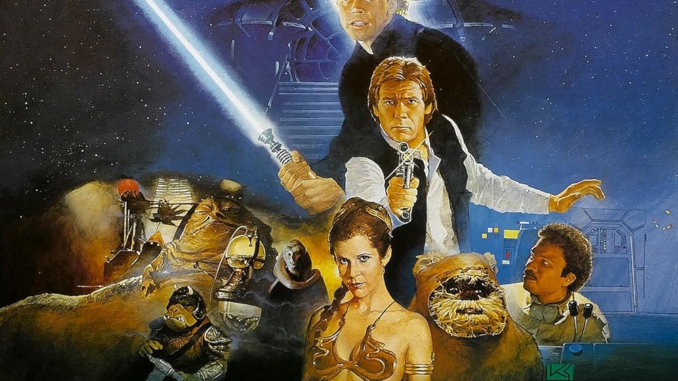
Return of the Jedi is more than the conclusion of the original Star Wars trilogy—it is the emotional payoff of a journey that began with rebellion, loss, and belief in the impossible. Released in 1983, the film delivers a finale that balances epic spectacle with deeply human themes, proving that Star Wars was never just about space battles, but about redemption, family, and the power of hope.

At its core, the story is driven by Luke Skywalker’s final confrontation with Darth Vader and Emperor Palpatine. Unlike the earlier films, Luke’s greatest weapon is not his lightsaber, but his refusal to surrender to hatred. His belief that there is still good in his father transforms the narrative from a simple battle between good and evil into a powerful meditation on choice and forgiveness. Vader’s redemption is not sudden or flashy—it is earned, painful, and profoundly emotional, culminating in one of cinema’s most unforgettable acts of self-sacrifice.
The film’s parallel conflict—the Rebel Alliance’s desperate assault on the second Death Star—raises the stakes to their highest point. As space battles rage and ground forces fight against overwhelming odds, Return of the Jedi reinforces a central idea of the saga: even the smallest acts of courage can change the fate of the galaxy. Victory is not achieved through superior power, but through unity, trust, and sacrifice.
What makes the ending truly iconic is its emotional resonance. The fall of the Emperor, the quiet moment between Luke and his redeemed father, and the final celebration across the galaxy all serve as a reminder that light does not erase darkness—it overcomes it. The final image of Luke seeing the spirits of those who came before him is not just a visual triumph, but a symbolic passing of legacy, affirming that hope endures beyond any single generation.
Return of the Jedi succeeds because it closes its story with sincerity and heart. It reminds audiences that no one is ever beyond saving, that family can be rebuilt, and that even in the darkest moments, choosing compassion can reshape the future.
More than four decades later, the film’s message remains timeless: the light always has a chance to win—if someone is brave enough to believe in it.