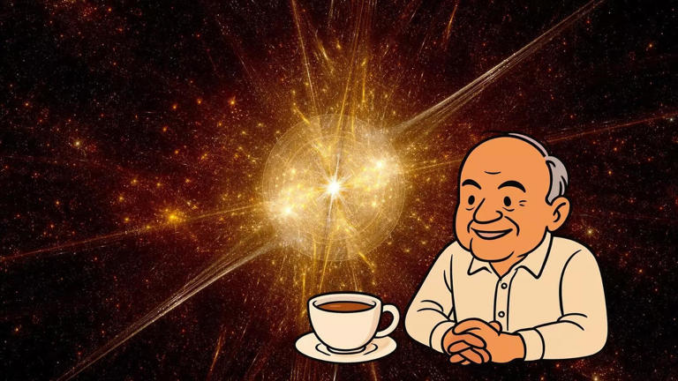
When renowned astrophysicist Jayant Vishnu Narlikar questioned the Big Bang theory, he didn’t do it with equations alone. He did it with tea.
“Chai took longer,” he once remarked—a deceptively simple line that captured his lifelong skepticism toward the idea that the universe burst into existence all at once. For Narlikar, the Big Bang felt too sudden, too tidy, and uncomfortably close to a creation story.
The Big Bang theory, which says the universe began 13.8 billion years ago from an impossibly hot, dense point, is backed by powerful evidence: expanding galaxies, the cosmic microwave background, and the abundance of light elements. Most scientists accept it as the best explanation we have.
Narlikar wasn’t convinced.
To him, a theory that begins where physics breaks down isn’t a true explanation—it’s a placeholder. He also bristled at the idea’s philosophical undertones, noting its religious parallels and the fact that it was first proposed by a Catholic priest, Georges Lemaître, and later endorsed by the Vatican. Science, he believed, should not rely on beginnings that resemble miracles.
Instead, Narlikar—working with Fred Hoyle—developed the Quasi-Steady State Cosmology, which argued that the universe has always existed. It expands slowly, renewing itself through small bursts of matter creation, without a single moment where everything begins and logic fails.
His ideas never replaced the Big Bang. But that wasn’t the point.
Narlikar stood for something more enduring: the right—and responsibility—of science to question itself. To doubt popular answers. To ask whether there might be another way to understand the universe.
In his view, the cosmos didn’t explode into being.