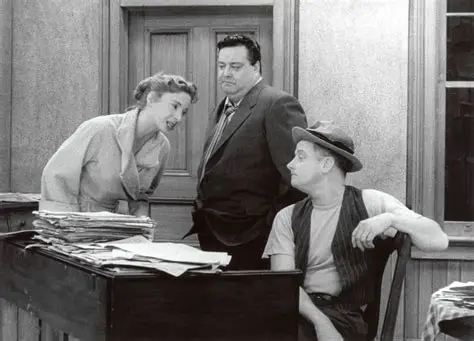
When people think of The Honeymooners, they picture a sparse, one-room apartment, a broken-down stove, and a bus driver struggling to make ends meet. But behind that “poor” aesthetic was a record-breaking financial investment that left Hollywood executives shaking in their boots.
In 1955, Jackie Gleason signed a contract that didn’t just break the bank—it rewrote the rules of the TV industry.
1. The “Big Three” Deal: $6,110,000 for One Show
At a time when you could buy a brand-new house for $10,000, Jackie Gleason signed a deal with Buick and CBS for a staggering $6,110,000.
-
The Context: This was for 78 half-hour episodes (though only 39 “Classic 39” were produced in that first legendary run).
-
Today’s Money: In 2026 dollars, that is the equivalent of roughly $72 million.
-
The Risk: No variety show star had ever pivoted to a filmed sitcom with that much upfront capital. The producers were essentially betting the entire network’s future on Ralph Kramden’s “Get Rich Quick” schemes.
2. The Electronicam: A High-Tech Money Pit
Why was the show so expensive? It wasn’t just Gleason’s salary. It was the technology.
Gleason hated doing multiple takes; he wanted the energy of a live audience. To capture this, the production used a revolutionary (and incredibly expensive) system called the DuMont Electronicam.
This system combined a live TV camera with a 35mm film camera. It allowed the show to be broadcast like a live play while simultaneously recording high-quality film for syndication. The maintenance and operation costs of these cameras were astronomical for the mid-50s.
3. Paying the “Great One”
Jackie Gleason wasn’t just the star; he was the creator and the boss. Out of that $6 million investment, Gleason’s production company, Peekskill Productions, took a massive cut.
-
Cast Salaries: While Gleason was making a fortune, his co-stars had to fight for theirs. Art Carney (Ed Norton) was paid well, but Audrey Meadows (Alice) famously had to have her lawyer insert a “residuals clause” in her contract—a move that made her a multi-millionaire later in life, as the show never stopped airing.
4. The “Set” That Cost a Fortune to Look Cheap
Ironically, the producers spent a lot of money making the Kramden apartment look like it was worth zero dollars. The “shabby” look was intentional, but the logistics of filming in front of a live audience at the Adelphi Theatre in New York required a massive crew, high-end lighting rigs, and a full orchestra.
Was the Investment Worth It?
At the time, the show actually dropped in the ratings compared to Gleason’s previous variety show, and Buick eventually pulled its massive sponsorship.
However, the long game paid off. Because the producers invested in high-quality 35mm film (the “Classic 39”), the show became the “King of Syndication.” Those 39 episodes have been running for 70 years, generating hundreds of millions of dollars in ad revenue—making that original $6 million look like a bargain.