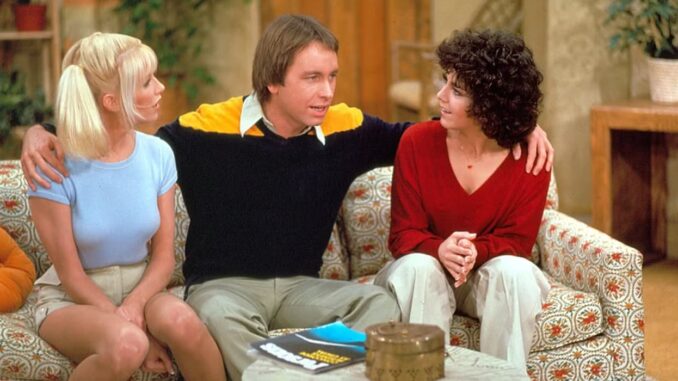
More than four decades after its debut, Three’s Company remains one of the most recognizable and rewatched sitcoms in television history. Premiering on ABC in 1977, the series transformed a simple living-together premise into a cultural phenomenon built on physical comedy, sharp misunderstandings, and unforgettable performances.
A Simple Premise That Works Brilliantly
The story centers on Jack Tripper, a culinary student who shares an apartment with two single women, Janet Wood and Chrissy Snow, in Santa Monica. To satisfy their conservative landlord’s rules against mixed-gender roommates, Jack pretends to be gay. This single lie becomes the engine for nearly every episode, fueling a constant stream of misunderstandings, near-discoveries, and comedic chaos.
What sets Three’s Company apart is how effectively it stretches this premise without exhausting it. Each episode introduces new variations, keeping the humor fresh and fast-paced.
John Ritter’s Defining Performance
At the heart of the show is John Ritter, whose portrayal of Jack Tripper is widely regarded as one of the greatest comedic performances in television. Ritter’s mastery of physical comedy—falls, double-takes, frantic gestures—elevated everyday situations into memorable moments. His timing and expressiveness allowed scenes to remain funny even with minimal dialogue, making him the undisputed centerpiece of the series.
Humor That Transcends Its Era
Although firmly rooted in late-1970s and early-1980s America, Three’s Company continues to resonate with modern audiences. The comedy relies less on topical references and more on universal themes: miscommunication, social awkwardness, and the tension between public image and private truth. This timeless approach explains why the series remains accessible to new viewers today.
Cultural Impact and Legacy
Beyond ratings success, Three’s Company influenced generations of sitcoms that followed. Its use of farce, ensemble chemistry, and situational misunderstandings became a blueprint for later comedies. The show also subtly reflected changing social attitudes of its time, particularly around gender roles and cohabitation, making it more than just light entertainment.
Why Three’s Company Is Still Worth Watching
-
It delivers concise, fast-moving episodes with consistent humor
-
The performances, especially John Ritter’s, remain unmatched
-
It offers insight into the evolution of modern sitcom storytelling
-
It provides reliable, uncomplicated entertainment
Conclusion
Three’s Company endures because it understands the fundamentals of comedy: strong characters, precise timing, and situations that escalate naturally into absurdity. Whether discovered for the first time or revisited years later, the series continues to prove that truly effective sitcoms never lose their appeal.