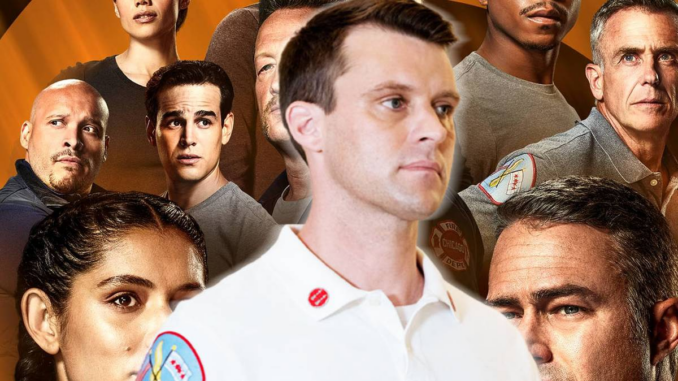
The roar of the engines and the glare of the flashing lights at Firehouse 51 remain as constant as ever, but for many long-term viewers of Chicago Fire, there is a persistent, hollow ache that no amount of high-octane action can quite soothe. It has been years since Jesse Spencer officially hung up Captain Matthew Casey’s turnout gear to move to Oregon, yet his absence continues to cast a long, complicated shadow over the series. As the show pushes forward into its mid-2020s era, a fundamental question remains at the heart of the fandom’s discourse: can the series ever truly recover from the loss of its moral compass, or did Spencer’s departure mark the beginning of an irreversible decline in the show’s original soul?
To understand why the pain of Jesse Spencer’s exit is so lingering, one must recognize that Matthew Casey was never just a character; he was the show’s psychological anchor. While Kelly Severide represented the adrenaline and the maverick spirit of the firehouse, Casey represented its conscience and its stability. He was the “Boy Scout” who led with a quiet, firm dignity, providing a necessary counterweight to the more volatile personalities in the house. When Spencer left during the show’s landmark 200th episode, the narrative didn’t just lose a captain; it lost the person who held the internal ethical compass of the station. The void he left behind was immense, creating a leadership vacuum that the show has struggled to fill with the same level of gravitas and audience connection.
The primary struggle for the writers in the post-Casey era has been the attempt to replicate the unique “firehouse family” dynamic that Spencer anchored for a decade. The show has introduced several new characters and promoted veterans to fill the void, but the chemistry often feels like a puzzle with a missing central piece. Casey’s relationships—specifically his brotherhood with Severide and his slow-burn, often tragic romantic history—were the primary engines of the show’s emotional stakes. Without Casey to bounce off of, even a titan like Taylor Kinney’s Severide at times felt untethered, his character forced to evolve in ways that occasionally felt jarring to fans who were used to the legendary “Casey and Severide” partnership.
Furthermore, the “lingering pain” is exacerbated by the way the show handled the “Brettsey” romance following his departure. By keeping Casey and Sylvie Brett in a long-distance relationship for so long before their eventual wedding and departure together, the show kept fans in a state of perpetual “what if.” While it was a beautiful tribute to give them a happy ending, the years of guest appearances and off-screen mentions served as a constant reminder of what the show was missing on a weekly basis. It prevented the audience from fully moving on and accepting a new era, as they were always looking toward the horizon for a potential Spencer cameo. This “half-in, half-out” presence made the eventual finality of his exit feel like a wound that was never allowed to properly scab over.
The creative team has certainly tried to pivot, focusing more heavily on the next generation of firefighters and expanding the roles of characters like Stella Kidd and Joe Cruz. However, Chicago Fire was built on the foundation of a specific ensemble. When you remove a pillar as structurally significant as Jesse Spencer, the entire house feels the tilt. Newer viewers may find the current iteration of 51 to be a thrilling procedural, but for those who were there when the doors first opened in 2012, the show feels like it has transitioned from a character-driven epic into a more standard ensemble drama. The “recovery” is therefore subjective; while the ratings remain high and the production quality remains top-tier, the “magic” that Spencer brought—a blend of Midwestern stoicism and profound empathy—is a rare commodity that cannot be manufactured through casting calls.
Ultimately, the pain of Jesse Spencer’s departure is a testament to the incredible work he did over eighteen years of television, including his time on House. He possessed the rare ability to make “doing the right thing” feel as compelling as any explosion or scandal. As Chicago Fire continues its journey, it must find a way to honor Casey’s legacy without being paralyzed by it. The show may never “recover” in the sense of returning to its original state, but it can evolve into something new. Yet, every time the bell rings for a call on Truck 81, a small part of the audience still expects to see Captain Casey stepping into the cab, a reminder that some heroes are simply irreplaceable.