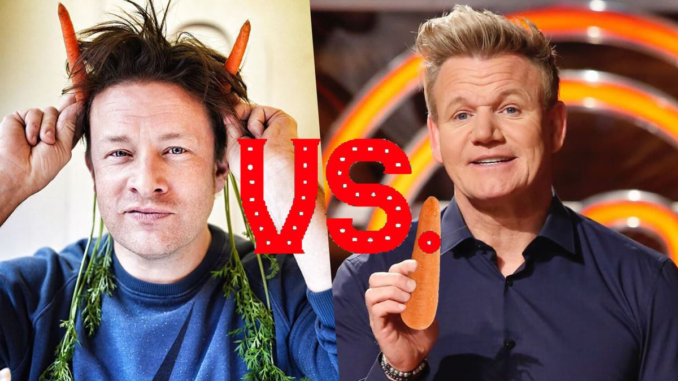
For years, the public story was simple: two British chefs, two wildly different styles, two separate lanes. Gordon Ramsay was the volcanic perfectionist, ruling professional kitchens through fear, discipline, and relentless standards. Jamie Oliver was the smiling populist, preaching accessibility, home cooking, and food as a social movement. They coexisted, occasionally shared a stage, and answered interview questions with polite restraint.
But behind that carefully managed image, insiders insist the relationship was never truly friendly.
Not then. Not now.
The rivalry between Gordon Ramsay and Jamie Oliver has simmered for decades, never exploding into a single definitive scandal, yet never cooling enough to disappear. Instead, it has lived in offhand remarks, strategic silences, industry gossip, and the unmistakable tension that surfaces whenever their names are mentioned in the same breath.
Those close to the British culinary television scene say the problem was never personal in the conventional sense. It was philosophical. And in this industry, philosophy cuts deeper than insults.
Ramsay came up through brutal, elite kitchens where precision wasn’t optional and failure meant exile. His identity was forged under chefs who believed excellence demanded pain. Oliver, by contrast, rose as a symbol of rebellion against that very culture — food without intimidation, cooking without hierarchy, chefs as approachable teachers rather than tyrants.
To Ramsay, that approach reportedly felt naïve at best and disrespectful at worst.
Insiders claim Ramsay never saw Oliver as a “chef’s chef.” While Oliver became a household name, Ramsay was grinding for Michelin stars and global restaurant credibility. The gap between their professional paths bred an unspoken resentment: one earned authority through kitchens, the other through charisma and television.
That distinction mattered — and still does.
Over the years, Ramsay’s comments about Oliver, while often wrapped in humor, carried an edge. Jokes about technique. Backhanded compliments about popularity over skill. Subtle reminders of who trained where, and who didn’t. To casual viewers, it sounded like banter. To industry insiders, it sounded like contempt carefully diluted for public consumption.
Jamie Oliver, for his part, has largely avoided direct confrontation. Friends say this wasn’t weakness but strategy. Oliver built his brand on positivity and social impact — school lunches, food education, accessibility. Engaging in a public feud with Ramsay would have undermined that image.
But silence doesn’t erase tension. It preserves it.
Behind closed doors, the rivalry reportedly intensified as both men expanded beyond cooking into empires. Television slots overlapped. Network influence grew competitive. Each represented opposing visions of what food television should be — and who it was for.
Executives allegedly found themselves navigating invisible fault lines. Booking one often meant awkward conversations about the other. Joint appearances were rare, and when they happened, staff noticed the distance: polite, professional, and unmistakably cold.
The tension sharpened during periods when Oliver’s career faced turbulence. Restaurant closures, financial losses, public scrutiny — moments when many expected Ramsay to soften his stance. Instead, insiders claim Ramsay saw these struggles as confirmation of his long-held beliefs about credibility versus popularity.
To him, this wasn’t personal failure. It was proof of principle.
Yet the irony is impossible to ignore. Ramsay himself has evolved. Once defined solely by rage and authority, he now occupies a more reflective, legacy-focused stage of his career. He speaks about mentorship, responsibility, and the emotional cost of leadership. In many ways, he has moved closer to the human-centered food philosophy Oliver championed years ago.
And still, the war hasn’t ended.
Why? Because this rivalry was never about who cooked better. It was about who got to define success.
Oliver redefined the chef as a cultural force — someone who could change how families eat, how governments think about food, how television communicates comfort. Ramsay defended the chef as a professional elite — trained, disciplined, unforgiving in pursuit of excellence. These visions cannot fully coexist without friction.
In 2026, that friction feels newly relevant.
As food television faces reinvention, streaming platforms demand depth, and audiences grow tired of recycled formats, both men represent competing futures. One rooted in accessibility and reform. The other in mastery and accountability. Their unresolved tension mirrors the industry’s own identity crisis.
And perhaps that’s why the feud still simmers — because neither side truly won.
Ramsay built a global empire and maintained elite credibility. Oliver changed how millions think about food but paid a brutal financial and reputational price. Each succeeded. Each sacrificed. Each quietly believes the other took the wrong path.
Those close to Ramsay say he doesn’t hate Jamie Oliver. Hate would be simpler. What lingers is something colder: dismissal. A belief that Oliver’s influence came without sufficient respect for the craft Ramsay bled for.
And those close to Oliver suggest he long ago accepted that Ramsay would never see him as an equal — and stopped needing that validation.
Yet the silence between them speaks louder than any televised argument ever could.
In an industry built on heat, their war has survived precisely because it never boiled over. No screaming match. No viral confrontation. Just decades of unresolved tension, quietly shaping careers, perceptions, and the mythology of modern food television.
It was never friendly.
And if history is any indication, it never truly will be.