🚢 The Unsinkable Star and the Sinking Privacy
Imagine being 22 years old and suddenly finding your face on every billboard, magazine cover, and television screen across the globe. For Kate Winslet, the release of James Cameron’s 1997 epic Titanic wasn’t just a career milestone; it was a total disruption of her reality. While we were all busy debating if Jack could have fit on that door, Kate was living through a literal nightmare behind the scenes.
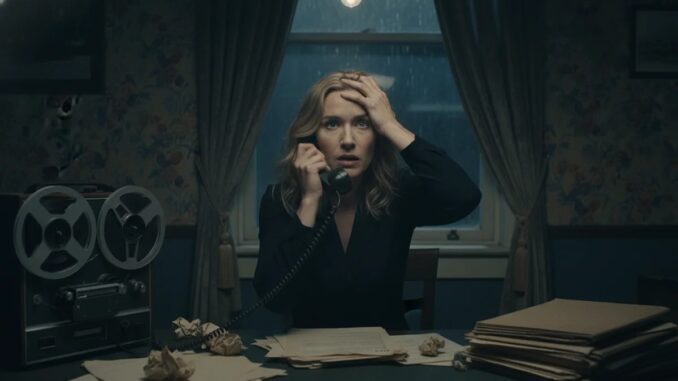
In a recent and deeply candid interview on BBC Radio 4’s Desert Island Discs, the Oscar-winning actress revealed a side of fame that most of us can’t even fathom. It wasn’t just the paparazzi following her to the grocery store—it was a coordinated, high-tech invasion of her most private moments. She described a world where she felt hunted, isolated, and ultimately “terrified to go to sleep.” Let’s take a look inside the harrowing phone-tapping ordeal and the relentless media intrusion that tried to sink one of Hollywood’s brightest stars.
🕵️ The “Horrific” Truth: Phone-Tapping and Constant Surveillance
When Kate Winslet describes the aftermath of Titanic, she doesn’t use words like “glamorous” or “exciting.” She uses words like “horrific” and “appalling.” For a young woman who was still figuring out who she was, the sudden interest in her personal life turned toxic almost instantly.
The Wire-Tapping Nightmare
The most shocking revelation from her 2025 interview was the confirmation that her private communications were compromised. “There were people tapping my phone,” she shared. Think about that for a second. Every private conversation with her family, every whispered worry to a friend, and every business negotiation was potentially being listened to by strangers looking for a headline.
-
Total Isolation: At the time, Kate lived alone. The knowledge that invisible eyes and ears were tracking her made her home feel less like a sanctuary and more like a glass box.
-
A World Without Sleep: The psychological toll was so heavy that she admitted to being scared to close her eyes at night. When you can’t trust your own phone or your own four walls, where do you turn?
H3: The Bin-Diving Obsession
If the digital invasion wasn’t enough, the physical hounding was just as invasive. Kate recalled paparazzi and “journalists” literally going through her trash cans. Why? To see what she was eating.
In the late 90s, the media was obsessed with Kate’s weight, often using abusive nicknames like “Blubber.” By searching her bins for grocery receipts, they were trying to “figure out what diet I was on or wasn’t on.” It’s an level of scrutiny that feels like something out of a dystopian thriller, but for Kate, it was just a Tuesday.
📉 The Relentless “Body-Shaming” Campaign
While the phone-tapping was the most illegal part of the ordeal, the public bullying regarding her appearance was perhaps the most enduringly painful.
H3: Abusive Nicknames and Media Cruelty
Long before we had terms like “body positivity,” the British press was notoriously cruel to young women in the spotlight. Kate Winslet bore the brunt of this. She described seeing herself on magazine covers accompanied by “awful, terrible, actually abusive names.”
-
The Drama Teacher’s Warning: Kate even shared that a drama teacher told her she’d have to settle for “the fat girl parts.”
-
Internal Struggles: At just 22, Kate admitted she wasn’t in “good shape” mentally regarding her body. The media didn’t just ignore this; they weaponized it to sell tabloids.
🛡️ Survival Strategies: How Kate Winslet Fought Back
So, how does a 22-year-old survive a global media onslaught while her phone is being tapped? For Kate, it was all about returning to the basics and relying on a small, loyal circle.
The “Pasta and Wine” Support System
One of the most touching stories Kate shared was about her neighbors. During the height of the hounding, a neighboring couple would leave a “bowl of steaming pasta and a little glass of red wine” on the garden wall for her. It was a simple gesture that reminded her there was still kindness in the world.
H4: Simple Joys as Mental Anchors
Kate has a famously grounded way of dealing with stress. She listed her coping mechanisms as:
-
A good meal.
-
Shared conversation.
-
A bit of Radiohead.
-
A “good poo.”
It sounds funny, but it’s actually a brilliant way to reclaim autonomy. When the world is trying to own your image, finding joy in the most basic human functions is an act of rebellion.
🕰️ A Recurring Nightmare: The 2010 Divorce Scrutiny
You might think that after the initial Titanic fever broke, things would get easier. Sadly, the intrusion returned with a vengeance in 2010 during her divorce from director Sam Mendes.
H3: Hounded in New York
Even with two young children in tow, the paparazzi wouldn’t let up. Kate described being followed through the streets of NYC by photographers desperate to know “the reason why Sam and I broke up.”
-
Protecting the Kids: Her strategy changed as a mother. She focused on keeping her head down, her mouth shut, and literally covering her children’s ears to shield them from the shouting photographers.
-
The Long Game: Kate realized early on that she wanted to be in the industry for the “long game,” which meant strategically choosing smaller roles to regain her privacy and dignity after the Titanic explosion.
🎬 The Legacy of the Phone-Tapping Scandal
Kate Winslet’s experience wasn’t an isolated incident. Her ordeal was part of a larger, systemic problem within the UK media landscape that eventually culminated in the Leveson Inquiry and the phone-tapping scandals of the 2010s.
H3: The Piers Morgan Connection
It’s worth noting that several journalists and editors from that era have been questioned regarding their methods. In 2011, reports surfaced about how certain newspapers obtained Kate’s private number. While Kate often chose to keep her “head down,” her recent comments provide a voice for many other celebrities who were silenced by fear during that period.
H4: Why She is Speaking Out Now
Now 50, Kate Winslet is no longer that “terrified” girl. She is a powerhouse performer and director (making her debut with Goodbye June). By sharing these harrowing details now, she is shining a light on the psychological damage caused by unbridled media intrusion—a message that is more relevant than ever in the age of social media and instant digital access.
Conclusion
Kate Winslet’s journey from the “Queen of the World” to a woman “terrified to sleep” serves as a stark reminder that fame often comes with a hidden, heavy price. The phone-tapping and surveillance she endured after Titanic weren’t just “part of the job”—they were a gross violation of human rights. Yet, despite the hounding, the bin-diving, and the body-shaming, Kate didn’t sink. She leaned on simple pleasures, good friends, and her own indomitable spirit to weather the storm. Today, she stands as a symbol of resilience, proving that you can survive the deepest waters of Hollywood and come out stronger on the other side.
❓ 5 Unique FAQs After The Conclusion
Q1: When did Kate Winslet first reveal her phone was tapped?
A1: While she had alluded to privacy issues in the past, her most detailed and harrowing account came in a December 2025 interview on BBC Radio 4’s Desert Island Discs, where she described being “terrified to go to sleep.”
Q2: Was anyone ever arrested for tapping Kate Winslet’s phone?
A2: While Kate herself hasn’t pursued specific public criminal cases for her individual tapping, her experience aligns with the broader UK phone-tapping scandal involving major tabloids. Many journalists from that era faced legal repercussions during the subsequent investigations.
Q3: How did the media intrusion affect Kate Winslet’s career choices after Titanic?
A3: Kate intentionally chose smaller, independent films (like Hideous Kinky and Holy Smoke!) rather than big Hollywood blockbusters. She did this to “understand the craft better” and to step away from the overwhelming spotlight of global superstardom.
Q4: What was the “trash can” incident Kate mentioned?
A4: Paparazzi would go through her trash to find shopping receipts and food scraps. Their goal was to determine exactly what she was eating so they could write articles about her weight and diet, contributing to a toxic culture of body-shaming.
Q5: Does Kate Winslet use social media today to connect with fans?
A5: No, Kate is famously anti-social media. She has often spoken about the dangers it poses to self-esteem and privacy, particularly for young people, and she chooses to maintain her personal life entirely offline.