🚢 The Debate That Won’t Sink: 25 Years of Door-Gate
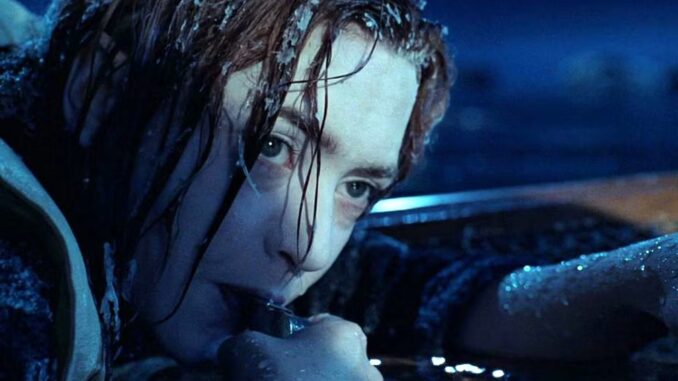
If you’ve spent any time on the internet over the last two decades, you’ve seen it. That grainy screenshot of Jack Dawson (Leonardo DiCaprio) shivering in the icy Atlantic while Rose DeWitt Bukater (Kate Winslet) sprawls out on a floating piece of wood with enough room for a small picnic. For twenty-five years, fans have called Rose a “door-hog” and labeled Jack’s death a needless tragedy. But did you know that director James Cameron, arguably the most meticulous filmmaker in history, actually got sick enough of the memes to commission a full-scale scientific study?
It turns out that what we’ve been calling a “door” isn’t a door at all, and the physics of staying afloat in 28-degree water are much more complicated than simply “scooting over.” James Cameron has finally addressed the controversy with cold, hard science, and the results might surprise you. As someone who has obsessed over maritime history and cinematic detail, Cameron didn’t just give an interview; he staged a forensic reconstruction to put a stake through the heart of this debate once and for all.
🚪 It’s Technically Not a Door: Correcting the Prop Myth
Before we get into the “will he or won’t he” of the survival science, we have to address the object itself. For years, the world has referred to it as the “Titanic door.”
The Real-Life Artifact
James Cameron has pointed out in several recent specials, including his National Geographic documentary Titanic: 25 Years Later, that the prop used in the film was actually modeled after a real piece of debris recovered from the 1912 sinking. It wasn’t a door; it was a fragment of ornate oak wall paneling from the first-class lounge.
Why Material Matters
Why does this distinction matter? Because paneling is thinner and less buoyant than a heavy, solid-core door. When fans argue about the surface area, they are missing the most critical factor: buoyancy. It isn’t about whether there was room for two people; it’s about whether the wood could support the weight of two people without sinking both of them into the freezing water.
🧪 The Scientific Study: Recreating the Freezing North Atlantic
In late 2022 and early 2023, James Cameron decided he had heard enough. To settle the matter for the 25th anniversary of the film, he hired two stunt performers with the exact same body mass as a young Leonardo DiCaprio and Kate Winslet.
The Laboratory Setup
Cameron didn’t just throw them in a pool. He worked with hypothermia experts and used a replica of the paneling from the movie. The stunt doubles were equipped with internal sensors to monitor how quickly their core temperatures would drop in simulated conditions.
Testing Multiple Scenarios
The team didn’t just test one way of sitting. They tried several different configurations to see if there was any mathematical possibility of a “happily ever after.”
-
Scenario A: Both try to get on the raft.
-
Scenario B: They both keep their upper bodies out of the water while partially submerged.
-
Scenario C: Rose gives Jack her life jacket for extra insulation.
📉 The Findings: Could Jack Have Survived?
The results of the study were fascinating because they offered a rare moment of “well, maybe” from Cameron, while still defending the original ending.
The Buoyancy Battle
In the first test, where both actors tried to climb fully onto the paneling, the results were disastrous. The raft immediately tipped or submerged deep enough that both actors were in the water. In water that cold, being submerged for even a few extra minutes is a death sentence.
The “Plank” Strategy
The study found one specific, grueling way Jack might have lived. If both performers managed to get their upper bodies out of the water and keep only their lower legs submerged, they could have lasted for several hours.
The Life Jacket Twist
In the most shocking part of the experiment, Cameron tested what would happen if Rose gave Jack her life jacket. This would have stabilized him and provided enough insulation to potentially keep him alive until the lifeboats arrived. Cameron admitted, “He might have made it,” but added a massive caveat: this assumes they weren’t already exhausted from running through a sinking ship for two hours.
🎥 The Artistic Choice: Why Jack Had to Die
Even with the scientific “maybe,” James Cameron remains adamant that the ending of the movie was correct. For him, Titanic isn’t a survival procedural; it’s a tragedy.
Romeo and Juliet on the Atlantic
Cameron often compares the film to Romeo and Juliet. “It’s a movie about love, sacrifice, and mortality,” he explains. If Jack survives, the sacrifice is gone, and the emotional weight of Rose’s “never let go” promise loses its power.
Jack’s Character Integrity
Cameron argues that Jack’s decision to not get back on the raft after the first failed attempt was 100% in character. Jack’s priority was Rose’s safety. If he had kept trying to climb on, he would have risked tipping her back into the water, which he was never going to do.
🧊 The Reality of Hypothermia in 1912
One thing the memes often ignore is the sheer brutality of the Atlantic that night. The water temperature was approximately 28 degrees Fahrenheit—literally below freezing due to the salt content.
H3: The Body’s Response to Cold Shock
When you hit water that cold, your body undergoes “cold shock,” causing you to gasp uncontrollably. If you’re underwater when that happens, you drown instantly. Even if you stay afloat, your muscles stop working within minutes.
H4: Loss of Fine Motor Skills
The idea that Jack and Rose could have “tied their life vests” under the door (a popular theory from the show MythBusters) is dismissed by Cameron as physically impossible. In 28-degree water, your fingers become useless in seconds. You can’t tie a complex knot while shivering uncontrollably and facing imminent death.
🤔 Frequently Asked Questions
Q1: Did James Cameron ever admit he was wrong about the door?
A1: Not exactly. He admitted that under a very specific set of perfect circumstances—including Rose giving Jack her life jacket—Jack might have lasted until a lifeboat arrived. However, he maintains that given the characters’ exhaustion, Jack’s death was the most realistic outcome.
Q2: Why didn’t Rose just scoot over?
A2: It wasn’t about space; it was about buoyancy. When Jack tried to climb on, the paneling tipped and submerged. If he had pushed further, it likely would have flipped over entirely, putting Rose in the water as well.
Q3: What happened to the original “door” prop?
A3: The actual prop used in the film recently sold at an auction for over $718,000. It remains one of the most famous pieces of movie memorabilia in history.
Q4: Did the MythBusters prove Jack could have survived?
A4: They proved it was physically possible if they had tied a life jacket to the bottom of the raft for extra buoyancy. However, James Cameron responded by saying they wouldn’t have had the time or physical capability to do that in the freezing water.
Q5: Is the door based on a real piece of the Titanic?
A5: Yes. The piece of wood is modeled after an actual fragment of carved oak paneling found in the debris field after the sinking, which is currently housed in the Maritime Museum of the Atlantic in Halifax, Nova Scotia.
Conclusion
At the end of the day, the “Titanic door” debate tells us more about our love for the characters than it does about physics. We want Jack to live because we spent three hours falling in love with him. James Cameron’s recent scientific deep-dive confirms what he’s been saying for decades: while there was a slim, mathematical chance for survival, the reality of the situation and the needs of the story demanded Jack’s sacrifice. So, the next time you see that meme, remember—it wasn’t a door, and Jack wasn’t just being polite. He was making sure the woman he loved had the best possible chance to survive.