🎬 The Perfectionist’s Confession: James Cameron and the Titanic Legacy
If you think of James Cameron, you probably think of a man who obsesses over every single pixel. From the bioluminescent forests of Pandora to the terrifyingly precise machinery of the Terminator, Cameron is a director who redefined “technical excellence.” However, even the king of the world has his “oops” moments. Recently, the legendary filmmaker opened up about a specific technical error in Titanic that has lived in plain sight for over 25 years.
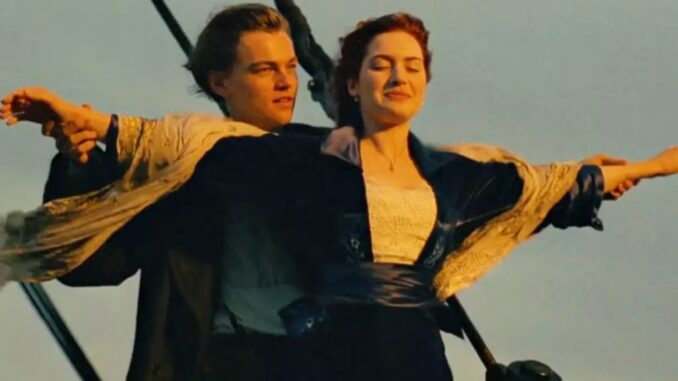
We aren’t talking about the “door” (which we all know was actually a piece of wall paneling—more on that later!). No, this mistake happens during the absolute peak of the movie’s romantic arc. It’s the moment Rose and Jack stand on the bow of the ship, the wind in their hair, declaring they are the masters of the world. While we were all reaching for tissues, Cameron was apparently cringing at a technical blunder involving the camera focus and a vanishing sunset.
🌅 The “Flying” Scene: A Race Against the Sun
The “I’m flying” scene is arguably the most parodied and beloved moment in cinema history. To capture that ethereal, golden glow, Cameron decided to skip the safety of a green screen and shoot with a real sunset on the horizon. This decision led to one of the most chaotic filming sessions of Kate Winslet and Leonardo DiCaprio’s careers.
The Two-Take Limitation
Because the sun waits for no director—not even an Oscar winner—the crew had a window of about eight minutes to get the shot. By the time the actors climbed the ladder to the precarious “bow” set (which was actually perched on a forklift-like structure), they only had enough light for two takes.
-
Take One: Completely out of focus.
-
Take Two: This is the one that made it into the movie. However, as Cameron recently revealed, even this take wasn’t perfect.
The Blur You Missed
In the final cut, the shot starts out of focus for approximately four seconds before the lens finally “pops” into clarity. For a man like Cameron, leaving a blurry shot in a billion-dollar blockbuster was a agonizing choice. But the beauty of the natural sunset was so superior to anything they could have faked in a lab that he chose the emotional impact over technical perfection.
🧬 The “Door” Debacle: Science vs. Cinema
You can’t talk about Titanic errors without addressing the elephant in the room (or the boy in the water). For decades, fans have screamed that Rose was a “door hogger” and that Jack could have easily fit on that floating piece of debris.
The Forensic Study of Jack’s Death
To silence the internet once and for all, Cameron actually commissioned a scientific study for a National Geographic special. He hired a hypothermia expert and two stunt doubles with the exact body mass of the 1997-era Leo and Kate.
-
The Buoyancy Battle: The study proved that while both could fit their bodies on the wood, the weight would have submerged the panel into the freezing North Atlantic water.
-
The Survival Reality: In water that cold, being even partially submerged leads to death within minutes. Jack’s vital organs needed to be out of the water to survive, and the panel simply couldn’t support both of them at that height.
H3: The Life Jacket Theory
Mythbusters famously suggested that if they had tied Rose’s life jacket underneath the board, it would have stayed afloat. Cameron’s response? A healthy dose of realism. He pointed out that Jack, in a state of advanced hypothermia and shock, probably wasn’t going to dive underwater in 28-degree Fahrenheit water to perform an engineering feat with a piece of wet rope.
🛠️ More Than Just a Blur: Other Technical Quirks
While the sunset blur is the mistake Cameron is most vocal about, eagle-eyed fans have found other technical “bursts” of imperfection that add to the film’s charm.
The Mirror Image Port
Did you know the entire Southampton boarding scene was shot in reverse? Because they only built one side of the ship’s set (the starboard side), and the real Titanic was docked on its port side in Southampton, they had to flip the film in post-production.
-
The Result: Everything had to be built backwards. Signs were written in mirror script, and actors had to be mindful of which hand they used. If you look closely at some of the background details, you can still catch tiny inconsistencies caused by this massive technical workaround.
H4: The Night Sky Controversy
James Cameron famously fixed one error because an astrophysicist called him out on it. Neil deGrasse Tyson noticed that the star alignment Rose sees while floating in the water was completely wrong for that specific date and location in 1912. Being the perfectionist he is, Cameron actually had the sky digitally altered for the 3D re-release to reflect the accurate constellations.
🎭 Why These Errors Don’t Sink the Ship
Rhetorically speaking, does a four-second focus pull or a mirror-image boat matter when you’re watching the greatest tragedy of the 20th century unfold? Of course not. These errors actually highlight the humanity behind the lens.
The Trade-Off: Heart vs. Hardware
Cameron’s choice to keep the out-of-focus take is a perfect analogy for art. Sometimes, the “wrong” technical move is the “right” emotional move. The raw, golden light hitting Leo and Kate’s faces feels authentic because it was authentic. A perfectly sharp CGI sunset would have lacked the soul that has kept audiences returning to the film for over two decades.
Conclusion
James Cameron’s admission about the technical error in the “flying” scene serves as a fascinating reminder that even the most meticulous projects have flaws. Whether it’s a frantic race against a setting sun or a scientific deep-dive into the buoyancy of a floating door, these details only add to the rich tapestry of Titanic. Cameron has shown us that while he can fix the stars in the sky, he’s willing to leave a little blur in the frame if it means capturing a moment of pure, cinematic magic. Jack might not have fit on the door, but the film certainly fits perfectly into history—imperfections and all.
❓ 5 Unique FAQs After The Conclusion
Q1: Was the “flying” scene actually filmed on the water?
A1: No, it was filmed on a set that utilized a forklift-like mechanism to elevate the actors. However, it was positioned outdoors so they could use the actual horizon and the natural light of the setting sun.
Q2: Why didn’t James Cameron just reshoot the blurry scene the next day?
A2: Filming Titanic was notoriously over budget and behind schedule. Each day of production cost hundreds of thousands of dollars. With the complex setup required for that specific location, a reshoot for a few seconds of focus wasn’t justifiable at the time.
Q3: Is the “door” real or made of prop materials?
A3: The “door” used in the movie was based on a real piece of wreckage—specifically an ornate oak door frame—that was recovered from the 1912 sinking. It is currently on display at the Maritime Museum of the Atlantic in Halifax, Nova Scotia.
Q4: What did Kate Winslet think about the sunset scene?
A4: Kate has described the filming as “hilariously hectic.” She recalled the director yelling “Go, go, go!” as the sun started to dip, forcing her and Leo to scramble up ladders and stay in a “clinch” for minutes at a time to catch the light.
Q5: Are there any other movies where James Cameron fixed errors years later?
A5: Yes! Besides the stars in Titanic, Cameron has used newer releases of his films like Aliens and The Abyss to perform digital clean-ups, though he usually focuses on enhancing the grain and color rather than changing the actual content.