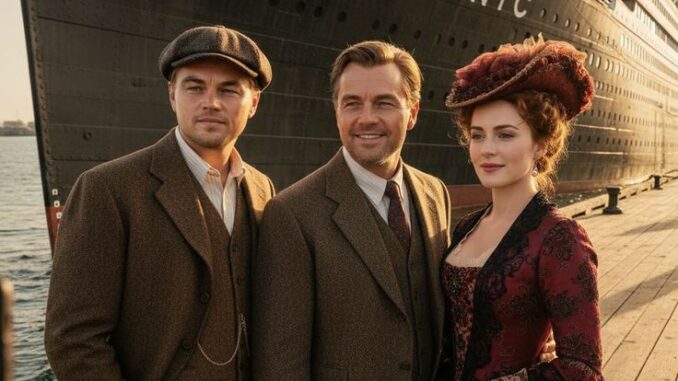
🚢 The Unsinkable Connection: Why James Cameron Owns the Chinese Box Office
When we talk about Hollywood giants, few loom larger than James Cameron. But while the world knows him as the king of the “King of the World” moment, his relationship with China is something truly special. It isn’t just about ticket sales (though those are astronomical); it’s about a deep-seated resonance that bridges East and West. From the tear-stained theaters showing Titanic in 1997 to the neon-blue immersion of Avatar: The Way of Water, Cameron has mastered a language that speaks directly to the Chinese soul.
But how does he do it? Is it just the CGI? Or is there something deeper—a mixture of landscape inspiration, philosophical alignment, and a knack for universal storytelling—that makes his films feel “homegrown” to a billion people? Let’s dive into the fascinating synergy between the world’s most ambitious filmmaker and its largest audience.
🌊 Titanic: The First Wave of a Cultural Phenomenon
Long before the Na’vi took flight, Titanic set a benchmark in China that changed everything. Released at a time when China was rapidly opening its doors to global culture, the film became more than just a movie; it became a collective memory.
The Universal Language of Love and Sacrifice
In 1997, Titanic wasn’t just a blockbuster; it was a cultural reset. The story of Jack and Rose—a romance that defied class boundaries—struck a chord in a society undergoing its own massive social shifts. For many Chinese viewers, the themes of duty versus passion and the tragic nobility of sacrifice were deeply relatable.
H3: A National Rite of Passage
Did you know that former Chinese President Jiang Zemin famously encouraged officials to watch the film to understand global storytelling? That’s some serious political clout for a romance. The movie stayed in theaters for months, with families returning multiple times. It proved that if you make a story “human” enough, the language doesn’t matter.
⛰️ The Floating Mountains: When China Inspired Pandora
When Avatar hit screens in 2009, audiences in China felt a strange sense of déjà vu. The misty, gravity-defying “Hallelujah Mountains” looked remarkably like a place they knew very well.
H3: Zhangjiajie and the Southern Sky Column
Cameron eventually confirmed what fans suspected: the breathtaking quartz-sandstone pillars of Zhangjiajie National Forest Park in Hunan Province served as the primary visual reference for Pandora’s floating peaks.
-
The Renaming: The impact was so great that local officials officially renamed the “Southern Sky Column” to “Avatar Hallelujah Mountain.”
-
Tourism Surge: Suddenly, a remote national park became a global pilgrimage site. Cameron didn’t just borrow the landscape; he exported a piece of Chinese natural beauty to the entire planet.
H4: Capturing the “Mist and Ink” Aesthetic
Traditional Chinese landscape painting often features towering peaks shrouded in swirling fog—an aesthetic known as shanshui. By incorporating this into Pandora, Cameron tapped into a visual DNA that Chinese audiences find inherently spiritual and majestic.
☯️ The Philosophy of Qi: Eywa and Eastern Thought
Beyond the visuals, there’s a philosophical heartbeat in Cameron’s work that aligns perfectly with ancient Chinese wisdom. In Avatar, the Na’vi speak of Eywa, a biological and spiritual network that connects all life.
The Parallel to “Qi” (Life Force)
For many Chinese viewers, Eywa is a digital manifestation of Qi. In traditional philosophy, Qi is the energy that flows through all things, binding the universe together. When Neytiri tells Jake Sully, “I see you,” she isn’t just looking at him; she’s acknowledging his spirit and his place in the flow of energy.
H3: Harmony vs. Exploitation
The core conflict of Avatar—the indigenous Na’vi protecting their home against a resource-hungry corporation—mirrors the Taoist principle of living in harmony with nature (Tian Ren He Yi). In a China that has faced rapid industrialization, this message of environmental stewardship and respect for the “Mother” resonates with a poignant, modern urgency.
🐉 Navigating the “Dragon Gate”: Cameron’s Diplomatic Mastery
Let’s be real: success in China isn’t just about art; it’s about navigation. Cameron has shown an incredible ability to work with Chinese systems rather than against them.
The Technical Exchange
Cameron doesn’t just sell his movies; he shares his toys. He has often engaged in high-level discussions with Chinese filmmakers about 3D technology and performance capture. By positioning himself as a partner in China’s cinematic growth, he’s built a level of goodwill that few other directors enjoy.
H3: The Anti-Imperialist Narrative
The Party and the public alike often appreciate Cameron’s choice of “bad guys.” His films frequently critique unchecked Western militarism and corporate greed. In the context of China’s own historical narrative regarding foreign intervention, the Na’vi’s resistance against the RDA feels like a familiar, heroic struggle.
📽️ The Future: Avatar 3 and the “Ash People”
As we look toward Avatar: Fire and Ash, there are whispers that Cameron might tap even further into Eastern elements. Fans have speculated that the “Wuxing” (Five Elements) system—Wood, Water, Fire, Earth, Metal—could be the secret roadmap for the five planned films.
H3: Tapping into New Landscapes
While Zhangjiajie provided the “Wood” (forest) and the “Water” was handled in the sequel, the upcoming “Fire” element might lead Cameron back to China’s volcanic or rugged terrains. He recently mentioned that photography from Hainan Province could inspire future settings, showing that his eyes are still fixed on the Middle Kingdom’s diverse beauty.
🌍 Why Universal Stories Win Every Time
At the end of the day, Cameron’s secret isn’t a magic formula; it’s humanity. He understands that whether you are in a skyscraper in Shanghai or a farmhouse in the Midwest, we all care about family, love, and our connection to the Earth.
By weaving Chinese landscapes into the fabric of Pandora and aligning his plots with deep-seated Eastern philosophies, he has ensured that his films aren’t seen as “foreign imports.” Instead, they are viewed as global celebrations of a shared human (and Na’vi) experience.
Conclusion
James Cameron’s success in China is a masterclass in cultural synergy. From the emotional tidal wave of Titanic to the landscape-inspired majesty of Avatar, he has consistently honored Chinese aesthetics and philosophy while delivering cutting-edge spectacle. By recognizing the spiritual power of “Qi” through Eywa and the visual awe of Zhangjiajie through the Hallelujah Mountains, Cameron has built a bridge that transcends politics. He doesn’t just make movies for China; he makes movies that allow China to see its own beauty and wisdom reflected on a galactic scale. As we prepare for the next chapters of Pandora, one thing is certain: the voyage between the “King of the World” and the Middle Kingdom is far from over.
❓ 5 Unique FAQs After The Conclusion
Q1: Did James Cameron actually film Avatar in China?
A1: No, the film was not physically shot in China. Instead, Cameron and his production team used extensive reference photography and 3D scans of the Zhangjiajie National Forest Park to digitally recreate the landscapes of Pandora.
Q2: Why was Titanic so much more successful in China than other Western films of that era?
A2: It was a perfect storm of timing and theme. Titanic arrived as China’s film market was opening up, and its themes of undying love and class struggle resonated deeply with traditional Chinese values regarding sacrifice and emotional sincerity (qing).
Q3: What is the “Avatar Hallelujah Mountain,” and can I visit it?
A3: Yes! It is the Southern Sky Column in Zhangjiajie, China. It was officially renamed in 2010 to capitalize on the film’s success. You can take the Bailong Elevator—the world’s tallest outdoor lift—to see the stunning views that inspired the movie.
Q4: How does the “Qi” philosophy connect to the Na’vi in Avatar?
A4: While not explicitly mentioned by name, the Na’vi’s connection to Eywa functions similarly to the concept of Qi—an invisible life force that flows through all living things and connects the individual to the collective energy of the universe.
Q5: Will future Avatar sequels be co-produced with China?
A5: While Cameron has expressed a high level of cooperation with Chinese tech companies and filmmakers, the core production remains primarily with Lightstorm Entertainment and 20th Century Studios (Disney). However, his strategic partnerships in China ensure his films receive massive distribution and support.