🎬 A Sea of Spectacle: Looking Beyond the Love Story
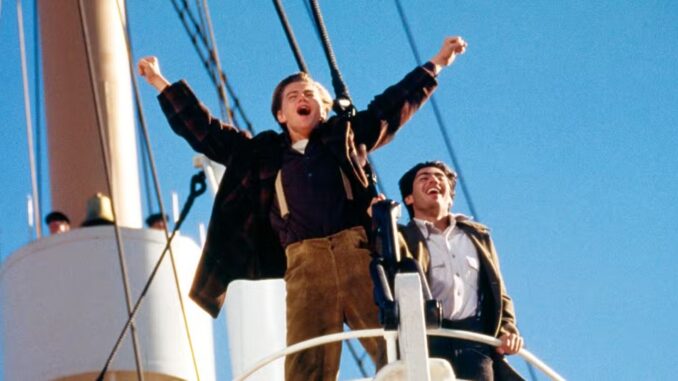
When you mention Titanic, most people immediately picture Jack and Rose at the prow of the ship, Celine Dion’s soaring vocals, or the heated debate about whether that wooden door could fit two people. But if we strip away the “King of the World” memes and the teen-idol hysteria of the late 90s, we are left with something far more impressive: a towering achievement in pure filmmaking.
I’ve always believed that Titanic isn’t just a movie; it’s a colossal feat of engineering that just happens to be projected on a silver screen. Have you ever wondered how James Cameron managed to make a tragedy everyone knew the ending to feel so heart-stoppingly urgent? It wasn’t just luck. It was a meticulous blend of cutting-edge technology, obsessive historical accuracy, and a narrative structure as sturdy as an ocean liner. Let’s pull back the curtain on the technical wizardry that makes this film a permanent resident in the history books.
🏗️ Building the Unsinkable: Production Design on a Titanic Scale
The first thing any filmmaker will tell you about Titanic is that the “set” wasn’t just a background; it was a character. Most directors would have been content with a few hallways and some clever green screen. Not James Cameron. He essentially rebuilt the ship.
The Great 90% Scale Model
To capture the sheer physical presence of the vessel, the production built a 775-foot-long replica in a 17-million-gallon water tank in Rosarito, Mexico. Think about that for a second. They didn’t just build a facade; they built a horizon-dominating structure that could tilt, sink, and withstand the battering of real water. This commitment to physical reality creates a “weight” in the frame that modern digital effects often struggle to replicate.
Historical Accuracy in Every Stitch
The production design team didn’t stop at the hull. They collaborated with historians to recreate the interiors down to the carpet patterns and the specific wood carvings in the Grand Staircase. Why go to that trouble? Because when the water starts rushing in, the destruction of something so beautiful and authentic hits the audience on a visceral level. You aren’t watching pixels break; you’re watching history disintegrate.
🎥 The Eye of the Storm: Cinematography and Visual Language
Russell Carpenter’s Oscar-winning cinematography is the unsung hero of this film. It transitions seamlessly from the golden, warm hues of the first-class dining room to the cold, industrial steel of the boiler rooms.
H3: Light as a Narrative Tool
Notice how the lighting changes as the ship begins its descent. The warm, inviting glow of the “Golden Age” slowly gives way to harsh, flickering emergency lights and eventually the terrifying, pitch-black abyss of the Atlantic. The camera moves from sweeping, romantic dollies to frantic, handheld chaos, mirroring the psychological state of the passengers.
H4: Capturing the Scale of Tragedy
One of the most iconic shots in the film involves the camera pulling back from the sinking stern, revealing thousands of people struggling in the water. This sense of scale—balancing the micro-story of Jack and Rose with the macro-tragedy of 1,500 lives—is a lesson in visual pacing. How do you keep the audience focused on two people while an entire world is ending around them? Carpenter and Cameron solved this by using the ship’s geometry to frame our heroes amidst the carnage.
🌊 The Practical Magic: Breaking Down the Sinking Sequences
In an era before we could just “fix it in post” with a few clicks, the sinking of the Titanic was a logistical nightmare. It involved massive hydraulic systems that could lift and tilt the entire 800-foot set.
Water as an Antagonist
The water in Titanic isn’t just a setting; it’s the villain. Cameron used real, freezing water to elicit genuine reactions from the actors. When you see the cast shivering, they aren’t always acting. This “method filmmaking” adds a layer of grit and survivalist reality that is hard to manufacture on a dry soundstage.
The Breaking of the Ship
The sequence where the ship snaps in half remains one of the most impressive technical feats in cinema history. It utilized a combination of full-scale sets, miniatures, and early CGI to show the structural failure of the hull. The way the stern crashes back down into the water creates a sonic and visual impact that still rattles subwoofers today.
💻 The Digital Frontier: Early CGI Done Right
While the film is famous for its practical effects, it was also a pioneer in digital technology. Digital Domain, the VFX house co-founded by Cameron, had to invent new ways to render water and digital crowds.
H3: Creating the Digital Sea
Rendering realistic water is the “Final Boss” of CGI. In 1997, the processing power required to simulate the physics of a splashing ocean was astronomical. The team used complex algorithms to ensure the digital water matched the practical water filmed in the tanks, creating a seamless blend that fooled even the sharpest eyes.
H4: The Digital Stuntmen
If you look closely at the shots of the ship’s deck as it tilts, many of those people are digital. This was one of the first times “MoCap” (motion capture) was used to create realistic human movement in the background of a live-action shot. It allowed for dangerous stunts—like people falling and hitting objects—to be portrayed with terrifying realism without actually risking lives.
✂️ The Heartbeat of the Movie: Editing and Pacing
With a runtime of over three hours, Titanic could have easily been a slog. Instead, it moves like a freight train. This is thanks to the incredible editing by Conrad Buff, James Cameron, and Richard A. Harris.
The Three-Act Structure of a Disaster
The film is essentially two movies in one. The first half is a lush period romance; the second half is a relentless survival thriller. The transition between these two is the “Iceberg Strike.” The pacing post-impact accelerates exponentially. Every scene becomes shorter, every cut becomes sharper, and the tension never lets up until the very final frame.
🔊 The Symphony of the Deep: Sound Design and Music
Filmmaking isn’t just what you see; it’s what you hear. The sound design of Titanic is a masterpiece of layering.
The Groans of a Dying Giant
Listen to the ship during the sinking. The sound team used recordings of metal twisting and wood snapping to create the “voice” of the ship. It sounds like a wounded animal. This anthropomorphizing of the Titanic makes its demise feel more like a death than a mechanical failure.
James Horner’s Emotional Core
James Horner’s score is the emotional engine of the film. While the “My Heart Will Go On” melody is the most famous, the use of Celtic whistles and ethereal vocals adds a haunting, mythic quality to the story. It reminds us that this isn’t just a news report; it’s a legend.
🎭 Directing the Chaos: James Cameron’s Obsessive Vision
You can’t talk about the filmmaking of Titanic without talking about the “Captain” himself. James Cameron is notorious for his demanding style, but that obsession is what birthed this movie.
The Deep Sea Explorer
Cameron personally dived to the actual wreck of the Titanic twelve times before filming even began. He didn’t just want to tell a story; he wanted to know the ship. This intimate knowledge allowed him to direct the actors with a level of authority that translated into the film’s undeniable sense of “being there.”
H4: Balancing Ego and Art
Many predicted Titanic would be the biggest flop in history. It was over budget and over schedule. But Cameron’s ability to hold his nerve and focus on the technical minutiae while the world’s press mocked him is a lesson in directorial grit. He knew that if the filmmaking was flawless, the audience would follow.
🚢 The Lasting Legacy: Why It Still Outranks Modern Blockbusters
In an age of “superhero fatigue” and green-screen over-saturation, Titanic stands as a reminder of what is possible when filmmaking is treated as a craft of physical reality.
The Authenticity Gap
When you watch a modern blockbuster, you often feel a disconnect. Your brain knows the actors are in a warehouse in Atlanta. In Titanic, your brain believes they are in the middle of the Atlantic. That “authenticity gap” is why the film continues to resonate. It’s the difference between a digital painting and a physical sculpture.
A Template for the “Epic”
Every modern disaster movie or historical epic owes a debt to Titanic. It proved that you could combine massive scale with intimate, personal stakes. It set a bar for production value that very few films have cleared since.
💡 Conclusion: The Unsinkable Craft
Appreciating Titanic from a filmmaking perspective requires us to look past the pop-culture fluff and see the sheer bravery of the craft. It was a $200 million gamble that relied on building a sea in a desert, inventing new digital worlds, and pushing a cast and crew to their absolute limits. James Cameron didn’t just make a movie about a ship; he built a cinematic vessel that proved filmmaking is the ultimate blend of art and engineering. Whether you love the romance or not, you have to respect the machinery. Titanic remains a masterclass in how to capture the impossible on film, and its technical brilliance is as unsinkable as the legend itself.
❓ 5 Unique FAQs After The Conclusion
Q1: How much of the ship in Titanic was actually built?
A1: James Cameron’s team built a 775-foot-long replica of the ship, which was about 90% of the actual size. It was constructed in a massive water tank in Rosarito, Mexico, allowing the filmmakers to capture real horizons and physical interaction with the water.
Q2: Did the actors actually get cold during the filming of the sinking?
A2: Absolutely. While the water in the tanks was sometimes slightly warmed to prevent hypothermia, it was still cold enough to cause genuine physical distress. This contributed to the realism of the performances, as the actors were truly struggling with the elements.
Q3: What was the most difficult scene to film from a technical standpoint?
A3: The “Grand Staircase” destruction was incredibly difficult because it had to be done in one take. The weight of the water was so massive that once it was released, it would destroy the set entirely. There was no way to “reset” the scene, so every camera had to be perfect.
Q4: How did they make the ocean look so big in a tank?
A4: This was achieved through a combination of “forced perspective” and a “vanishing edge” on the tank. By placing the tank right up against the actual Pacific Ocean in Mexico, the filmmakers could blend the water in the tank with the real horizon, creating the illusion of being in the middle of the sea.
Q5: Is Titanic considered the first movie to use modern CGI crowds?
A5: While not the very first, it was a major pioneer. It used motion-capture technology to create “digital actors” that populated the decks during wide shots. This allowed for realistic human movement in dangerous areas of the ship that would have been impossible or too risky for live stuntmen.