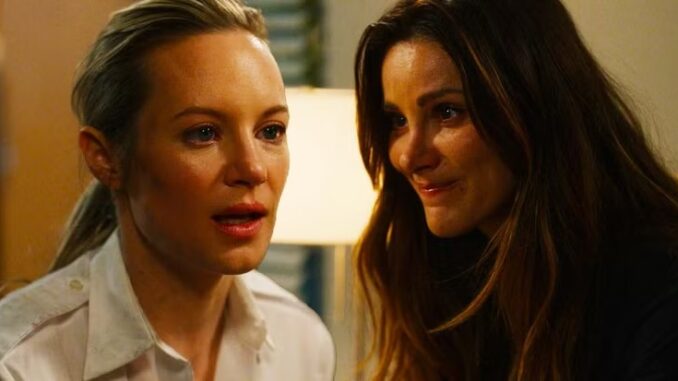
🔥 The Heart of the Matter: A Journey from “Win at All Costs” to “Give at All Costs”
If you have been riding with Station 19 since the early days, you know that Maya Bishop wasn’t always the soft, selfless, and emotionally available person we see today. In the beginning, Maya was a shark. She was an Olympic gold medalist who operated on a singular, cold frequency: winning. To Maya, life was a track meet, and everyone else was just an obstacle in her lane.
But then came the series of life-altering shifts—the fall from grace, the near-loss of her marriage to Carina DeLuca, and the grueling work of dismantling her father’s abusive “eyes forward” legacy. Nothing, however, signaled her transformation more clearly than the moment she offered her eggs for their IVF journey. It wasn’t just a medical choice; it was a total surrender of her ego. Let’s dive into why this specific plot point is the gold standard for character evolution in modern television.
🏆 The Olympic Mindset: Understanding the “Old” Maya
To appreciate how far she’s come, we have to remember where she started. Maya Bishop’s identity was once inextricably linked to her physical perfection and her biological dominance.
The Body as a Machine
As a world-class athlete, Maya viewed her body as a high-performance vehicle. Every calorie, every muscle fiber, and every biological function existed to serve her ambition. In her earlier seasons, the idea of “sharing” her biology—or even acknowledging the vulnerability of reproduction—would have felt like a weakness.
H3: The Fear of Failure
For years, Maya equated motherhood or family planning with a loss of focus. She feared that anything taking her away from the firehouse or the track was a “loss.” By offering her eggs, she finally stopped viewing her biological assets as something to be hoarded for personal glory and started viewing them as a gift for her family.
🏗️ Dismantling the Bishop Legacy: Healing from Lane Bishop
The biggest hurdle in Maya’s life was always her father, Lane Bishop. His abusive coaching style ingrained in her that her only value was her output.
Moving Beyond “Eyes Forward”
The “Eyes Forward” mantra meant ignoring pain, ignoring others, and ignoring the heart. For Maya to offer her eggs, she had to stop looking forward and start looking at Carina. She had to recognize that the future wasn’t a podium; it was a nursery.
H3: Breaking the Generational Trauma
By choosing to create a family on her own terms, Maya effectively killed the version of herself that her father created. She chose a path of creation over a path of competition.
👩❤️💋👩 The Marina Dynamic: A Marriage Rebuilt on Selflessness
Let’s be real: Maya and Carina (affectionately known as Marina) went through hell. Between Maya’s mental health crisis and her obsession with the Captaincy, their marriage was on life support.
Putting Carina First
For a long time, Carina was the one doing all the heavy emotional lifting. She was the anchor while Maya was the storm. When Maya offered her eggs, she finally stepped up as a co-pilot. She realized that Carina’s dream of being a mother was just as important—if not more so—than Maya’s dream of being in control.
The Vulnerability of IVF
IVF is a grueling, clinical, and often heartbreaking process. For a woman who spent her life needing to be “strong,” allowing herself to be part of such a vulnerable, uncertain biological process was a huge leap of faith. It showed she finally trusted her wife—and herself—enough to handle a “win” that couldn’t be quantified on a scoreboard.
🔬 The Significance of the Eggs: More Than Just Biology
Why did it have to be Maya’s eggs? On a surface level, it’s about genetics, but on a narrative level, it’s about surrender.
H3: Relinquishing the Biological “Win”
In many lesbian relationships, the choice of whose eggs to use is a deeply personal one. For Maya to offer hers, especially after Carina had struggled with her own fertility journey, was an act of profound empathy. She wasn’t trying to “best” Carina’s biology; she was trying to support it.
A Gift of Life, Not a Medal
Maya’s eggs were once the “golden eggs” of a champion. By moving them into the context of IVF, she transformed them from symbols of individual excellence into symbols of collective love. It’s a beautiful metaphor for her entire character arc.
🧠 Mental Health and the Path to Parenthood
We can’t talk about Maya’s evolution without mentioning her mental health journey. The Maya Bishop who was hospitalized and broken is the only reason the Maya Bishop who offers her eggs exists.
H4: Self-Awareness as a Superpower
Maya learned that she couldn’t be a good parent—or a good partner—until she was a whole person. Her decision to participate in IVF came from a place of stability. She wasn’t doing it to “fix” the marriage; she was doing it because she was finally healthy enough to sustain a family.
🌈 Representation Matters: The Power of the Marina Storyline
Station 19 has always pushed the envelope with LGBTQ+ representation, but the IVF storyline took it to a new level of realism.
Normalizing Queer Family Building
The show didn’t shy away from the technicalities, the stressors, or the emotional toll of IVF. By having a character as prominent as Maya Bishop lead this story, it gave a voice to thousands of queer couples navigating similar paths.
The Non-Traditional Family Tree
Maya’s willingness to be the biological donor while Carina carried the baby (ROPA – Reciprocal IVF) is a specific, beautiful form of motherhood that celebrates both women’s roles. It’s a modern family dynamic that mirrors the show’s progressive heartbeat.
🚒 The Firehouse Family: How 19 Reacted
Maya’s growth wasn’t just visible to Carina; it was visible to the entire team at Station 19.
-
Support from the Squad: Seeing the “Ice Queen” melt into a compassionate, family-oriented woman changed the culture of the firehouse.
-
Leadership Through Softness: Maya proved that you don’t have to be a tyrant to be a leader. Her journey into motherhood actually made her a better firefighter because she finally understood the value of the lives she was saving on a deeper, more personal level.
🤔 What’s Next? Maya as a Mother
If offering her eggs was the first step, actually raising a child will be the marathon. How will Maya handle a crying baby when she used to handle five-alarm fires?
H4: The Balance of Power
The next phase of Maya’s growth will likely involve balancing her career with her new identity as a mom. We expect to see her struggle, but unlike before, we know she has the tools to succeed. She no longer fears the “mess” of life; she embraces it.
Final Conclusion
Maya Bishop offering her eggs for IVF wasn’t just a plot twist in a medical drama; it was the definitive closing of a chapter on her old, toxic self. It represented the moment she officially traded her Olympic “winning” mindset for a life defined by sacrifice, empathy, and love. By moving past the trauma inflicted by her father and embracing the vulnerability of a shared biological journey with Carina, Maya proved that true strength isn’t found in a gold medal or a Captain’s bars—it’s found in the selfless act of giving. She has transitioned from a woman who ran away from her emotions to a woman who is building a future on them. And honestly? That’s the biggest win of her career.
❓ 5 Unique FAQs After The Conclusion
Q1: Why did Maya decide to use her eggs instead of Carina’s?
A1: Initially, the couple planned for Carina to use her own eggs, but after facing fertility challenges and heartbreak, Maya offered hers as a way to keep their dream of a family alive. It was a gesture of love to ensure that they both felt biologically and emotionally connected to the process.
Q2: What is Reciprocal IVF (ROPA), and how does it apply to Maya and Carina?
A2: ROPA is a process where one partner provides the eggs (Maya) and the other partner carries the pregnancy (Carina). This allows both mothers to be physically involved in the creation and birth of their child.
Q3: How did Maya’s father, Lane Bishop, affect her views on motherhood?
A3: Lane Bishop raised Maya to believe that anything other than elite performance was a distraction. This made Maya view motherhood as a potential failure or a “weakness” for a long time. Overcoming this was a central part of her Season 6 and 7 character arc.
Q4: Did Maya’s mental health crisis in Season 6 play a role in this decision?
A4: Absolutely. Her “rock bottom” forced her to enter therapy and confront her demons. Without that breakdown, she never would have developed the emotional intelligence or the selflessness required to put Carina’s needs and their future family above her own career ambitions.
Q5: Is the “Marina” baby storyline considered a landmark for LGBTQ+ TV representation?
A5: Yes. Many critics and fans praise the storyline for its realistic portrayal of the legal, medical, and emotional hurdles queer couples face during IVF, as well as for showing a healthy, evolving lesbian relationship on primetime television.