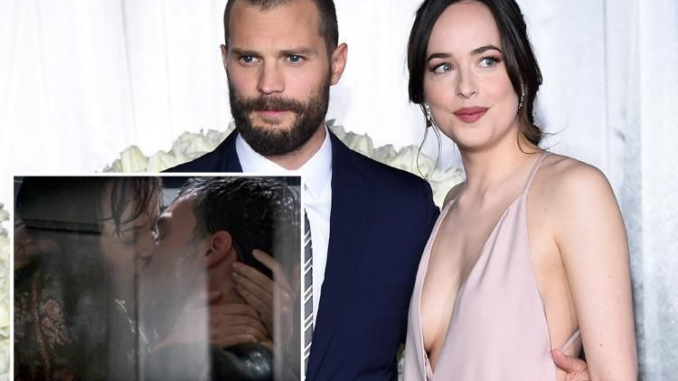
For Jamie Dornan and Dakota Johnson, the true toll of Fifty Shades of Grey didn’t occur during the grueling 14-hour days on set or the infamous “Red Room” sequences. Instead, the real cost was paid in the years that followed—a period defined by psychological residue, shattered privacy, and a desperate battle to reclaim their identities from a global obsession that refused to let go.
In late 2024 and early 2025, new insights have emerged about the “hangover” effect of the franchise, revealing that the “mayhem” Dakota described was only the beginning of a much longer struggle.
1. The “Psychotic” Production Aftermath
Dakota Johnson famously described the filming process as “psychotic” and “mayhem,” citing the constant creative tug-of-war between the director and the book’s author, E.L. James. But the hidden cost was the creative exhaustion that followed.
The “Two Versions” Stress: Dakota revealed they often had to shoot two versions of every scene—one that the author demanded and one that the director actually wanted.
The Result: This left both actors feeling like “puppets” in a power struggle, leading Dakota to admit she wouldn’t have signed on if she had known the production would be so “crazy.” The cost was a loss of trust in the “big studio” system, causing both stars to flee into independent, low-budget cinema for the next half-decade.
2. The Physical Safety Breach: “Scary” Real-World Consequences
While the films were a fantasy for millions, they created a terrifying reality for Jamie Dornan’s family. In a jarring 2024 admission, Jamie revealed that the franchise’s “hidden cost” was the breach of his domestic sanctuary.
“I had a stalker-type situation before Covid. That was f—king scary. Someone turned up at my house when my kids were there.”
For Jamie, the cost was the death of his anonymity. He admitted that he has spent years “putting walls up” around his fans, refusing to engage with the “noise” to protect his three daughters. The “Grey” era didn’t just end with a wrap party; it ended with Jamie having to implement high-level security protocols for a life that was once quiet and normal.
3. The “Brother-Sister” Trauma Bond
Perhaps the most unique “cost” was the transformation of their relationship. Because the world was so obsessed with their sex lives, Jamie and Dakota were forced into a defensive, almost military-like alliance.
The Defense Mechanism: Dakota has repeatedly described Jamie as “a brother,” a term many fans find “weird” given their onscreen chemistry.
The Reality: This was a survival tactic. They had to trust each other implicitly to survive the “exposure” of being naked and vulnerable in front of a crew for months. The cost was a friendship that is forever tied to a “foxhole” mentality—they are close, but their bond is rooted in the shared trauma of a “psychotic” experience.
4. The Professional “Shaming”
Jamie Dornan has spoken about the “wrath of hatred” directed at the films by critics. The hidden cost for him was a decade of “reputation repair.” * He spent years taking “ugly” and “violent” roles (like the serial killer in The Fall) just to prove he wasn’t the shallow “pretty boy” the world thought he was.
The energy required to “wash off” Christian Grey was immense, leading him to avoid any projects that involve “insane scrutiny,” such as superhero movies or James Bond.
Final Thoughts: Was It Worth It?
In 2025, both actors seem to have finally reached a place of peace. Dakota acknowledges the franchise “was great for our careers,” and Jamie admits he can now “sit on the Tube and be fine.”
But the “hidden cost” remains visible in their choices. They don’t do big franchise sequels. They don’t engage with fan theories. They have built a “Fortress of Normalcy” that was bought and paid for by the chaos of their 20s. They survived the Red Room, but they’ll never truly leave the shadow of the door they opened.a