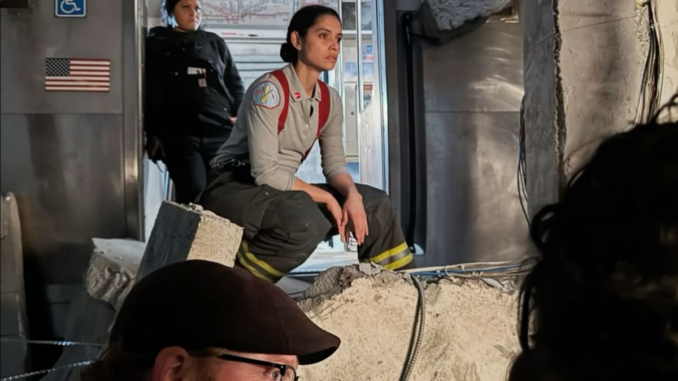
In the sprawling, high-stakes drama of Firehouse 51, where the smoke rarely clears and the emotional stakes are as high as the flames, one figure has risen to a position of near-mythic importance: Lieutenant Stella Kidd. Since her arrival, Miranda Rae Mayo’s portrayal has transformed Kidd from a scrappy newcomer into the undisputed matriarch of the house, a trajectory that mirrors the show’s own evolution from a gritty ensemble piece to a more character-driven saga. However, as her star has risen, so has a palpable tension within the “One Chicago” fandom, a growing sense that while every other character is subjected to the brutal whims of the “Puppet Masters,” Stella Kidd is operating under a different set of rules. There is a singular, nagging question that Chicago Fire keeps dodging—a question that hangs over every “Girls on Fire” meeting and every domestic scene with Severide—and it’s not because the writers have forgotten it, but because they are terrified of what the answer might do to the show’s fragile internal balance. This “Kidd Shield,” as some have dubbed it, isn’t just about her survival; it’s about a fundamental refusal to let her fail in a way that is truly ugly, truly human, or truly irredeemable. The question the show avoids is simple: Is Stella Kidd actually a flawed leader, or is the narrative reality of 51 being warped to ensure she is never wrong? For years, fans have watched as other characters, from Casey to Herrmann, have been raked over the coals for their mistakes, yet Kidd seems to possess a narrative immunity that protects her from the natural consequences of her own ambition. When she vanished for a significant portion of Season 10 to expand her “Girls on Fire” program, leaving her crew and her fiancé in a state of limbo, the expected fallout was strangely muted. In the real world of the CFD, or even in the established logic of the show’s earlier seasons, that kind of professional ghosting would have resulted in a loss of command or at least a permanent stain on her reputation. Instead, the “Puppet Masters” chose to frame her return not as a moment of accountability, but as a triumphant reclamation of her throne, forcing the characters around her—most notably Severide—to do the emotional heavy lifting of forgiveness without her ever truly having to earn it.

This avoidance has created a “Pedestal Problem” where Kidd is no longer allowed to be a character and has instead become a symbol of perfection that the writers are too afraid to tarnish. The fans know exactly why this is happening: the show is desperately trying to avoid the “Gabby Dawson Trap.” For years, the character of Dawson was the lightning rod of the series, often criticized for her perceived selfishness and the way the plot seemed to bend to her will. When Dawson left, a vacuum was created, and the writers shifted that focal point onto Kidd. But in their attempt to make her a more “palatable” version of the strong female lead, they have accidentally stripped away her ability to be genuinely challenged. By refusing to let her be wrong, they are denying her the growth that comes from failure. Every time a conflict arises—whether it’s a dispute with a superior or a friction within her marriage—the script almost inevitably validates her perspective, often at the expense of other characters’ established personalities. Fans see this “protective writing” as a sign of creative insecurity, a fear that if the audience sees Stella Kidd as anything less than the moral and professional gold standard, the entire structure of Firehouse 51 will collapse. This has led to a strange dissonance where the character’s achievements, like her promotion to Lieutenant, feel less like hard-won victories and more like inevitable milestones in a pre-ordained script.
Furthermore, the “One Question” extends into the dynamics of “Stellaride,” the franchise’s flagship relationship. The show consistently avoids asking whether Kidd’s ambition is actually compatible with the stability of the house, or if she is simply using the people around her as rungs on a ladder. While Severide has been systematically broken down and humbled over the years—moving from a playboy to a devoted partner who often sacrifices his own spotlight for her—the reciprocity is often missing. The fans have noticed that the narrative rarely asks Stella to sacrifice for Kelly in the same way he does for her. This imbalance isn’t a character flaw of Stella’s; it’s a failure of the writers to allow her to be vulnerable or to put her in a position where she isn’t the one holding all the cards. The “Kidd Shield” acts as a barrier to true intimacy because true intimacy requires the possibility of being wrong and being forgiven. By making her perpetually right, the writers have ironically made her more isolated from the audience’s empathy. We don’t connect with perfection; we connect with the struggle to be better, a struggle that Stella is rarely allowed to participate in because the show insists she is already there.
Ultimately, the truth the fandom knows is that Chicago Fire is currently being held hostage by its own need for a “perfect hero.” In an era of television where audiences crave complex, morally gray protagonists, the insistence on keeping Stella Kidd on an unshakeable pedestal feels like a regression. The “Puppet Masters” are so focused on protecting her from the “Dawson-esque” backlash that they are inadvertently creating a new kind of resentment—one born from the boredom of predictability. The only way to save the character is to finally answer the question the show has been avoiding: to let her fail, to let her be selfish, and to let her face a consequence that she can’t simply charm or “Girls on Fire” her way out of. Only then will she become as “strong” as the writers claim she is. Until the show decides to break the “Kidd Shield,” she will remain a beautifully rendered but ultimately flat icon, a leader who is followed not because she has earned it through the fires of failure, but because the script says no one is allowed to lead better. The real happy ending for Stella Kidd isn’t a promotion or a perfect marriage; it’s the permission to be human, a permission that the gods of the Windy City are currently too terrified to grant.