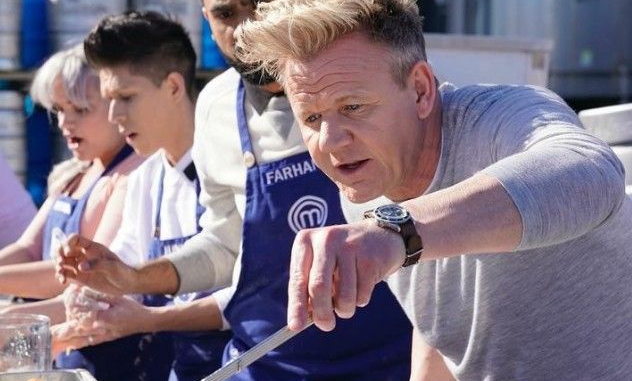
For years, Gordon Ramsay’s television empire was built on one brutal promise: cook well, or go home. Skill ruled. Pressure exposed truth. But according to a new insider account now circulating quietly among industry circles, that foundation may be shifting—and not everyone is comfortable with what Ramsay’s shows are becoming.
“It’s not about finding the best chef anymore,” the insider claimed. “It’s about finding the moment that trends.”
The allegation didn’t come from a tabloid interview or a dramatic press conference. It surfaced in fragments—anonymous posts, off-the-record comments, and private messages shared by crew-adjacent workers who say they’ve watched the tone of Ramsay’s shows change from the inside out.
What they describe isn’t a single scandal, but something more unsettling: a slow rewrite of priorities.
According to the insider, recent seasons across multiple Ramsay-led series have leaned harder into engineered tension. Challenges designed less to test technique and more to provoke breakdowns. Time limits that border on impossible. Twists introduced not to surprise chefs, but to destabilize them emotionally.
“The food almost becomes secondary,” they said. “What production really wants is the reaction.”
Fans have noticed the shift. Episodes feel louder. Cuts are faster. Conflicts escalate quicker than they used to. Where Ramsay once lingered on technique and precision, recent edits favor confrontation, tears, and shock eliminations that leave viewers stunned—but confused.
“It feels different,” one longtime fan posted. “Like the chaos matters more than the cooking.”
The insider claims Ramsay is aware of the change, but not always in control of it. Networks, they say, are chasing viral moments in an oversaturated streaming landscape. A perfect dish doesn’t travel on social media the way a meltdown does. Silence doesn’t clip well. Anger does.
That pressure, the insider alleges, trickles down to contestants.

Chefs are encouraged to talk more in confessionals—not about food, but about stress, rivalry, and personal doubt. Some are subtly nudged to lean into frustration. Others are told to “be more honest,” a phrase that allegedly translates to “be more explosive.”
“It’s emotional extraction,” the insider said bluntly.
Ramsay’s role in this evolution is where opinions divide. Some insiders believe he’s resisting more than fans realize, pushing back to preserve credibility. Others think he’s adapting, knowingly or not, to the new reality of television where outrage equals engagement.
What’s clear is that Ramsay’s on-screen persona has sharpened again after years of softening. The bark is back. The insults hit harder. And while fans once celebrated that return, some now wonder if it’s being amplified beyond authenticity.
Former contestants have started hinting—carefully—at similar experiences. Not outright accusations, but phrases like “manufactured pressure” and “psychological games” are appearing more often in post-show interviews.
One ex-competitor described feeling “constantly on edge for reasons that had nothing to do with food.” Another admitted they stopped cooking instinctively and started cooking defensively, afraid of how a mistake would be framed rather than how it tasted.
Still, defenders of Ramsay argue that high pressure has always been the point. Kitchens are brutal. The shows reflect that. “If you can’t handle it,” one fan wrote, “you shouldn’t be there.”
But critics push back: real kitchens don’t have editors.
That distinction matters. When pressure is real, it teaches. When it’s constructed for drama, it manipulates. And viewers, increasingly savvy, are beginning to sense the difference.
The danger isn’t immediate backlash. It’s erosion. Trust slipping quietly. Fans watching not to admire excellence, but to anticipate disaster.
For Ramsay, whose legacy rests on authority and authenticity, that shift carries risk. He isn’t just a host—he’s the brand. If audiences start believing the shows are chasing shock over substance, his credibility takes the hit first.
So far, Ramsay hasn’t addressed the whispers. And perhaps he doesn’t need to—yet. Ratings remain strong. Clips still go viral. But the tone of the conversation has changed.
It’s no longer just “Who will win?”
It’s “What are they really trying to make us feel?”
And once viewers start asking that question, the show stops being a competition—and starts being something else entirely.
Whether this is evolution or erosion depends on what happens next. But one thing is certain: Gordon Ramsay’s television empire is at a crossroads.
And the next explosion might not come from a contestant—
but from the audience itself.