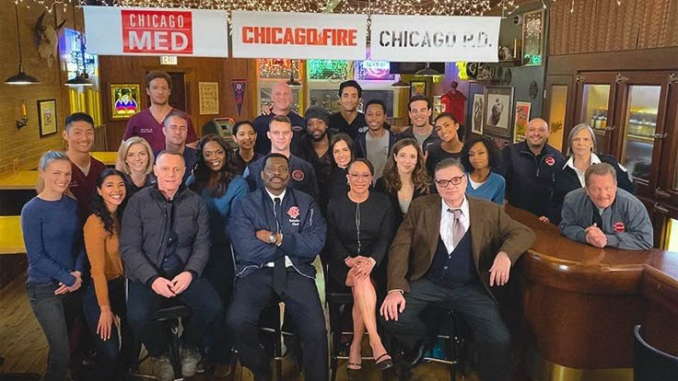
In the smoke-filled corridors of Firehouse 51, the high-stakes trauma bays of Gaffney Chicago Medical Center, and the gritty interrogation rooms of the 21st District, the concept of a “happy ending” is a fragile, flickering candle in a perpetual windstorm. For fans of the One Chicago universe—comprising Chicago Fire, Chicago P.D., and Chicago Med—the question of who actually decides who gets to ride off into the sunset is not a matter of fate or karma, but a complex tug-of-war between narrative necessity, actor contracts, and the brutal “Dick Wolf Formula.” We watch these heroes risk their lives weekly, projecting our hopes onto their relationships and survival, yet the true puppet masters aren’t the characters themselves or even the internal logic of the Windy City; they are a cabal of showrunners, network executives, and the cold, hard metrics of Nielsen ratings that decide whether a character gets a wedding or a funeral.
The primary architect of joy and misery in the One Chicago world is the “Contractual Executioner,” a force that dictates a happy ending often depends more on a talent agent’s negotiations than a character’s moral standing. When we see a beloved figure like Matthew Casey leave Chicago Fire for a life of noble service in Oregon, it feels like a hard-won, bittersweet victory—a happy ending of sorts. However, the reality is that the “ending” was decided by the expiration of a contract and the actor’s desire to move on. In this universe, the writers act as frantic tailors, stitching together a resolution that fits the sudden departure of a lead. This creates a strange paradox where the characters who get “happy endings” (the quiet exits, the long-distance romances) are often the ones whose actors leave on good terms, while those caught in the crossfire of creative shifts are met with sudden, jarring tragedies like the death of Leslie Shay or the exit of Alvin Olinsky.

Beyond the boardroom, the “Tonal Dictatorship” of the genre itself acts as a gatekeeper for happiness, particularly within the grim confines of Chicago P.D. In the world of Sergeant Hank Voight, the showrunners have established a law of diminishing returns on joy; here, the “happy ending” is an endangered species. The audience is conditioned to know that for every moment of peace found by characters like Kim Burgess or Adam Ruzek, a traumatic price must eventually be paid. The writers of the One Chicago franchise operate on a “Hedonic Treadmill” where the stakes must be constantly raised to keep the procedural gears turning. This means that “happiness” is often used as a narrative device—a “lamb to the slaughter” trope where a character is given a moment of peak contentment specifically to make the inevitable tragedy more gut-wrenching for the viewers.
Furthermore, we cannot ignore the “Fan-Service Committee,” a digital shadow-government of social media discourse that exerts immense pressure on the writers’ room. Ships like “Linstead,” “Upstead,” or “Brettsey” aren’t just creative choices; they are massive community investments. The decision to grant a happy ending to a couple is often a calculated response to the “shipping wars” that dominate the online fandom. When the writers finally allow a long-awaited union to happen, they are reacting to a decade of audience feedback, proving that, in a way, the viewers are the silent partners in the decision-making process. Yet, this is a double-edged sword; the “Gods of Chicago” may grant a wedding in one season only to dismantle it in the next to generate “meaningful conflict,” revealing that in the eyes of the network, a stable happy ending is the death of drama.
Ultimately, the true “Who” behind the happy endings in the One Chicago universe is the relentless machine of “Procedural Longevity.” Because these shows are designed to run for decades, a permanent happy ending is actually a threat to the franchise’s survival. A character who is truly happy, settled, and safe has nowhere left to go in a story built on crisis. Therefore, the “Puppet Masters” decide that the only way to get a real happy ending is to leave the show entirely. To stay in Chicago is to remain in a state of perpetual purgatory, where your happiness is always on loan and the interest is paid in blood, sweat, and cliffhangers. The only true winners are the ones who make it out of the city limits while the credits are still rolling and the sirens are far in the distance.