📺 The Nostalgia Machine: Why We Need More Power!
Let’s be honest: in the current television landscape, everything old is new again. We’ve seen beloved sitcoms from the ’80s, ’90s, and early 2000s dust off their sets, gather their original casts, and attempt to recreate the magic that made them cultural touchstones. From Full House to Will & Grace and even Roseanne, the reboot train keeps rolling. So, naturally, one of the most persistent and passionate fan requests centers on the iconic, powerhouse comedy of the 1990s: Home Improvement.
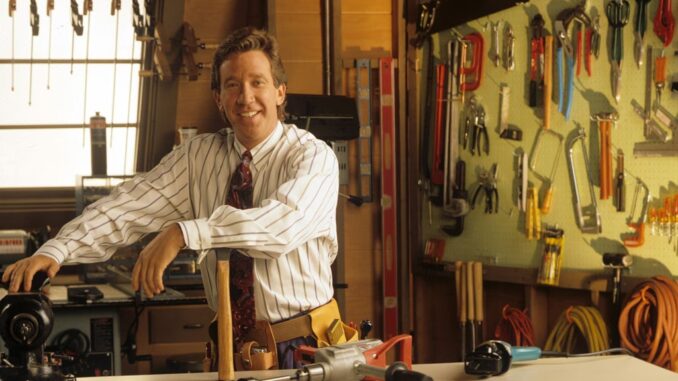
For eight glorious seasons, we watched Tim “The Toolman” Taylor (Tim Allen) dispense hilariously misguided advice on Tool Time, mangle home renovation projects, and, most importantly, navigate the complexities of family life with his wife Jill (Patricia Richardson) and their three sons. The show was a genuine phenomenon, anchored by the unique comedic blend of masculine bravado and deep, unexpected heart.
But despite the immense nostalgia and the undeniable bankability of Tim Allen, why hasn’t the Home Improvement reboot happened yet? We finally have the definitive answer, straight from “The Toolman” himself. And the reason isn’t about scheduling conflicts or network politics; it’s about a crucial, irreplaceable character dynamic that the actor believes is impossible to replicate.
🗣️ Tim Allen’s Core Insight: The Missing Dynamic
Tim Allen has been vocal about his desire to revisit the world of the Taylors. He has the power, the platform, and clearly, the audience interest. Yet, he is holding back, driven by a profound respect for the show’s original chemistry. His explanation cuts straight to the heart of what made Home Improvement work, revealing that the single biggest hurdle is the absence of the show’s silent, grounding force.
H3: The Unspoken Wisdom of Earl Hindman’s Wilson
The character whose absence dictates the fate of the reboot is Wilson W. Wilson Jr., the Taylors’ mysterious, wise, and famously facially obscured neighbor, played by the late, great Earl Hindman. Hindman passed away in 2003, and his loss created a narrative void that Allen believes is impossible to fill without compromising the entire fabric of the show.
-
The Third Element: Allen argues that the relationship between Tim, Jill, and Wilson was the essential three-legged stool of the show’s emotional life. Tim provided the chaos, Jill provided the realism and intellectual challenge, and Wilson provided the gentle, philosophical wisdom that steered Tim back to center.
-
The Emotional Safety Net: Wilson wasn’t just a neighbor; he was Tim’s confidant and moral compass. Every episode required Tim to wrestle with a problem, and the guaranteed moment of relief and resolution came when he consulted Wilson over the backyard fence. Without Wilson, Tim Taylor loses his sounding board, and the show loses its signature structure.
The Irreplaceable Character Function
Tim Allen asserts that the role Wilson played was not just comedic; it was functional and structural.
“Without Wilson, Tim Taylor is just a guy making mistakes. With Wilson, he’s a guy who learns from his mistakes, which is the heart of our show.”
You can hire another funny neighbor, but you can’t hire another Wilson. The mystery, the philosophical quotes, and the specific rhythm of that relationship were unique to Earl Hindman’s portrayal.
💔 The Personal and Professional Loss: A Tribute to Earl Hindman
Allen’s reluctance is deeply rooted in his personal respect and affection for Earl Hindman, making the absence much more than just a creative problem—it’s an emotional one.
Honoring a Legacy
For Allen, reviving the show without Hindman would feel like a betrayal of their professional partnership and friendship. The actor is unwilling to dilute Wilson’s powerful, iconic legacy by attempting to replace him with a different character fulfilling the same function.
-
The Fence: The famous fence , which partially obscured Wilson’s face in nearly every appearance, became one of the most recognizable set pieces in television history. This visual running gag was integral to the character’s mystery. Any attempt to introduce a new neighbor with the same gimmick would feel cheap and exploitative.
H4: The Challenge of Recasting an Icon
While some reboots have recast characters, Wilson’s role was too spiritually central and too perfectly executed by Hindman to tolerate a replacement. Allen correctly understands that the audience’s emotional connection to the show is bound up in those original, specific performances. To introduce a “new Wilson” would be to instantly invite comparison and criticism.
✍️ The Creative Hurdle: Replicating the Original Magic
Beyond the Wilson issue, Tim Allen has pointed to the broader creative challenges involved in bringing the show into the 21st century. The world has changed dramatically since Home Improvement went off the air in 1999.
Modernizing Tool Time in the Age of YouTube
The central premise of a syndicated local cable access show, Tool Time, needs significant modernization.
-
The DIY Overload: In the 1990s, the concept of a local TV home repair show was novel. Today, we have hundreds of YouTube channels, TikTok feeds, and streaming series dedicated to DIY and renovation. How would Tool Time stand out in this saturation? Tim Taylor’s trademark incompetence might look less charming and more dangerous in the age of instant video reviews.
-
Tim’s Masculinity: Tim Taylor’s brand of boisterous, often clueless masculinity was a central theme of the original show, frequently juxtaposed against Jill’s feminist perspective. Modernizing this dynamic without making Tim look completely regressive or out of touch is a massive writing challenge that requires surgical precision.
H4: The Taylor Kids Are Grown Up
The revival would focus on the adult lives of the Taylor sons—Brad, Randy, and Mark.
-
The New Dynamic: The show would likely focus on Tim and Jill as grandparents, or perhaps Tim trying to help (and accidentally sabotage) one of his son’s own home lives. While this shift is interesting, it inherently moves the core dynamic away from the parenting focus of the original, forcing the show to evolve into a family dramedy, rather than a sitcom centered on the shop and the home.
🚪 The Door is Not Locked: The Possibility of a Spiritual Successor
It’s crucial to note that Tim Allen hasn’t definitively ruled out a return; he’s simply stated that the current conceptual attempts haven’t met his high standards.
H3: The Spin-off Scenario: Tool Time Lives On?
Allen has hinted that if a revival were to happen, it might be more of a spin-off or a spiritual continuation, perhaps focusing on the next generation.
-
Brad and Randy: Could one of the Taylor sons—perhaps Brad (Zachary Ty Bryan) or Randy (Jonathan Taylor Thomas)—take over Tool Time, with Tim appearing as the slightly intrusive, advice-giving dad? This would shift the hierarchy and allow Tim’s character to remain relevant without having to carry the entire comedic weight.
-
The Return of JTT: Getting the original cast, particularly Jonathan Taylor Thomas (Randy), who left the show early and had a very private life after the finale, to commit is another massive hurdle, but one that would undoubtedly generate immense fan excitement.
The Last Man Standing Parallel
It is clear Allen cherishes the traditional, multi-camera sitcom format, as proven by his long run on Last Man Standing. His criteria for reviving Home Improvement are high because he knows what true, generational sitcom success looks like. He’s not willing to risk tarnishing the legacy for a quick cash grab.
⭐ The Final Word: Patience and Preservation
Tim Allen’s explanation serves as a powerful reminder that creative integrity often trumps commercial viability. He recognizes that the heart of Home Improvement was not the power tools or the celebrity cameos; it was the quiet, profound, and often hilarious relationships built between three distinct figures. Without the wisdom of Wilson W. Wilson Jr., the machine simply doesn’t run the same. And until the creative team finds a way to honor that essential dynamic, Allen will keep the most famous home renovation show in television history on the shelf, preserving its perfect legacy.
Final Conclusion
Tim Allen has clearly explained that the primary reason a Home Improvement reboot has not yet materialized is the absence of Wilson W. Wilson Jr., played by the late Earl Hindman. Allen believes the unique, philosophical dynamic between Tim, Jill, and Wilson was the essential structural foundation of the show. Without Wilson serving as Tim Taylor’s moral and comedic sounding board, the core premise—a man who learns and grows through his mistakes—is severely compromised. While Allen is open to a revival, he refuses to compromise the integrity of Wilson’s iconic legacy by simply replacing the character, demonstrating a profound respect for the show’s original chemistry and Hindman’s irreplaceable contribution.
❓ 5 Unique FAQs After The Conclusion
Q1: Which actor played Wilson W. Wilson Jr., the neighbor whose absence prevents the Home Improvement reboot?
A1: The character of Wilson W. Wilson Jr. was played by the actor Earl Hindman, who appeared in all eight seasons of the show before his passing in 2003.
Q2: Have any Home Improvement cast members reunited since the show ended?
A2: Yes. Several cast members, including Patricia Richardson (Jill Taylor), Jonathan Taylor Thomas (Randy), and Richard Karn (Al Borland), all made guest appearances on Tim Allen’s subsequent show, Last Man Standing, showing their ongoing professional connection.
Q3: What was the recurring physical joke associated with the character of Wilson?
A3: The recurring physical joke was that Wilson’s face was almost always obscured by a prop—usually the fence, but sometimes objects like a hat, a mask, or even a bush—so the audience never got a full, clear look at his face until the series finale’s curtain call.
Q4: Is Tim Allen currently working on any other television reboots or new sitcoms?
A4: While Allen has expressed interest in a Galaxy Quest series revival, his primary current focus is maintaining his established roles and executive producing projects. He recently concluded his long-running show Last Man Standing, but remains open to new ventures that respect the multi-camera format.
Q5: What was the main difference in tone between Home Improvement and Last Man Standing?
A5: Home Improvement centered on Tim’s relationship with his wife and his mishaps in home repair, focusing on the domestic and relationship comedy. Last Man Standing centered on Tim’s political and philosophical conservative views, focusing more on culture wars and generational differences within his family.