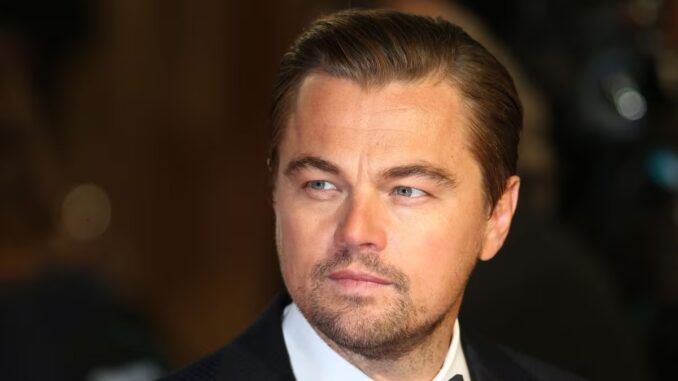
🎬 The Heart of a Hollywood Titan: Unveiling DiCaprio’s Cinematic Soul
When we think of Leonardo DiCaprio, we picture epics: the doomed romance of Titanic, the psychological thrillers of Scorsese, the gritty realism of The Revenant. His career is defined by massive, high-octane, prestige filmmaking. So, when the man who is arguably the biggest movie star on the planet names his all-time favorite film, we stop and pay attention. We expect some obscure foreign masterpiece or maybe a classic from the Golden Age of Hollywood.
But DiCaprio’s choice, while fitting for a man known for his deep emotional commitment to roles, might surprise you. His favorite film is a profound, uplifting, and relentlessly humane masterwork that managed to make the entire world cry. It’s a film he admits he watches “over and over again,” a powerful indicator that its emotional core transcends mere entertainment.
The film Leonardo DiCaprio loves, the one he calls a “hymn to humanity,” is It’s a Wonderful Life (1946), directed by the legendary Frank Capra and starring the eternally wholesome James Stewart. Why does this black-and-white, post-war Christmas classic hold such sway over a modern icon known for dark, complex roles? Because, at its core, it speaks to the elemental truth that DiCaprio, despite his fame, seeks in every script: the deep, messy, and undeniable value of a single human life.
🌟 A Hymn to Humanity: The Enduring Power of It’s a Wonderful Life
It’s a Wonderful Life is far more than a sentimental Christmas movie. It is a profound philosophical treatise wrapped in the accessible packaging of a holiday drama. It tells the story of George Bailey (James Stewart), a man perpetually thwarted in his grand ambitions to travel the world, who instead stays in his small town, Bedford Falls, sacrificing his dreams to run a small building and loan association and help his community.
The Core Conflict: Unrecognized Worth
The film’s genius lies in its exploration of George Bailey’s desperation. Feeling trapped and worthless, particularly when faced with a catastrophic financial crisis, George contemplates suicide on Christmas Eve. He feels like a failure, a drain on society, and a man whose absence would simplify life for everyone he loves.
-
The Anti-Ego Narrative: This theme stands in sharp contrast to the typical Hollywood success story. George’s value is not measured by wealth or fame, but by the quiet, daily acts of kindness and sacrifice that have woven him into the fabric of his community.
-
The Existential Question: The film poses the ultimate existential question: What if you were never born? George is shown a world where he never existed, revealing the terrifying, massive void his absence would create in the lives of hundreds of people.
The Flood of Emotion: Why the World Cried
The film’s famous climax—when George realizes the immense positive impact his life has had—is a scene of pure, unadulterated emotional catharsis. It’s the moment when the audience, having witnessed the grim, alternative reality of Potter’sville, floods with relief and affirmation.
-
Affirmation of Purpose: This climax validates every quiet, selfless person in the audience. It confirms that the hard, thankless work of being a good person, a good neighbor, and a loving family member is the most important contribution one can make to the world. That message is timeless and universal.
🎭 DiCaprio’s Artistic Reflection: The Echoes in His Own Work
DiCaprio’s deep affection for It’s a Wonderful Life provides a fascinating window into his own artistic priorities. While his characters are often far more morally ambiguous than George Bailey, the underlying theme of searching for purpose and confronting existential dread is a constant in his filmography.
From The Aviator to Inception
Consider the characters Leo often plays:
-
Howard Hughes (The Aviator): A man whose overwhelming ambition and wealth lead to profound isolation and mental instability. He lacked the simple, human connections George Bailey cherished.
-
Cobb (Inception): A man so lost in his professional, dream-weaving life that he risks everything to regain the simple, uncorrupted reality of his family.
-
Jack Dawson (Titanic): A man with nothing, whose greatest contribution is simply teaching a lonely woman to live fully and free herself from gilded cages.
DiCaprio’s preference for It’s a Wonderful Life suggests that after exploring the destructive forces of unchecked ambition and complex moral failure on screen, he finds profound comfort and validation in the simple, moral clarity of George Bailey’s story. It’s his emotional compass.
📽️ Capra’s Genius: The Legacy of Simple Humanism
Frank Capra, the film’s director, was a master of what we now call Capra-corn—films that champion the everyday hero and celebrate the triumph of the common man over systemic greed and corruption.
H3: The Triumph of the Common Man
It’s a Wonderful Life is arguably Capra’s purest expression of this philosophy. The villain is the cold, capitalistic, and physically disabled Mr. Potter, who represents the lack of empathy and the destructive power of greed. George Bailey and the Building and Loan represent the antidote: community, shared effort, and human kindness.
-
A Political Statement: The film, released shortly after WWII, was a powerful statement about rebuilding and community solidarity over individual selfishness. It was a call to prioritize humanity over profit. This theme, addressing societal decay through wealth disparity, resonates deeply with DiCaprio’s known activism today.
H3: The Artistic Draw for an A-Lister
For an actor who dedicates his life to the craft, the film is a masterclass in performance, particularly from James Stewart. Stewart’s ability to transition from wide-eyed optimism to utter despair, only to return to a tearful, grateful joy, is the definition of high-level acting. Watching it “over and over again” is likely DiCaprio studying the emotional precision and the ability of a single actor to carry such massive thematic weight.
⭐ Beyond the Blockbuster: The Power of Emotional Revisit
Why does DiCaprio watch it repeatedly? The answer lies in the psychological comfort the film provides.
The Comfort of Resolution
DiCaprio’s films often feature ambiguity, tragedy, or an ending that requires intellectual unpacking. The Departed ends with despair; Shutter Island ends with haunting uncertainty. It’s a Wonderful Life, however, ends with absolute, unambiguous resolution and warmth.
-
Emotional Recalibration: After spending a year exploring the dark side of humanity for a role, watching a film that unequivocally affirms the goodness in people is a form of emotional recalibration. It’s his way of washing away the cynicism required for his more demanding roles.
H4: The Global Anthem of Kindness
The film’s reputation as a global anthem of kindness further solidifies its enduring appeal. It doesn’t rely on special effects or violence; it relies purely on the human connection. That simplicity is the ultimate measure of cinematic art, and that is what DiCaprio admires most. It’s the kind of film that acts as an ethical anchor in the turbulent, often morally corrupt waters of Hollywood.
✨ The Legacy: The Film That Failed Before It Triumphed
It’s an interesting historical footnote that It’s a Wonderful Life was actually considered a box office failure upon its initial release and even prompted an FBI investigation due to its seemingly anti-capitalist themes (Mr. Potter was deemed too evil).
Its current legendary status was only achieved years later through repeated television showings during the Christmas season. The film’s eventual triumph over its initial failure mirrors the themes of the film itself: the quiet worth of something often goes unrecognized until it is nearly lost.
DiCaprio’s championing of the film helps to solidify its status not just as a holiday staple, but as a masterpiece worthy of serious dramatic consideration—a “hymn” that resonates year-round.
Final Conclusion
Leonardo DiCaprio’s favorite film, which he watches “over and over again,” is Frank Capra’s 1946 masterpiece, It’s a Wonderful Life. His deep affection for this movie reveals an enduring commitment to the power of humanism and the search for profound, simple purpose, themes that underpin even his most complex, modern roles. The film’s ability to create a global, unified emotional response—making the world cry with cathartic joy—is a testament to its timeless exploration of the value of a single, well-lived life. For DiCaprio, the film is not just nostalgic comfort; it is an artistic benchmark, a moral compass, and the ultimate hymn to the quiet, vital goodness that survives even the darkest financial and existential crises.
❓ 5 Unique FAQs After The Conclusion
Q1: Which actor stars as the main character, George Bailey, in It’s a Wonderful Life?
A1: The main character, George Bailey, is portrayed by the legendary American actor James Stewart. His performance is widely considered one of the greatest in cinematic history.
Q2: Why does Leonardo DiCaprio refer to It’s a Wonderful Life as a “hymn to humanity”?
A2: DiCaprio uses this phrase because the film’s central theme is the affirmation of a single person’s worth, regardless of wealth or fame. It celebrates the collective impact of kindness, community, and selfless sacrifice, serving as an uplifting and moralistic anthem for human goodness.
Q3: Was It’s a Wonderful Life a box office hit when it was first released?
A3: Surprisingly, no. It’s a Wonderful Life was considered a box office disappointment upon its 1946 release and led to financial troubles for director Frank Capra’s production company. It gained its iconic status decades later through repeated airings on television, particularly during the Christmas season.
Q4: Has Leonardo DiCaprio ever stated what genre of film he watches most often for pleasure?
A4: While DiCaprio is known for starring in dramas and thrillers, his choice of It’s a Wonderful Life suggests a preference for emotionally resonant, humanistic dramas for personal viewing, films that explore deep character motivations and moral dilemmas.
Q5: What major awards did It’s a Wonderful Life receive nominations for?
A5: It’s a Wonderful Life received five Academy Award nominations, including Best Picture, Best Director (Frank Capra), and Best Actor (James Stewart). It did not win any major categories at the 19th Academy Awards.