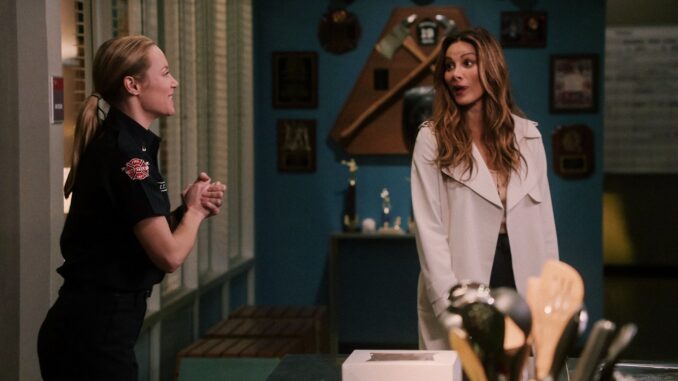
🔥 The Crossover Conundrum: When Integration Becomes Sabotage
As dedicated citizens of ShondaLand, we thrive on the chaotic, interconnected universe created by Grey’s Anatomy and its high-octane sibling, Station 19. The crossover events—when the doctors rush to the scene of a fire or the firefighters bring patients to Grey Sloan Memorial—are supposed to be the best of both worlds: high-stakes action married to emotional character drama. It’s a narrative feast!
But if we’re honest with ourselves, the integration often comes at a steep price. When two successful shows must share the screen and the focus, one character inevitably ends up carrying the narrative burden for the entire event. And too many times, that burden falls unfairly on Maya Bishop (Danielle Savre).
The common consensus among Station 19 fans is clear: the high-profile crossover events—which are often creatively driven by the priorities of the mother ship (Grey’s Anatomy)—frequently fail Maya Bishop. These events don’t enhance her growth; they regress her character, use her primarily as a plot device, or simplify her complex, multi-season struggles into a quick, digestible conflict necessary to serve the Grey’s storyline. It’s time to admit that the interconnected universe, while fun, has done a severe disservice to one of Station 19‘s most dynamic and compelling characters.
👑 The Depth of Maya Bishop: A Character Built for Complexity
To understand why the crossovers fail her, we must first appreciate the complexity of Maya Bishop’s character arc—a journey that is far more nuanced than most TV heroes.
From Perfectionist to Predator: A Defining Arc
Maya started as an intense, driven Olympic gold medalist whose entire identity was built on achievement and success. Over the seasons, we witnessed her descent into perfectionism, self-destruction, and unchecked ambition, fueled by her abusive, controlling father.
-
Emotional Complexity: Her storyline is rich with themes of trauma, self-worth, disordered eating, and control issues. Her personal relationships—especially with Carina DeLuca—were constantly tested by her deep-seated need for control.
-
The Redemption Cycle: Station 19 dedicated significant time to showing Maya’s slow, painful path toward recovery: attending therapy, accepting help, and learning to relinquish control for the sake of her mental health and her marriage.
This complexity is precisely what the fast-paced, action-focused crossover events cannot handle.
💥 The Crossover Regression: Sacrificing Growth for Conflict
The primary failure of the crossover events regarding Maya is their tendency to simplify her deep-seated issues into an easily solvable, single-episode conflict that often portrays her as the aggressive, emotionally unstable antagonist.
The “Unstable Ex-Captain” Trope
Whenever a crisis hits during a crossover, particularly one that requires quick, decisive command decisions, the Grey’s Anatomy-centric narrative often resorts to relying on an old, outdated version of Maya.
-
Emotional Volatility: Instead of showing the Maya who has been attending therapy and working on her emotional intelligence, the crossover events often revert to the volatile, aggressive Maya who makes reckless decisions out of frustration or a thirst for authority. This simplifies her mental health struggles, turning a complex journey into a cheap source of drama.
-
Undermining Station 19’s Work: This regression negates the painstaking, multi-season work Station 19 writers put into her recovery. It’s like hitting a reset button on her emotional progress, forcing her back into the narrative box of the “dangerous, ambitious character” to raise the stakes for the shared event.
🚨 The Failed Command Structure: A Crisis of Authority
Crossover events inherently create a crisis of authority by throwing two command structures—the Firehouse (Captain/Battalion Chief) and the Hospital (Chief of Surgery/Trauma Attending)—into the same chaos. This often highlights Maya’s professional failures rather than her successes.
H3: The Narrative Need for a Fall Guy
In the joint narrative, if a decision goes wrong or creates high-stakes medical jeopardy, the blame must fall somewhere immediate and dramatic.
-
Maya as the Target: Because of her history of being demoted for boundary issues and reckless ambition, Maya often becomes the convenient “fall guy” for these shared crisis events. Her established character flaw (ambition) is exploited to justify a poor command decision made during the crossover. This makes the Grey’s doctors look competent and cool-headed, while making the Station 19 fire commander look overly emotional or unstable.
-
The Doctor’s Perspective: Crossover episodes are often filmed and framed through the eyes of the Grey’s doctors. From their perspective, Maya’s urgency and aggressive tactics—necessary for a firefighter—can look reckless or antagonistic. The narrative doesn’t take the time to truly validate her tactical perspective, seeing only the resultant medical crisis.
💔 The Personal Price: Maya and Carina’s Relationship as Plot Fuel
Perhaps the most damaging effect of the crossover is how it weaponizes Maya’s relationship with Carina DeLuca (Stefania Spampinato), who is a doctor at Grey Sloan.
H4: Relationship Conflict as Crossover Content
When the two shows merge, the Maya/Carina (Marina) relationship often becomes a source of tension rather than stability, serving as easy emotional fodder for the event.
-
Medical vs. Fire Disagreements: Crossovers frequently pit Carina’s calm, medical perspective against Maya’s intense, decisive fire command. Their personal relationship is used to raise the tension of the medical outcome, often framing Maya as the one who unnecessarily endangered herself or others, forcing Carina to worry and react dramatically.
-
The Wasted Opportunity: Instead of using the crossover to show Marina’s strength—how two professionals in high-stress fields support each other—the events leverage their relationship for cheap conflict, neglecting the emotional progress they’ve made on their respective home shows.
✍️ The Writer’s Dilemma: Prioritizing the Mother Ship
We must acknowledge the practical reason for this narrative failure: network priorities.
H3: Grey’s Anatomy as the Creative Center
As the original, longer-running, and arguably higher-rated show, Grey’s Anatomy inevitably remains the creative center of the ShondaLand universe.
-
Plot Mandates: Crossover events must, first and foremost, serve the plot and emotional arcs of the Grey’s Anatomy main cast (Nolan, Bailey, etc.). If that requires a Station 19 character—even one as complex as Maya—to act as a temporary antagonist or a catalyst for chaos, the writers often make that sacrifice.
-
Time Constraint: Crossovers move fast. There isn’t the narrative space to thoroughly explore the deep-seated emotional reasons behind Maya’s actions, as Station 19 does. Therefore, they default to the established, superficial character traits—ambition and aggression—because they are immediately recognizable to the casual viewer.
This is a structural flaw, where the need for maximum audience engagement during the crossover supersedes the need for character integrity within the spin-off.
🌟 A Path Forward: Restoring Maya’s Integrity
For future crossover events (assuming Station 19 continues or its characters transition to Grey’s), the writers need to be more mindful of Maya Bishop’s journey.
Focus on Tactical Excellence, Not Emotional Instability
Instead of using Maya’s past trauma, future crossover events should highlight her unparalleled excellence as an athlete, a tactician, and a firefighter.
-
Show the Growth: Depict Maya using her high standards to lead efficiently and safely, not recklessly. Show her making a difficult, technically sound decision that the doctors initially question but ultimately proves correct.
-
Validate the Firefighter Perspective: Use the crossover to educate the Grey’s doctors—and the audience—on the necessary difference between medical triage and fire command, validating the quick, often brutal decisions firefighters must make.
By elevating her professional achievements, the show can leverage her high-intensity character for the crossover without sacrificing the complex, hard-won emotional maturity Station 19 has spent seasons building.
Final Conclusion
While the Station 19 and Grey’s Anatomy crossover events provide high-stakes action and interconnected drama, they consistently fail Maya Bishop by simplifying her hard-won emotional maturity. The necessity of serving the Grey’s Anatomy narrative often forces Maya back into the convenient trope of the “emotionally unstable ex-Captain,” undermining the extensive, complex work Station 19 has done to explore her healing journey from childhood trauma and perfectionism. This regression is a disservice to one of ShondaLand’s most fascinating characters, whose storylines deserve to be treated with respect, not merely used as fuel for the mother show’s episodic conflict.
❓ 5 Unique FAQs After The Conclusion
Q1: Which major Station 19 character’s storyline is most affected by Maya Bishop’s struggles in crossover events?
A1: Dr. Carina DeLuca is the most affected. As Maya’s wife and a doctor at Grey Sloan, Carina is often utilized during crossovers to provide the emotional, high-stress reaction to Maya’s command decisions, leading to unnecessary conflict in their marriage.
Q2: Was Maya Bishop ever actually fired or simply demoted from her Captain role on Station 19?
A2: Maya Bishop was demoted from her role as Captain back to Lieutenant by Chief Herrera and then briefly to a lower rank, but she was never officially fired from the fire department itself. Her demotion was due to her reckless behavior and prioritizing personal ambition over the safety of her crew.
Q3: Which event on Station 19 most significantly fueled Maya Bishop’s control issues and professional ambition?
A3: Maya’s character struggles stem primarily from the abusive and controlling psychological pressure exerted by her father during her childhood as an Olympic track athlete. Her constant need for achievement and control is a direct result of this deep-seated parental trauma.
Q4: Who often acts as the counter-balance to Maya’s intense style during joint operations with the LAPD or EMS?
A4: Andy Herrera often acts as the counter-balance, providing a more emotionally grounded, empathetic, and team-oriented approach to leadership. Also, Robert Sullivan often contrasts Maya with his own strictly by-the-book tactical experience.
Q5: Are the writers of Station 19 and Grey’s Anatomy the same people for the crossover episodes?
A5: No, both shows maintain separate, dedicated writing rooms and showrunners. However, for a crossover, the teams must coordinate their scripts closely, and the final narrative decisions are often filtered through the executive producers and the network, prioritizing the story flow of the main show (Grey’s Anatomy).