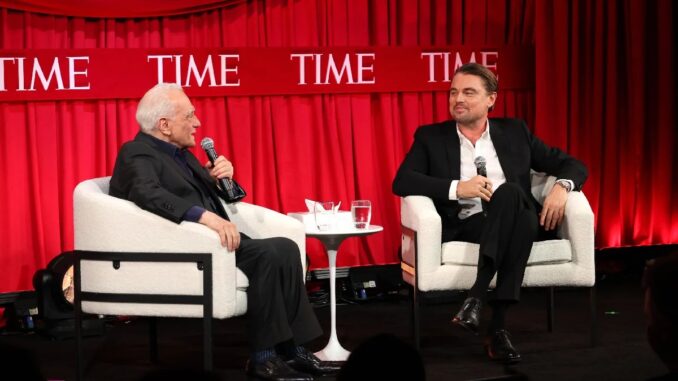
🎥 The Art of Creative Conflict: Defining a Legendary Partnership
When you hear the names Martin Scorsese and Leonardo DiCaprio, what comes to mind? Cinematic genius, guaranteed critical acclaim, and likely, a certain number of Oscar nominations. Their collaboration is not merely an actor and a director working together; it’s a modern cinematic dynasty, a pairing that has delivered modern classics like The Departed, The Wolf of Wall Street, and the recent epic, Killers of the Flower Moon. Since their first film together, Gangs of New York (2002), they have created a body of work defined by uncompromising quality and raw, explosive energy.
But here is the untold truth behind that spectacular success: their process is not one of easy, harmonious agreement. It is, in fact, an intense, months-long crucible of ideas, debates, and creative friction. They don’t just chat over coffee about the script; they debate for months before the camera ever starts rolling.
Why the relentless back-and-forth? Because they are both masters operating at the very peak of their respective crafts, and neither is willing to settle for anything less than perfection. We are going to dive deep into the specific reasons this intellectual sparring is essential to their creative process, how it shapes the final product, and why their commitment to brutal honesty is the secret ingredient in their recipe for cinematic gold.
🧠 The Intellectual Crucible: Two Titans Challenging Each Other
The core reason for the extended, pre-production debates is simple: neither Scorsese nor DiCaprio treats the script as a fixed document. They treat it as a starting point for exploration. Their debates are not arguments rooted in ego, but intense, highly focused intellectual sparring sessions rooted in a shared commitment to psychological realism.
The Search for Psychological Truth
Scorsese’s films, particularly those starring DiCaprio, are always deeply complex psychological studies of morally ambiguous men. Think of Jordan Belfort’s blinding hedonism, or Howard Hughes’s descent into obsessive isolation.
-
DiCaprio’s Demand for Depth: DiCaprio is renowned for his meticulous research. He doesn’t just read the script; he reads the history, the psychology reports, and the biographies. He enters the debate armed with volumes of external information, constantly asking: Why does my character do this? What is the real pain underneath the action?
-
Scorsese’s Narrative Purity: Scorsese, the ultimate cinematic historian and moralist, is ensuring that the psychological exploration serves the greater narrative theme. He argues for clarity, thematic resonance, and the dramatic necessity of every scene. Their debate is about fusing DiCaprio’s detailed psychological truth with Scorsese’s grand, moral vision.
H3: Elevating the Script from Good to Great
The weeks of sustained debate function as a form of cinematic quality control. They act as the ultimate perfection filter.
-
Identifying Flaws: Every script, no matter how good, has weak spots, moments where dialogue falls flat, or character motivations feel thin. Their intense scrutiny forces those flaws to the surface.
-
Creating Burstiness: Their arguments aren’t just about fixing; they are about elevating. They look for moments of high emotional or narrative ‘burstiness’—the unexpected twist, the explosion of rage, or the quiet moment of profound realization. These debates often result in rewriting scenes entirely to maximize impact.
📜 The Screenplay as a Blueprint: Not a Bible
For most Hollywood productions, the shooting script is treated as the final word. For the Scorsese-DiCaprio team, it’s treated as a flexible blueprint. This is a major philosophical difference that necessitates constant debate.
The Collaborative Rewrite Process
DiCaprio is known for suggesting significant rewrites and structural changes, even on set. While many directors would reject this, Scorsese respects it because DiCaprio is debating the character, not just the scene.
-
Revisiting Motivation: For Killers of the Flower Moon, they spent extensive time debating the true nature of Ernest Burkhart. Was he a simpleton? A true villain? Their debates led to the decision to portray him as a man deeply conflicted but ultimately corrupted by weakness and avarice—a far more complex character than a mere bad guy.
-
Open-Ended Exploration: The “months” of debate are the commitment to leave the script open to improvement until the very last moment. This flexible approach ensures that the most authentic version of the story makes it to the screen.
🤝 The Partnership Dynamic: Actor and Director as Equals
The fundamental reason the debates are so fruitful is that Scorsese treats DiCaprio not just as his leading man, but as his equal partner in the creative execution of the vision.
H4: Beyond the Muse: Leo as a Co-Conspirator
DiCaprio is often referred to as Scorsese’s modern “muse,” replacing Robert De Niro in that role. However, their relationship goes beyond inspiration; it is a co-conspiracy.
-
Trust Built Over Decades: After six feature films together, their professional trust is absolute. DiCaprio knows that Scorsese will never let him deliver a poor performance, and Scorsese knows that DiCaprio will fight fiercely for the character’s integrity. This mutual respect allows them to push back against each other without the risk of professional rupture.
-
The Shared Risk: They are both taking enormous risks with their projects—historically complex topics, huge budgets, and heavy psychological weight. They must be in complete philosophical agreement on the moral core of the story before they ask millions of dollars from a studio. The months of debate are the high-stakes negotiation of that shared risk.
🎬 The Real-World Impact: Shaping the Final Performance
The fruits of these intense pre-production battles are visible in every minute of their shared filmography. The debates don’t just shape the script; they condition DiCaprio’s performance.
Conditioning DiCaprio’s Intensity
The process of debating forces DiCaprio to internalize the character’s contradictions and motivations to an extreme degree.
-
The Internal Conflict: When they debate, DiCaprio is effectively rehearsing the character’s internal conflict against the director. By the time he steps onto the set, he has already fought every philosophical battle over his character’s choices. This preparation allows his performance to feel incredibly immediate and fully realized.
-
Improvisation and Authenticity: The deep understanding forged during the debates enables moments of controlled, brilliant improvisation. When the camera rolls, DiCaprio knows the character so intimately that his reactions are authentic, even when he deviates slightly from the dialogue.
H4: The Pressure Cooker Effect
Think of their debate process as a pressure cooker. The intense pressure of challenging every choice for months means that only the most robust, truthful, and dramatically effective ideas survive. What audiences see on screen are the diamonds that emerged from this high-pressure intellectual environment.
🌟 A Model for Collaboration: The Future of Prestige Cinema
The Scorsese-DiCaprio method of sustained pre-production debate offers a profound lesson for all aspiring filmmakers and actors. It teaches us that collaboration is not about easy agreement; it is about productive, passionate disagreement in the service of a singular, magnificent artistic goal.
They don’t argue because they dislike each other; they argue because they respect the art form and know that true cinematic masterpieces are rarely born from consensus. They are born from rigorous testing, fierce commitment, and a relentless search for the truth, no matter how uncomfortable the conversation gets.
Final Conclusion
Leonardo DiCaprio and Martin Scorsese engage in intense, months-long debates before every film because their shared pursuit of cinematic perfection demands it. These extended discussions are not ego battles but rigorous intellectual sparring sessions focused on validating the psychological truth of DiCaprio’s character against the thematic integrity of Scorsese’s grand moral vision. This process—challenging every motivation, every piece of dialogue, and every narrative decision—elevates their work from mere filmmaking to profound cinematic art. The ultimate reward is the unshakeable authenticity and explosive intensity visible in their filmography, proving that creative conflict is the secret ingredient to their enduring legacy.
❓ 5 Unique FAQs After The Conclusion
Q1: Which film marked the first collaboration between Leonardo DiCaprio and Martin Scorsese?
A1: The first feature film collaboration between Leonardo DiCaprio and Martin Scorsese was Gangs of New York, which was released in 2002.
Q2: Does Martin Scorsese follow a similar intense debate process with all his lead actors, or is it unique to DiCaprio?
A2: Scorsese is known for a highly collaborative and intense process, particularly with his “muses” like Robert De Niro and DiCaprio. The long, deep relationship he established with DiCaprio has allowed their debates to become particularly personal and structurally influential on the script’s final form.
Q3: What specific type of moral ambiguity do DiCaprio and Scorsese often debate in their films?
A3: They frequently debate the nature of the American anti-hero—characters who pursue the American Dream through amoral or criminal means (e.g., The Wolf of Wall Street) or characters who are fundamentally decent but corrupted by systemic or personal weakness (e.g., Killers of the Flower Moon).
Q4: Has the intensive debate process ever led to a significant delay or budget issue in their productions?
A4: While their films are known for being large-scale and sometimes facing production challenges, the intense pre-production debate is largely seen as a risk mitigation strategy. By resolving creative and structural issues before filming begins, they save time and money on set, ultimately making the high-budget projects run smoother than they might otherwise.
Q5: How many feature films have Leonardo DiCaprio and Martin Scorsese made together to date?
A5: Leonardo DiCaprio and Martin Scorsese have collaborated on six feature films: Gangs of New York (2002), The Aviator (2004), The Departed (2006), Shutter Island (2010), The Wolf of Wall Street (2013), and Killers of the Flower Moon (2023).