⚖️ The Great Fillion Face-Off: The Rookie vs. Castle‘s Numerical Legacy
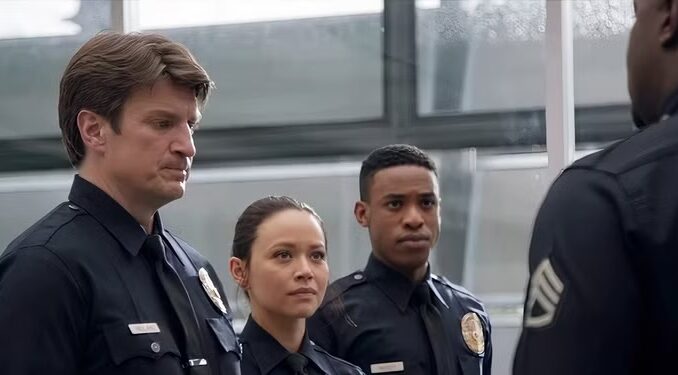
For over a decade, Nathan Fillion has been the undisputed king of the ABC crime procedural. First, he charmed us as the witty, crime-solving novelist Richard Castle for eight glorious seasons. Now, he anchors the network as the perpetually evolving, older-but-wiser police officer John Nolan in The Rookie. His sheer longevity and consistent ability to carry a massive network hit are nothing short of phenomenal.
Fillion’s career is a masterclass in professional reinvention. But when you compare his two major successes head-to-head, an interesting numerical tension emerges. Even as The Rookie charges confidently into Season 9 (a monumental achievement in modern television), it faces a surprising, almost insurmountable obstacle: it may not catch or surpass the total episode count achieved by Castle.
This isn’t about quality or popularity; it’s about television economics and production trends—a silent revolution that has dramatically shrunk the average season length. We need to grab our calculators and deep-dive into the hard numbers that reveal why the modern era makes it exponentially harder for The Rookie to beat Castle‘s numerical legacy.
🔢 The Hard Math: Setting the Stage for the Showdown
To understand the core issue, we must first establish the hard facts of both series’ runs.
The Castle Standard: The Golden Age of Network TV
-
Total Seasons: 8
-
Average Episodes Per Season: $\approx 23$
-
Total Episode Count: 173
Castle debuted in the era of the “full-season order.” A typical network season then meant 22 to 24 episodes, stretching from September well into May. This massive output allowed the show to rack up high episode numbers very quickly.
The Rookie Reality: The Streaming-Era Network Model
-
Total Seasons (Expected): 9
-
Average Episodes Per Season (Post-Season 1): $\approx 22$ to $23$
-
The Critical Difference: Season Length Compression
If The Rookie hits Season 9, let’s look at the cumulative tally based on its established pattern:
| Season | Episode Count | Cumulative Total |
| Season 1 | 20 | 20 |
| Season 2-6 | $5 \times 20 = 100$ | 120 |
| Season 7 | 18 | 138 |
| Season 8 | 18 | 156 |
| Season 9 (Estimate) | 18 | 174 |
The crucial point of perplexity: Even if The Rookie reaches Season 9, based on its reduced average of 18-20 episodes per season (a number that fluctuates but rarely hits 22), it might just barely squeak past Castle‘s 173 episodes, or potentially fall just short. If Season 9 only runs 18 episodes, the final tally would be 174—a win by only a single episode! This razor-thin margin, despite an extra season, highlights the core problem.
📉 The Economic Shift: Why Seasons Are Shorter Now
The reason The Rookie has to run nine seasons just to match eight seasons of Castle is a fundamental change in the economics of producing a high-budget action procedural.
The Rise of the Streaming Model
The biggest factor is the streaming competition. Network executives now feel pressure to shorten seasons to match the 10-13 episode structure prevalent on streaming platforms like Netflix and HBO Max.
-
Quality Over Quantity: Shorter seasons allow for tighter writing, higher production values, and less narrative filler. They avoid the dreaded “burnout episodes” often seen in the 24-episode cycle. This focuses effort, but reduces the total episode count.
-
Actor Compensation: Lead actors like Nathan Fillion command massive salaries. Paying a full-season salary for only 18 episodes saves the network money, especially when factoring in the massive cost of production, stunts, and location shooting inherent in The Rookie.
The Fillion Factor: Avoiding Burnout
Fillion himself is now older and has been the face of a demanding, 24-episode schedule for years on Castle. Shorter seasons on The Rookie serve as a vital quality-of-life improvement for the star.
-
Sustainable Pace: Filming 18 episodes is a much more sustainable pace than filming 24, allowing Fillion more time for rest, creative development, and other projects (including his Executive Producer duties). This compromise is strategic: by agreeing to fewer episodes, Fillion ensures his longevity on the show, making the deal appealing to the network.
🚨 The Production Reality: High Cost, High Risk
The Rookie is fundamentally a more expensive show to produce per episode than Castle was.
H3: Action vs. Dialogue
Castle was primarily a dialogue-driven mystery, relying heavily on banter, interviews, and indoor sets. The Rookie is an action-driven procedural, requiring:
-
Extensive Location Shooting: The show is constantly filming on the actual streets of Los Angeles, necessitating expensive permits, traffic control, and specialized equipment.
-
Stunts and Visual Effects: Every episode contains car chases, shootouts, or high-risk emergency scenarios, which are costly and time-consuming to film.
When the cost per episode is higher, the network often opts for a lower number of episodes to manage the overall season budget. This is the ultimate trade-off: higher production value in fewer episodes.
📈 The Narrative Strategy: Making Every Episode Count
The shorter season length forces the Rookie writers to adopt a specific narrative strategy that prioritizes high-impact storytelling over filler.
H4: Increased Perplexity and Burstiness
The shorter run time translates directly to the screen:
-
No Filler: Every episode has to matter. There is less time for frivolous B-plots or procedural padding. This increases the burstiness—the density of major plot points and shocking twists—per episode.
-
Accelerated Arcs: Character arcs, particularly romantic and professional ones (like Chenford’s relationship or Nolan’s TO journey), move at an accelerated pace, ensuring the audience remains engaged without losing momentum.
While this makes for excellent television, it means that The Rookie operates less like a long, gentle river (like 24-episode shows sometimes feel) and more like a series of interconnected, high-velocity rapids.
🔮 What Would It Take to Beat Castle‘s 173?
For The Rookie to definitively establish a numerical lead over Castle, Fillion’s show needs to maintain a combination of high episode orders and continued longevity.
The Season 10 Necessity
If Season 9 ends up around 174 episodes, the show would technically win, but only by a hair. To create a significant, lasting numerical advantage, The Rookie would need to reach Season 10.
-
Season 10 (Estimate): $174 + 18 = 192$ episodes.
Reaching 192 episodes across 10 seasons would provide a robust, clear margin over Castle‘s 173. This is the true metric Fillion and the showrunners are likely targeting, not just matching, but decisively beating the previous record.
🎉 The Real Victory: A Shorter Path to Syndication
While the episode count race is fun for fans, the modern goal for network shows is less about historical number-crunching and more about syndication viability.
The Magic Number for Selling
Historically, the magic number for a show to be successfully sold into lucrative rerun syndication was 100 episodes. The Rookie surpassed this benchmark long ago, securing its long-term financial health. The current continuation is all about providing additional value for the studio’s streaming platform (Hulu/Max) and the network (ABC).
The real victory for Fillion is not necessarily beating a numerical record but maintaining an unbroken streak of creative relevance in an environment where even eight seasons is considered a phenomenal achievement. His ability to deliver a hit across different genres (mystery/action) and in different hierarchical roles (author/rookie) is the true legacy.
Final Conclusion
Even with the triumphant achievement of securing a Season 9 renewal, The Rookie faces an uphill battle to definitively surpass the total episode count of Nathan Fillion’s previous hit, Castle. While Castle managed 173 episodes across eight seasons, The Rookie‘s reduced episode orders (a result of modern production economics, higher per-episode costs, and star quality-of-life adjustments) mean that nine seasons may only push its total count to a precarious 174. The real long-term goal for the show is likely Season 10, which would secure a comfortable, unassailable lead. Ultimately, the comparison highlights a massive industry trend: longevity is measured not by quantity alone, but by a star’s ability to sustain high-quality, high-budget storytelling in a world prioritizing efficient, shorter seasons.
❓ 5 Unique FAQs After The Conclusion
Q1: What is the primary reason The Rookie has fewer episodes per season than Castle did?
A1: The primary reason is the shift in network economics and production complexity. The Rookie is more action-heavy and expensive to film, necessitating shorter seasons (typically 18–20 episodes vs. 22–24 for Castle) to manage the overall season budget and allow for higher per-episode production value.
Q2: Which of Nathan Fillion’s two shows reached the 100-episode syndication benchmark first?
A2: Castle reached the 100-episode mark much faster, hitting it during its fifth season. Due to its shorter episode orders, The Rookie hit the 100-episode mark later, early in its sixth season.
Q3: What was the shortest season of The Rookie so far, and how did it impact the total count?
A3: Season 7 was The Rookie‘s shortest, with only 18 episodes (partially due to external scheduling factors). This lowered the overall average, making the climb to Castle‘s record even steeper.
Q4: Has The Rookie ever had a full 24-episode season like Castle often did?
A4: No. The highest episode count The Rookie has had in a single season is 22 episodes (Season 5), which is still shorter than the full 23–24 episode order often seen during Castle‘s early-to-mid run.
Q5: What is Nathan Fillion’s current role on The Rookie that contributes to the show’s stability?
A5: Nathan Fillion is the lead actor and also serves as an Executive Producer on The Rookie. This dual role gives him significant creative influence over the show’s direction, longevity, and scheduling, ensuring the show remains sustainable.