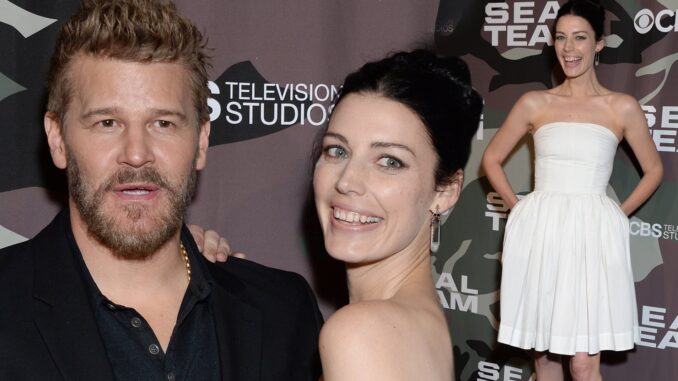
As an actress, director, and longtime creative partner on SEAL Team, Jessica Paré has gained a deep understanding of what makes David Boreanaz’s portrayal of Master Chief Jason Hayes so compelling. Poré, known to fans as CIA operative Amanda “Mandy” Ellis, has spent years exploring the emotional and psychological layers of her own character while simultaneously witnessing the evolution of Jason Hayes—one of the most complex military figures on modern television.
Paré describes Jason Hayes as a man defined not only by his battlefield brilliance but also by the profound emotional wounds he carries beneath the surface. “What David brings to Jason is this incredible balance of strength and fragility,” she explains. “He shows us the fearless leader, the tactical genius—but he also shows us the man who is constantly questioning the cost of that leadership. That’s what makes the character so human.”
She emphasizes that Boreanaz’s performance goes far beyond physicality or military precision. It’s rooted in a deep respect for the real-life warriors whose experiences inspire the series. Paré often notes how Boreanaz collaborates closely with the show’s military advisors to ensure authenticity in every movement, gesture, and decision. “The work he puts into honoring the SEAL community is extraordinary,” she says. “You can feel his commitment in every frame.”
Having directed several episodes of the series, Paré has an even more intimate view of Boreanaz’s craft. She describes him as an actor who thinks on multiple levels at once—emotionally, tactically, and visually. “When you direct David, you realize he’s not only performing for himself but continuously shaping the energy of the entire cast,” she explains. “He has this ability to elevate each moment, making sure the story stays truthful to the emotional stakes.”

Paré also reflects on the unique bond between their characters, Jason and Mandy. Their relationship—marked by trust, shared trauma, unspoken affection, and parallel sacrifices—has become one of the show’s most emotionally rich dynamics. “There’s a language between them that doesn’t always require words,” she says. “Working with David in those scenes is incredibly rewarding because he plays Jason with such raw honesty. It allows you to meet him at the same emotional level.”
She points out that Boreanaz’s portrayal captures a side of heroism seldom explored on television: the private battles, moral conflicts, and the lasting psychological impact of service. “Jason carries the weight of being responsible for his team’s lives,” Paré says. “David shows how isolating that burden can be. It’s not just about the missions—it’s about the toll each mission takes.”
To Paré, SEAL Team succeeds because it never shies away from that complexity, and Boreanaz anchors the entire narrative through his layered, deeply empathetic performance. “Jason Hayes is strong, flawed, loyal, haunted—sometimes all in the same scene,” she says. “And David embraces every dimension of that. He’s fearless in showing the pain, the doubt, the humanity.”
In her view, this courage—on top of Boreanaz’s leadership and work ethic—has helped shape the emotional heart of SEAL Team. “He’s not just acting,” Paré concludes. “He’s living inside the character. And that’s why Jason Hayes stays with fans long after the credits roll.”