🔮 Beyond the Mansion: Unpacking the Logic of the Afterlife
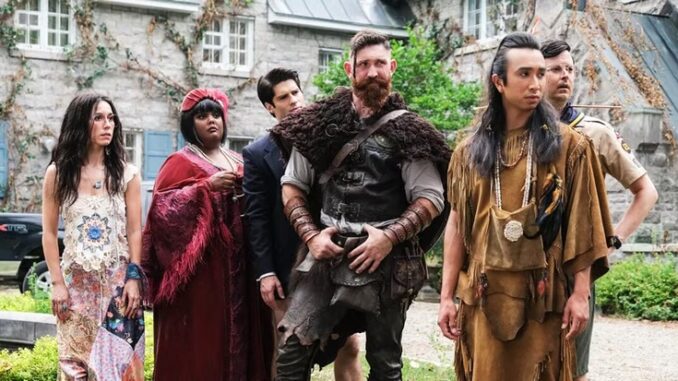
We are absolutely obsessed with the CBS sitcom, Ghosts. It’s the perfect blend of goofy comedy, genuine heart, and surprisingly touching character backstories. The show, which revolves around the perpetually cheerful Samantha (Sam) and Jay who inherit a sprawling, haunted estate, thrives on its central conceit: Sam can see and hear the quirky assembly of deceased residents who are permanently trapped in the house.
The core premise is brilliant in its simplicity: death equals permanent residence. Whether they died in the Stone Age, the Revolutionary War, or a tragic ’90s accident, they are all stuck in the purgatorial loop of Woodstone Mansion.
But if we, as dedicated fans, take a step back and look at the foundation of the show’s afterlife logic, a massive, glaring headscratcher emerges—one that completely threatens to undermine the entire premise. It’s the inconsistency that screams louder than Alberta’s jazz vocals, and the show simply needs to address it to maintain its internal coherence: Why are there so few ghosts, and what happened to all the others?
🏠 The Ghostly Math Problem: Where Are All the Other Residents?
Woodstone Mansion is established as a structure with a rich, centuries-long history. It’s an old country estate that has served as a private residence, a temporary military barracks, a boarding house, and likely a dozen other functions across hundreds of years. People have lived, worked, visited, and, crucially, died there continuously since the 1700s, and even earlier on the surrounding land.
The Law of Averages vs. The Cast List
Think about the sheer probability:
-
Hundreds of Years of Habitation: Accidents, illnesses, old age, childbirth complications, fires, and violent incidents (like the Revolutionary War skirmish) must have claimed hundreds of lives on that property over 300 years.
-
The Small Roster: Yet, the main cast of ghosts is remarkably small: Pete, Hetty, Flower, Trevor, Alberta, Isaac, Thorfinn, Sass, and the basement cholera victims. That’s a tiny, highly curated list of the deceased, almost all of whom are primary characters.
The fundamental, nagging question is: Where are the ghosts of the hundreds of other people who must have died in or on the property? If the rule is “die on the property, stay on the property,” the house should be so densely packed with transparent spirits that Sam and Jay couldn’t even walk through a room without brushing against twenty different historical figures. It should be a chaotic, silent, ghostly Times Square!
👻 The Rules of Confinement: The Unexplained Exit Clause
The show needs to explain why the vast majority of people who died at Woodstone are not ghosts. The only logical explanations, which the show has consistently failed to explore, suggest a complicated, unexplained exit clause to the haunting premise.
The “Unfinished Business” Fallacy
Many ghost stories rely on the “unfinished business” trope: a spirit stays until they resolve their earthly ties.
-
Ghosts Doesn’t Use This Rule: The show actively refutes this rule. Characters like Pete want to resolve their issues, but their resolution doesn’t necessarily free them. The ghosts’ inability to “ascend” is explicitly tied to their lingering attachments, but their physical presence is simply due to dying there. If all the non-cast ghosts finished their business and ascended, it would imply that these nine specific main characters are the only people who died at Woodstone with unresolved issues, which is highly improbable.
H3: The Ascended vs. The Trapped
The most straightforward explanation is that some ghosts ascend (move on to the afterlife, heaven, etc.) and others don’t. But why?
-
The Criteria Mystery: What is the criteria for ascension? Is it moral quality? Is it emotional completeness? Is it religious faith? The show has yet to clearly define the rules that determine why the random 1980s stockbroker (Trevor) is stuck forever, but the servant who died in 1890 simply vanished. The lack of defined criteria makes the afterlife feel random and arbitrary, which weakens the stakes of the main characters’ predicament.
H3: The Role of Trauma and Suddenness
Perhaps the trauma of the death is the determining factor. Most of the main ghosts died suddenly and tragically: explosion, shooting, fever, axe blow.
-
The Peaceful Death Conundrum: Does this mean anyone who died peacefully in their sleep (i.e., the former owners of the mansion over 150 years) automatically ascends? If so, why is Hetty (who died in bed, albeit angrily) still there? If peaceful death is the ticket out, the show needs to say so explicitly, or the house should still be teeming with servants who died from common diseases.
✍️ The Writer’s Dilemma: Prioritizing Comedy Over Coherence
We understand why the writers ignore this issue. It’s a creative constraint driven by the demands of a sitcom.
The Comedy Constraint
A large cast of hundreds of ghosts would be impossible to write for.
-
Overwhelming the Lead: Sam, the human intermediary, would be constantly bombarded by questions, requests, and conflicting histories. The comedy would become noise, and the character development would grind to a halt.
-
Budgetary Realities: Imagine the sheer cost and logistical nightmare of having hundreds of digital extras standing around in every scene. The show must limit its visible ghosts to manage production and budget.
The problem, however, is that while we accept the constraint, the show hasn’t given us an in-universe explanation for it. They are choosing comedy and efficiency over the internal consistency of their premise, and that choice is what creates the “headscratcher.” It feels like a foundational rule of the universe has been bent purely for convenience.
🔮 The Fan Theory Lifeline: Trying to Fix the Plot Hole
Fans have stepped in to try and fill the void left by the writers, often proposing complex, yet plausible, theories to explain the missing hundreds of ghosts.
The House Itself is Selective
One popular theory suggests that Woodstone Mansion itself holds a kind of unique, spiritual energy that acts as a filter.
-
Emotional Magnetism: Only ghosts who died with intense, unresolved, and often extreme emotional resonance are captured. Pete’s explosion, Alberta’s poisoning, Trevor’s sudden fall, Hetty’s rage—these were all high-intensity deaths.
-
The Basement Exception: The large group of cholera ghosts in the basement (who died en masse and are not part of the main cast) suggests that a sudden, mass-death event might also qualify for automatic entrapment, even if the individuals lacked unique emotional resonance. This theory helps explain the high-drama cast while still acknowledging the house’s history.
H4: The Role of the Portal
Another theory suggests that the “portal” that opened when Sam suffered her head injury was not a new gateway, but a temporary, localized disruption to the spiritual plane.
-
Releasing the Clutter: Perhaps, during the brief window of the portal’s opening, the hundreds of older, less-attached, less-consequential ghosts were finally able to escape or ascend, leaving only the most emotionally rooted and stubborn spirits behind. This would offer a clean, retroactive explanation for the empty house, tying the event directly to the catalyst of the show’s premise.
📝 Why Ghosts Needs to Address This Head-On
Ghosts has demonstrated a masterful ability to handle difficult, emotional topics, such as Isaac’s sexuality, Pete’s trauma, and Alberta’s murder mystery. They are capable of intricate, serious storytelling.
Restoring the Stakes
The show needs to give us a definitive answer, not just for logical coherence, but to restore the emotional stakes of the main characters.
-
Defining Purgatory: If the ghosts understand the rules of ascension, they can actively work toward it. If they believe they are randomly trapped forever, their predicament is a tragedy. The show must define their purgatory.
-
Respecting the Lore: A consistent, well-defined supernatural lore is the backbone of any successful fantasy or supernatural premise. By defining the “why” of the missing ghosts, the show strengthens the “why” of the trapped main cast.
The show has given us countless beautiful backstories. Now, it needs to give us the Woodstone Rulebook. It’s time to stop the cheerful silence on the hundreds of missing spirits and give us an explanation worthy of this brilliant comedy.
Final Conclusion
The biggest, most glaring headscratcher that subtly taints the premise of the CBS hit Ghosts is the massive, unexplained absence of the hundreds of spirits that, statistically, should be haunting Woodstone Mansion. If the rule is “die here, stay here,” the house should be impossibly crowded. The writers have, for comedic and budgetary convenience, ignored the logical consequences of their premise. However, for the show to maintain its strong internal consistency and elevate the emotional stakes for the main cast, it absolutely must provide an in-universe explanation—be it a special criterion for ascension, a selective power possessed by the house itself, or a past event that cleared out the spiritual clutter. The audience is ready for the Woodstone Rulebook that defines why our handful of lovable eccentrics are the only ones left behind.
❓ 5 Unique FAQs After The Conclusion
Q1: What is the most common fan theory for why there are so few ghosts at Woodstone Mansion?
A1: The most common fan theory suggests that the house itself is selective, only capable of trapping ghosts who died with incredibly high levels of emotional intensity, trauma, or strong unresolved attachment. This explains why the main cast members, who all had dramatic deaths, remain.
Q2: Does the cholera pit in the basement count as evidence that more ghosts should be present?
A2: Yes, the large group of cholera ghosts in the basement is often cited as the strongest evidence. They prove that death in the house does lead to entrapment, highlighting the inconsistency of why hundreds of non-main character ghosts from other historical periods (like the servants or other owners) are not present.
Q3: Which two main characters represent the earliest and most recent deaths at Woodstone?
A3: Thorfinn, the Viking, represents the earliest ghost, having died on the land over 1,000 years ago. Trevor, the stockbroker, represents the most recent major death, having died in the 1990s.
Q4: Has the show offered any official explanation for why ghosts ascend to the afterlife?
A4: The show has only hinted at the criteria for ascension, implying that it might be linked to achieving a sense of inner peace or letting go of their deepest attachments. However, a clear, definitive rule or mechanism for why some ghosts move on and others don’t has not been officially established.
Q5: If the show addressed the “missing ghosts” issue, how would it likely affect Sam and Jay’s story?
A5: Addressing the issue would likely increase the stakes for Sam and Jay. If they discover the mechanism for ascension, they could actively help their ghost friends move on, leading to emotional farewells and potentially a greater awareness of the house’s supernatural power.