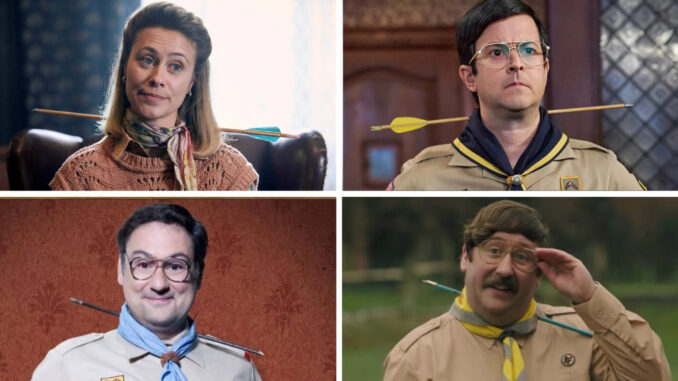
👻 The Global Ghost Hunt: Why This British Sitcom Conquered the World
There’s a certain magic to the British sitcom Ghosts. It’s funny, certainly, but it’s also incredibly warm, deeply emotional, and surprisingly clever. The premise is simple yet brilliant: a young couple, Alison and Mike Cooper, unexpectedly inherit a massive, crumbling country estate (Button House), only to find it populated by the multitude of deceased residents who died on the property over the centuries. These ghosts, visible only to Alison after a near-fatal accident, are eternally stuck in the house, doomed to bicker, share life advice, and try to scare the living.
What makes Ghosts truly special—and what has driven its massive international success—is its universal appeal. At its core, it’s a show about acceptance, found family, and learning to coexist with people who are fundamentally different from you. This strong thematic foundation has allowed the show to be adapted in six different countries around the world, each version taking the core premise and twisting it to fit local cultural references, comedic styles, and historical contexts.
The global journey of Ghosts is fascinating. It’s a testament to the original creators’ genius (the Horrible Histories team) that their concept translates so smoothly across borders. Let’s dive deep and explore how all six of these global adaptations stack up, comparing their unique flavor, cast chemistry, and success in replicating the Button House magic.
🇬🇧 The Cornerstone: BBC’s Original Ghosts (UK)
Before we look at the adaptations, we must bow to the original. The UK version, which aired on BBC One and streams internationally on Max, is the gold standard.
The Quintessential Cast Chemistry
The key to the UK show’s success lies in the unbreakable chemistry of its six core actor-creators. They have worked together for years, fostering an effortless, quick-witted banter that is impossible to replicate.
-
Historical Depth: The UK ghosts—ranging from a pompous, trouser-less MP (Julian), a romantic, poet laureate (Thomas), a perpetually cheery WWII soldier (The Captain), to a sweet, naïve Edwardian noblewoman (Fanny)—are meticulously crafted to reflect distinct periods of British history and social class.
-
The Heart: The UK show excels at blending slapstick comedy with genuine, tear-jerking moments of profound character exploration. It is often cited as one of the few comedies that can make you genuinely cry about a ghost’s unfinished life.
🇺🇸 The Breakout Success: CBS’s Ghosts (USA)
The US adaptation, premiering on CBS in 2021, is easily the most successful and high-profile remake. It has become a ratings powerhouse, often outperforming many of the network’s traditional procedural dramas.
The Americanization of Button House
The American version trades the sprawling British country estate for a massive, yet financially crippling, mansion in upstate New York. The couple, Sam and Jay Arondekar, are writers living in the city.
-
Increased Production Gloss: The US version benefits from a larger network budget, offering higher production values and a faster comedic pace characteristic of US sitcoms.
-
The Ghostly Cast: The US version has brilliantly re-imagined the ghosts to fit American history:
-
Isaac Higgintoot: A buttoned-up Revolutionary War soldier (taking the role of The Captain).
-
Trevor: A hedonistic, pants-less Wall Street bro from the 1990s (the US equivalent of Julian).
-
Sasappis: A dead Native American from the Lenape tribe (providing a unique perspective on American history).
-
Alberta: A sassy, 1920s jazz singer (providing the show’s vocal flair).
-
-
Why It Works: The US version succeeds because it captures the found family dynamic while maintaining its own comedic rhythm. It wisely keeps the central premise—a living person negotiating domestic life with a houseful of dead friends—intact, earning critical praise and massive viewership.
🇫🇷 The Parisian Take: Fantômes (France)
France was one of the first countries to recognize the core genius of the Ghosts premise and launched its own adaptation, Fantômes (Ghosts), which aired on Série Club.
A More Cynical, Urban Flavor
The French version tends to lean into a more cynical, less overtly wholesome comedic style, fitting the traditions of French urban comedy.
-
Location Shift: Instead of a remote country home, the setting is often an apartment building or smaller historical mansion in or near a major city, making the ghosts’ predicament feel more claustrophobic and grounded in modern urban life.
-
Fewer Characters, Tighter Focus: Early reports suggest the French version streamlined the massive cast of ghosts, focusing on a smaller core group to allow for deeper, quicker character development over fewer episodes. It’s a pragmatic approach that attempts to capture the essence of the original with fewer moving parts.
🇩🇪 The German Approach: Die Geister von Fleat House (Germany)
Germany, with its strong tradition of historical drama and precise comedy, also adapted the format. The German adaptation, which translates roughly to The Ghosts of Fleat House, focuses heavily on the historical context of its spirits.
Focus on Historical Precision and Bureaucracy
German humor often relies on detailed observation and slightly absurd rules (think German bureaucracy). The adaptation reportedly uses this structure to its advantage.
-
Detailed Ghost Backstories: The German version gives the ghosts intensely detailed backstories, often spending significant time in flashback sequences that explore the political and social events that led to their demise, contrasting the strict societal rules of the past with the chaotic freedom of the present.
-
The Property’s Significance: The house itself takes on a huge role, often symbolizing layers of complex German history and identity, forcing the living owners to confront deep-seated cultural memory.
🇵🇱 The Polish Cultural Twist: Duchy Domu (Poland)
The Polish adaptation, Duchy Domu (Ghosts of the House), showcases how local history fundamentally alters the character mix.
A Focus on National Trauma and Humor
Polish history, marked by periods of occupation and political upheaval, provides a unique canvas for the ghosts’ tragic backstories.
-
Wartime Ghosts: The inclusion of ghosts whose deaths relate directly to 20th-century national trauma (World War II or Cold War conflicts) adds a heavy, sometimes dramatic, layer to the comedy. The humor often derives from the contrast between the grim realities of their past lives and the trivial concerns of the modern living couple.
-
Unique Relationships: The dynamics between the ghosts are heavily influenced by the social hierarchies of Polish history, creating unique clashes between nobles, soldiers, and everyday citizens stuck together forever.
🇮🇳 The Indian Reinvention: Bhoot Ghar (India)
The announcement of an Indian adaptation, rumored to be titled Bhoot Ghar (Ghost House) for a major streaming platform, proves the concept’s reach extends far beyond the West.
Adapting to Bollywood and Family Drama
The Indian version will naturally gravitate toward the traditions of Bollywood and Indian television, which often blend high-stakes drama, musical numbers, and intense family dynamics.
-
The Extended Family: Unlike the UK and US versions, which focus primarily on the nuclear living couple, the Indian adaptation will likely involve a larger, extended family unit inheriting the house, exponentially increasing the number of living people the ghosts must interact with and torment.
-
Ghostly Mythology: The Indian adaptation will rely on local mythology and folklore surrounding ghosts (bhuts) and spirits, giving the show a distinct mythological and spiritual framework that the Western versions lack. This could make for a fascinating blend of slapstick comedy and spiritual seriousness.
🏆 Stacking Them Up: The Success Scale
While all adaptations aim for the heart, they succeed on different scales based on chemistry, narrative coherence, and cultural impact.
| Rank | Adaptation | Key Success Factor | Unique Twist |
| 1 | UK Original | Unbeatable Cast Chemistry | Historical depth and seamless emotional blending |
| 2 | USA (CBS) | Broad Network Reach and Pacing | American historical figures (Revolutionary War, Wall Street Bro) |
| 3 | Germany | Focus on Historical Detail | Bureaucratic humor and political backstory |
| 4 | Poland | National Trauma Integration | WWII and Cold War ghost dynamics |
| 5 | France | Urban Cynicism | Tighter focus and fewer characters |
| 6 | India (Upcoming) | Potential for Musical/Family Drama | Integration of local mythology and extended family |
The UK original still sets the benchmark for its sheer emotional weight and character cohesion, but the US version demonstrates the highest level of successful cultural translation, proving the concept is truly universal.
🔑 The Universal Key: Why Ghosts Works Everywhere
Why does a concept about spectral beings trapped in an old house travel so well? The answer lies in the analogy of co-existence.
H4: The Ghost as the Metaphor
The ghosts are the ultimate metaphor for unwanted houseguests, unresolved trauma, and generational differences.
-
The Burden of History: Every country has its Button House—an old place weighted by history. The show effectively dramatizes the idea that we, the living, are constantly negotiating space with the past, whether that past is a dead soldier or a difficult ancestor.
-
Learning to Share: At its core, the story is about the living couple learning to accept and even love this bizarre, chaotic found family of spirits. That message—the idea of creating unity from desperate, disparate personalities—is a message that resonates in every language.
🔄 The Future of the Adaptations: Cross-Cultural Learning
The global success of Ghosts creates an interesting feedback loop. The US writers can now look at the French or German adaptations to find new ways to explore their characters, and vice-versa. The Polish version’s focus on wartime trauma could inform a powerful, dramatic arc for one of the American ghosts, for example. The show has become a master class in cross-cultural storytelling adaptation.
Final Conclusion
The journey of Ghosts from a quirky BBC comedy to a six-part global phenomenon is one of modern television’s most surprising success stories. While the UK original retains the crown for its unmatched chemistry and emotional depth, the US adaptation has proven the concept’s powerful commercial viability by skillfully translating the historical and comedic elements to fit an American audience. Each international version—from the cynical French apartment to the historically layered German house—demonstrates that the core premise of learning to live and love alongside the weight of the past is a beautifully universal theme. The adaptations prove that even the most quintessentially British comedy can transcend borders when its heart is truly in the right place.
❓ 5 Unique FAQs After The Conclusion
Q1: Who created the original British version of Ghosts, and why did they decide to do an adaptation?
A1: The original British version of Ghosts was created by the same team of six actors who previously worked together on the popular children’s comedy series Horrible Histories. They decided to create the show because they wanted a new project where they could all continue to perform together as a stable ensemble.
Q2: Which adaptation of Ghosts is still currently airing new seasons?
A2: Both the UK Original and the USA (CBS) adaptation are currently airing or have been renewed for upcoming seasons, confirming their ongoing critical and commercial success in their respective markets.
Q3: Which character archetype appears in almost every global Ghosts adaptation?
A3: The character archetype of the “Nude/Pants-less Ghost” (Julian in the UK, Trevor in the US) appears in almost every adaptation. This ghost is typically a charismatic former politician or wealthy figure who died in an embarrassing state and is perpetually trapped in that condition, serving as the show’s primary source of inappropriate, surface-level comedy.
Q4: Did the original Ghosts writers have any creative input into the American version?
A4: Yes, the original UK creators—including Mathew Baynton and Jim Howick—served as Executive Producers on the American version. This involvement helped ensure that the core spirit, tone, and emotional integrity of the original series were maintained during the translation process.
Q5: Are there any plans to produce a Ghosts adaptation in an Asian country, such as Japan or South Korea?
A5: While the concept’s focus on mythology and family would suit Asian drama traditions well, no official announcement has been made regarding a Ghosts adaptation in Japan, South Korea, or other East Asian countries as of the current time.