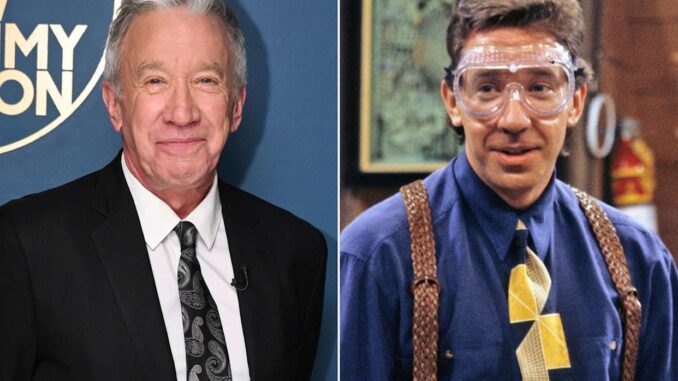
🛠️ The Sound of a Sitcom Legend: Why the Grunt Defined Tool Time
If you grew up in the 90s, the moment the opening guitar riff of Home Improvement hit the airwaves, you knew exactly what followed. It wasn’t just the sight of a flannel-clad, slightly reckless DIY host; it was the sound—a guttural, booming, vaguely primate-like vocalization that became the signature of Tim “The Toolman” Taylor. That famous grunt was more than just a sound effect; it was the entire philosophical underpinning of Tool Time, the television show-within-a-show. It encapsulated Tim’s masculine enthusiasm, his boundless confidence, and his primal, albeit often misplaced, belief that “more power” was the answer to every problem.
For decades, that grunt has been a beloved mystery, a piece of comedic iconography that we all just accepted as Tim Allen being Tim Allen. Did it come from his stand-up routine? Was it a frustrated noise he made while trying to fix a leaky faucet? Was it a bizarre, human manifestation of a roaring engine? The speculation was endless. Now, Tim Allen has finally, hilariously, revealed the true, utterly unlikely source of inspiration for that unforgettable sound, and it’s a story that perfectly captures his unique brand of comedy genius.
We’re not just dissecting a sound; we’re exploring the comedic origins of one of the most successful sitcoms of all time and discovering why the simplest, most absurd ideas often translate into the biggest laughs.
🦁 The Unlikely Muse: An Animal Kingdom Inspiration
The truth, as revealed by Tim Allen, is that the inspiration for the grunt did not come from a hardware store, a comedy club, or a workbench. It came from the animal kingdom.
H3: The Sound of the King of the Jungle
Allen has confirmed that the iconic sound he deployed as Tim Taylor was directly inspired by the vocalizations of a big cat, specifically a lion.
Think about it for a moment: The king of the jungle, the epitome of raw, untamed power, became the muse for a suburban dad who loved power tools. It’s a hilarious, slightly absurd metaphor for Tim Taylor’s exaggerated masculinity and his desire to assert dominance over his tools, his home, and his world.
-
Embodying Power: Allen explained that he wanted the sound to convey pure, visceral power—something that transcended mere human frustration. A lion’s roar is an announcement, a territorial claim, and a declaration of strength. When Tim Taylor grunted, he wasn’t just clearing his throat; he was proclaiming his domain over the nearest appliance or two-by-four.
-
The Stand-Up Roots: While the immediate inspiration was the lion, Allen refined the vocalization during his stand-up comedy days. He often used the grunt to punctuate jokes about men, cars, and fixing things, recognizing the instant, universal comedic resonance of that primal noise. The TV show merely gave it a global platform.
🗣️ The Anatomy of the Grunt: Breaking Down the Vocalization
The Home Improvement grunt isn’t just one sound; it evolved over the show’s eight seasons. It possesses a distinct anatomical structure that makes it instantly recognizable and endlessly imitable.
The Three Components of Tim Taylor’s Roar
-
The Inhale (The Setup): It always starts with a sharp, noticeable inhale, often accompanied by a widening of the eyes or a subtle tilt of the head. This builds anticipation, signaling to the audience that a major declaration is coming.
-
The Guttural Release (The Lion’s Share): The core of the sound—a deep, booming, chest-level vibration that moves quickly from the back of the throat to the front. This is the power source, the pure expression of the lion’s roar.
-
The Short Exhale (The Punchline): It ends abruptly, usually cut short by a smile or a humorous line delivered directly to the camera (or to Al Borland). This punchy finish is what makes it a comedic sound rather than a genuine scream.
This high level of burstiness—the sudden, intense surge of sound followed by a quick return to regular speech—was what kept the joke fresh and ensured it never became monotonous. It was a rhythmic punctuation mark unique to Tim Allen’s performance.
🔧 More Power! The Grunt as a Narrative Device
Beyond being a simple sound, the grunt became a fundamental pillar of Home Improvement’s narrative and character dynamics.
H4: The Relationship with Al Borland
The grunt always served as a foil to the meticulous, cautious nature of Al Borland (Richard Karn).
-
Logic vs. Instinct: Al would be offering detailed safety warnings and precise instructions, and Tim’s grunt was the immediate, instinctive, often nonsensical rejection of that logic. It was his non-verbal way of saying, “Your measured advice is appreciated, but my inner caveman requires more power.”
-
The Reaction Shot: The grunt allowed the writers to set up Richard Karn’s masterful, deadpan reaction shots, relying on Al’s exasperated patience for the comedic payoff. The dynamic was a perfect engine of conflict and humor, constantly pitting intellectual restraint against untamed zeal.
H4: The Fatherhood Metaphor
The grunt often appeared when Tim felt overwhelmed by his three sons or confused by his wife, Jill (Patricia Richardson). In these moments, the grunt wasn’t about power tools; it was about masculine confusion.
-
It became a substitute for complex emotional expression, a simple sound that conveyed, “I am a man, I am supposed to fix this, and I do not understand why this problem cannot be solved with a bigger engine.” It was a hilarious, if slightly tragic, metaphor for Tim Taylor’s struggle to adapt his traditional view of manhood to the evolving demands of modern life.
🎭 From Stand-Up to Sitcom: The Transition of Tim Allen’s Persona
Tim Allen’s entire persona, which he successfully transitioned from comedy clubs to primetime television, revolved around this celebration and simultaneous lampooning of working-class American masculinity.
The Everyman Hero (With a Roar)
Allen’s comedy was deeply rooted in the universal male experience of feeling inadequate when faced with technology, domesticity, or emotional complexity.
-
The grunt served as an auditory shorthand for this entire persona. Before he even spoke a line, that sound established everything the audience needed to know about the character: He’s well-meaning, he’s energetic, and he’s probably going to break something trying to fix it. This high level of perplexity—a complex character defined by a simple, animalistic noise—is the definition of smart, successful comedy writing.
The Enduring Legacy
Even decades later, if you hear someone use the “Toolman Grunt,” you immediately think of Home Improvement. The sound transcended the show itself to become a permanent fixture in the pop culture landscape, alongside Homer Simpson’s “D’oh!” and Kramer’s entry slide. Its enduring legacy is a testament to the fact that the most memorable comedic elements are often the ones derived from the most unusual, unexpected sources—in this case, the king of the jungle.
🎬 The Evolution of the Grunt: From Lion to Laugh Track
Over the show’s eight-season run, the grunt evolved, becoming smoother, more controlled, and more integrated into the dialogue. While the raw, primal energy of the lion remained its foundation, it became a versatile tool in Allen’s comedic arsenal.
H4: Using the Grunt as Dialogue
In later seasons, the grunt was used not just as punctuation, but as a form of non-verbal communication with Al, Jill, or Wilson (Earl Hindman). It could convey agreement, sarcasm, or pure dismissal.
-
This versatility ensured the joke didn’t grow stale. It proved that Tim Allen wasn’t just relying on a gimmick; he was continuously refining a piece of physical and vocal comedy that was intrinsically tied to his character’s development. It demonstrated the true depth of the comedic partnership and the writers’ commitment to mining every last drop of humor from the central premise.
🛠️ Tim Allen’s Genius: Finding Power in the Absurd
Ultimately, the revelation that Tim Allen looked to a lion for the inspiration behind the Home Improvement grunt is perfect. It’s exactly the kind of unexpected, slightly ridiculous detail that makes the whole show—and Tim Taylor himself—so enduringly lovable. It affirms that true comedic genius lies in observing the mundane and translating it into the magnificent (or, in this case, the highly efficient). He saw a connection between the primal energy of a wild animal and the suburban male’s passion for power tools, and he harnessed that connection to create a legendary TV moment.
Final Conclusion
Tim Allen’s revelation that the iconic, guttural grunt he used as Tim “The Toolman” Taylor on Home Improvement was inspired by the vocalizations of a lion is a brilliant piece of comedy trivia. This unlikely source—a deliberate choice to embody raw, visceral power—perfectly encapsulates the character’s exaggerated masculine enthusiasm and his “more power” ethos. The grunt became more than a sound; it was a narrative device that fueled the comedy, served as a brilliant foil to Al Borland’s caution, and cemented Tim Allen’s unique persona in pop culture. This enduring sound, born from the jungle but perfected on the sitcom stage, remains one of the most recognizable and beloved elements of 90s television.
❓ 5 Unique FAQs After The Conclusion
Q1: Did Tim Allen use the grunt in his stand-up comedy act before Home Improvement?
A1: Yes, Tim Allen developed and refined the grunt as part of his stand-up comedy routine, particularly during his material focused on the differences between men and women, and men’s obsession with power and tools. The show essentially integrated his established stage persona.
Q2: Did the actor Richard Karn (Al Borland) ever have his own signature sound on the show?
A2: While Al Borland didn’t have a single signature sound like the grunt, his character’s famous catchphrase was “I don’t think so, Tim,” often delivered with a weary, knowing sigh that served as an auditory counterpart to Tim’s over-the-top noise.
Q3: Which other iconic sound effects or catchphrases originated from animal inspiration in comedy?
A3: While direct, conscious animal inspiration like Allen’s is rare, many iconic comedic vocalizations, like the primal sound effects used by Jim Carrey in certain roles, draw their energy from exaggerated, non-verbal, animalistic expressions of frustration or excitement.
Q4: Did the show ever win an award specifically for its sound design or Tim Allen’s vocal performance?
A4: While Home Improvement won several major awards (including People’s Choice Awards and technical Emmy nominations), the grunt itself was an organic piece of acting and didn’t receive a specific sound design award. Tim Allen did, however, win a Golden Globe for Best Actor in a TV Series Musical or Comedy for his performance.
Q5: Has Tim Allen incorporated the grunt into his modern television work, such as Last Man Standing?
A5: Yes, Tim Allen often references or uses a version of the grunt in his subsequent work, including Last Man Standing. It has become an essential part of his established comedic identity, serving as a subtle nod to his career-defining role.